
Voice AI latency is the time between a caller finishing a sentence and the system's first audible reply. The practical target is a p50 under 800 milliseconds and a p95 under 1,500 milliseconds, with truly human‑feeling exchanges sitting nearer 200 to 300 milliseconds. Hit that, and endpointing, streaming architecture, and network path are the three levers that get you there.
TL;DR:
- Achieving a p50 latency under 800 milliseconds is essential for natural conversation, with p95 often exceeding 1,500 milliseconds if thresholds are not managed carefully.
- Endpointing and model response times dominate the latency budget, making streaming ASR, early LLM output, and parallel tool calls the most effective optimizations.
- Network choices, such as WebRTC over PSTN, and reducing round-trip times at each stage significantly influence overall responsiveness.
- Proper latency measurement requires tracking multiple stages with p50 and p95 metrics, using timestamped events for precise diagnostics across pipeline boundaries.
- Short-term improvements include tuning endpoint thresholds and adding filler acknowledgments, while long-term gains involve deploying streaming pipelines, edge, and regional inference infrastructure.
Table of Contents
- What is voice AI latency and why does it matter?
- What does a full voice AI latency budget look like, stage by stage?
- Where does voice AI latency actually accumulate?
- How do you measure and benchmark voice AI latency properly?
- What actually reduces voice AI latency in production?
- Which architecture pattern actually reduces latency, and which just adds cost?
- What should teams tackle first when latency slips?
- How Gmdautomation helps you hit latency SLOs without building the stack yourself
- Sources
What is voice AI latency and why does it matter?
Human conversation has a rhythm most people never think about until it breaks. Research on conversational turn‑taking by Stivers and colleagues found a modal gap of roughly 200 milliseconds between one person finishing and the next starting, consistent across many languages. That number is not arbitrary. It is the baseline every voice AI system gets measured against, whether the product team realises it or not.
Cross that threshold and callers notice immediately, even if they cannot explain why. A response arriving after 300 to 500 milliseconds feels slightly stiff but tolerable. Push past 800 milliseconds and the pause reads as hesitation, or worse, as the system not having heard you. Push past 1,500 milliseconds and people start talking again, assuming a failure. That produces the two classic failure modes in voice AI: awkward dead air, and users talking over a response that was already on its way.
These are not cosmetic problems. Long response gaps correlate with lower satisfaction scores, higher call abandonment, and agents that get escalated to a human faster than a well‑tuned system would need. In a sales or booking context, every extra half‑second of dead air is a moment where the caller's attention drifts, and drifted attention is how qualified leads turn into hang‑ups.
Voice AI responsiveness also has to compete with an older, network‑level standard. ITU‑T Recommendation G.114 sets guidance on acceptable one‑way transmission delay for interactive voice, originally written for telephony rather than AI pipelines. It is a useful sanity check: even before an AI system does any processing, the network itself is expected to introduce delay, so your latency budget for AI reasoning, recognition, and synthesis sits on top of that baseline, not instead of it. Any AI voice processing delay analysis that ignores the underlying network path is measuring the wrong thing.
The practical upshot is that "fast enough" is not a feeling, it is a number, and it is a number worth writing down before you start optimising.
What does a full voice AI latency budget look like, stage by stage?
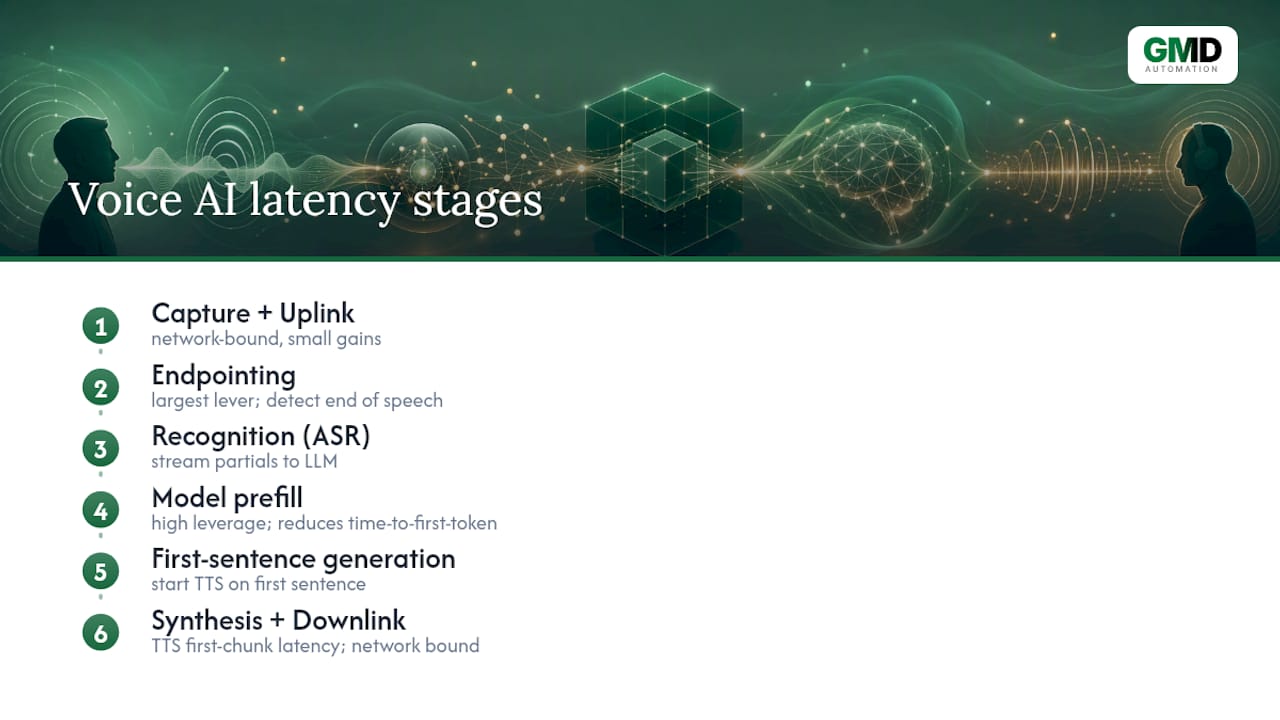
Breaking the end‑to‑end gap into stages is the single most useful thing a team can do before touching any code. Each stage has its own p50 and p95 characteristics, and they do not fail equally. The full latency budget framework from Multigrid splits the pipeline into capture, uplink, endpointing, recognition, model prefill, first sentence generation, synthesis, and downlink, and treats endpointing and sequential stages as the biggest levers available to engineering teams.
Here is a representative budget for a well‑built streaming pipeline, with rough p50 and p95 figures per stage:
Add the p50 column and you land close to the 600 to 800 millisecond range that Twig's analysis of voice AI latency budgets treats as the practical ceiling for natural‑feeling conversation. Add the p95 column and you can easily clear 2 seconds if even two stages run pessimistically at once, which is exactly why p95 tracking matters more than averages.
Statistic to remember: hitting an 800 millisecond p50 requires stages to overlap, not just individually shrink, because summing every stage's median in strict sequence rarely leaves room for the ASR and LLM stages to breathe.
Two stages dominate the budget in most real deployments. Endpointing is the first, because deciding when a human has actually stopped talking (as opposed to pausing mid‑thought) is a genuinely hard problem, and getting it wrong either clips the caller or adds thick, needless silence. Model time‑to‑first‑token is the second, because it is where prompt size, tool calls, and retrieval steps pile up unpredictably. A pipeline that streams ASR partials, starts LLM generation before the transcript is fully final, and begins TTS playback on the first sentence rather than the whole response can shave 300 to 500 milliseconds off the naive sequential version without touching a single model.
The stages worth obsessing over, in order of leverage, are endpointing tuning, model prefill time, and TTS first‑chunk latency. Capture, uplink, and downlink are usually network bound and offer smaller, harder‑won gains.
Where does voice AI latency actually accumulate?
Every stage in the budget above has a specific failure mode behind it, and most engineering teams are chasing the wrong one.
On the network side, the choice between PSTN and WebRTC transport matters more than people expect. Traditional PSTN call legs route through carrier infrastructure with variable hop counts, adding round‑trip time that a well‑configured WebRTC session avoids entirely. Jitter buffers, which smooth out irregular packet arrival, add a deliberate delay of their own, typically 20 to 60 milliseconds, and codec frame size decisions (say, 20 millisecond Opus frames versus larger legacy frames) compound on top of that. None of this is dramatic on its own. Stacked together across a few hundred milliseconds of round‑trip time in a poorly routed carrier leg, it is often the single biggest, most invisible line item in the budget.
On the recognition side, the gap between batch and streaming ASR is not subtle. A batch model that waits for a full audio segment before transcribing adds the entire utterance length as pure dead time before anything else can start. Streaming ASR, by contrast, emits partial transcripts continuously, which lets endpointing and even early LLM work begin before the caller has finished the sentence. Teams still running batch ASR "because it's more accurate" are usually trading several hundred milliseconds of latency for a marginal accuracy gain that streaming models have mostly closed anyway.
The model layer introduces its own choke points. Time‑to‑first‑token depends heavily on prompt size, and prompts that grow with every turn (full conversation history, retrieved documents, tool schemas) slow prefill steadily over the course of a call. Sequential tool calls are worse: a pipeline that looks up a customer record, then checks availability, then confirms a booking, one call after another, stacks each tool's round trip directly onto the response time. This is the exact failure mode that The New Stack's analysis of agentic AI latency highlights: CPU‑side orchestration and upstream tool hops, not raw model compute, are what push enterprise agentic workloads past their latency targets under load.
On the output side, non‑streaming TTS is a silent tax. A synthesiser that waits for the complete response text before generating any audio adds the full synthesis time as a flat delay, whereas a streaming TTS engine can start playback on the first sentence while later ones are still being generated. Lack of proper "kill" or barge‑in support compounds this: if a caller interrupts and the system cannot stop playback instantly, the perceived latency of the next turn effectively includes the tail of the interrupted one.
Finally, orchestration itself can quietly dominate everything else. CPU‑bound waits between service calls, GPU capacity sitting idle while a CPU thread blocks on an upstream API, and unnecessary network hops between microservices are the least visible cause of latency and often the largest.
How do you measure and benchmark voice AI latency properly?
You cannot fix what you have not instrumented, and voice pipelines hide latency in more places than most monitoring dashboards expect. A workable KPI set has five entries: time‑to‑first‑audio (the true end‑to‑end number users experience), time‑to‑first‑token (how fast the model starts generating), endpointing latency (how long the system takes to decide the caller has stopped talking), barge‑in latency (how fast playback stops when interrupted), and both p50 and p95 for every one of those, not just averages. Averages hide the tail, and the tail is where callers notice.
Getting reliable numbers takes a consistent measurement approach, built around a few practical steps:
- Emit a timestamped event at every pipeline boundary — capture, endpointing decision, ASR final, model first token, TTS first chunk, and audio playback start — so each stage duration can be computed independently rather than inferred.
- Run synthetic single‑call tests with pre‑recorded audio to get a clean, repeatable baseline free of real‑world network noise.
- Run carrier‑leg tests separately for PSTN and WebRTC paths, since the network contribution to latency can differ by hundreds of milliseconds between the two.
- Load‑test under peak‑concurrency agentic chains, not just single calls, because orchestration and tool‑call latency often only appear once multiple sessions compete for the same downstream services.
- Sample production traffic continuously, not just during launch week, since latency drifts as prompt sizes grow, integrations change, and traffic patterns shift.
- Report p50 and p95 together to stakeholders, alongside the specific stage responsible for any regression, rather than a single blended latency figure that hides where the time actually went.
Treat this as a repeatable checklist run on every release, not a one‑off audit. A team that benchmarks once at launch and never again will not notice when a new tool integration quietly adds 400 milliseconds of sequential API calls to every turn.
What actually reduces voice AI latency in production?
Latency work splits cleanly into three horizons: things you can change this week, things that take a sprint or two, and architectural bets that take longer but pay off structurally. Confusing the three is how teams end up buying GPU capacity to solve a problem that was actually a tuning issue.
Quick wins, deployable almost immediately:
- Tune endpointing thresholds specifically for your caller population rather than accepting vendor defaults built for a generic use case.
- Add short filler acknowledgements ("Let me check that for you") that play instantly while the real answer is still being generated, which research on perceived latency shows measurably improves how fast a response feels, even when the underlying processing time is unchanged.
- Reduce playback buffer sizes wherever the network path can tolerate it, trimming tens of milliseconds off downlink without touching the model stack.
Pro Tip: Filler phrases only work if they sound like genuine acknowledgement rather than a stalling tactic. "One moment" repeated on every turn reads as robotic within three calls; rotate a small set of natural variants tied to what the system is actually doing.
Streaming everywhere is the mid‑term project that delivers the biggest single improvement most teams will ever make. That means streaming ASR partials instead of waiting for finalised transcripts, streaming LLM output token by token instead of waiting for the full response, and streaming TTS in chunks so playback starts on the first sentence rather than the last. Each of these overlaps stages that would otherwise run sequentially, and overlap is the entire trick behind hitting an 800 millisecond p50 in the first place.
Speculative execution and prompt caching attack the model stage specifically. Speculative retrieval starts pulling likely‑needed context (a customer record, a knowledge‑base article) before the model has finished deciding it needs it, based on early signals from the transcript. Prompt caching avoids re‑processing the same system instructions and conversation history on every single turn, which matters more as calls run longer and context windows grow. Both techniques target time‑to‑first‑token, consistently one of the two highest‑leverage stages in the budget.
Tool calls deserve the same scrutiny. A pipeline that checks availability, pulls a customer record, and logs the interaction one after another in sequence pays for each round trip in full. Running independent tool calls in parallel, and prefetching or caching common CRM and knowledge‑base lookups, removes latency that has nothing to do with model quality and everything to do with orchestration design. This is precisely the CPU‑bound waiting pattern that turns a fast model into a slow product.
Edge and co‑location choices form the longer‑term architectural layer. Terminating WebRTC sessions at edge relays, close to where callers actually are, shortens the first network hop before any AI processing even begins, a pattern detailed in OpenAI's engineering work on delivering low‑latency voice AI at scale. Running inference regionally rather than in a single central cluster reduces the round‑trip distance for every model call in a session, not just the first one. Neither change is free, and both require genuine infrastructure investment, but they attack the network and orchestration layers that quick wins cannot touch.
Operational discipline ties the whole list together. Set explicit latency service level objectives (SLOs) for p50 and p95, write runbooks for what happens when a stage regresses, define clear escalation paths when latency breaches thresholds in production, and build graceful degradation modes (shorter responses, simpler tool chains) that trigger automatically under load rather than letting every call degrade uniformly. Voice interaction speed without an operational safety net tends to erode quietly over months as integrations accumulate, and nobody notices until CSAT scores start slipping.
Which architecture pattern actually reduces latency, and which just adds cost?
The instinct to throw more GPU compute at a slow voice pipeline is usually wrong, and this is the point where a lot of budget gets spent for very little latency improvement.
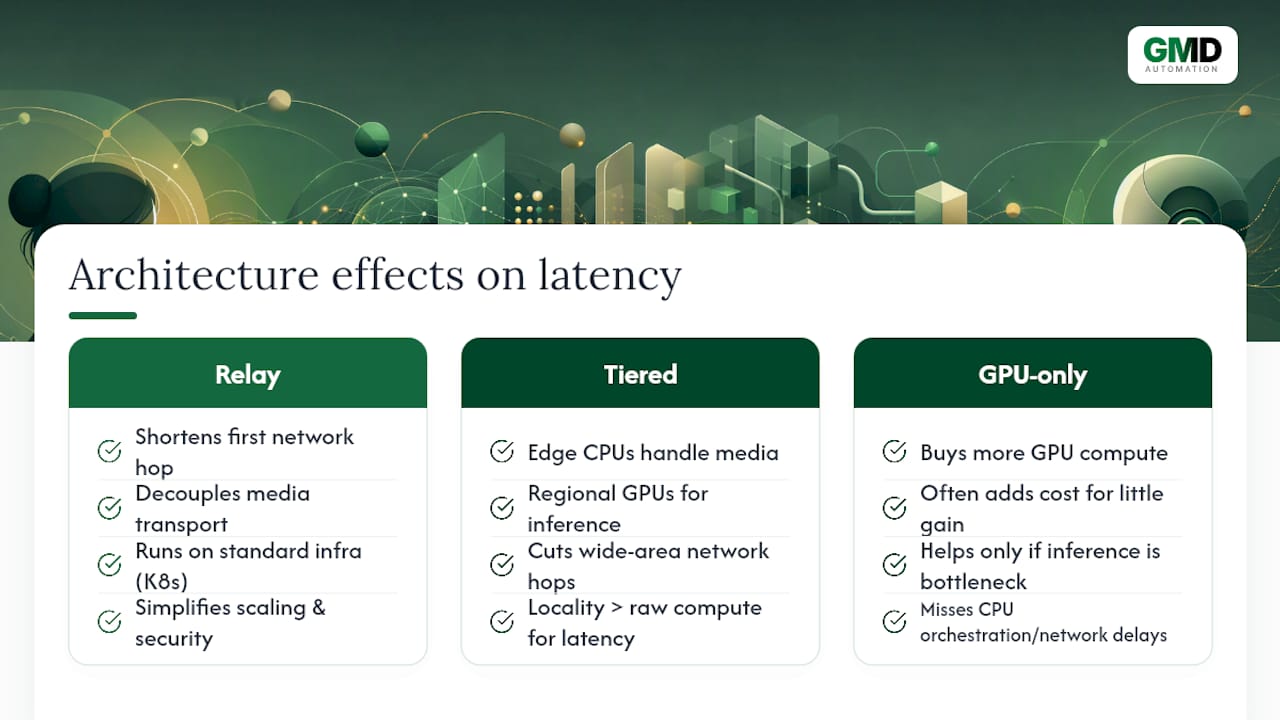
WebRTC termination point is the first real architectural lever. A relay and transceiver pattern, where WebRTC sessions terminate at a dedicated relay layer rather than directly on application backends, shortens the first network hop and lets the backend run on standard infrastructure like Kubernetes without needing to expose per‑session UDP port ranges to the public internet. OpenAI's approach to scaling low‑latency voice AI documents this pattern specifically because it decouples media transport from application logic, which simplifies both scaling and security without adding a processing hop that costs latency.
Tiered architectures extend the same logic further out. Edge CPUs handle the immediate media and endpointing work closest to the caller; regional GPU clusters handle model inference within a shorter geographic radius than a single central cluster could; a central core handles anything that genuinely does not need to be fast, like batch analytics or long‑term logging. Each tier exists to cut wide‑area network hops, and analysis of agentic AI infrastructure makes the point directly: distribution and locality often matter more than raw compute for these workloads, because orchestration and tool hops dominate the latency budget more than model inference time does. A useful primer on these choices sits in Gmdautomation's guide to AI agent architecture for teams weighing where to start.
This is also where the GPU myth breaks down concretely. If your model's time‑to‑first‑token is already fast but your overall p50 is still climbing, the bottleneck is very unlikely to be GPU throughput. It is far more likely to be CPU orchestration waiting on sequential tool calls, or network hops between microservices that have nothing to do with model inference at all. Buying a bigger GPU cluster in that situation improves a number nobody is bottlenecked on. A broader look at how scalable deployments handle these trade‑offs in practice is worth reading before committing budget in either direction.
None of this comes free, though. Edge and regional deployment adds genuine operational complexity: more environments to patch, more places for configuration to drift, and more surface area for security review. It also raises observability demands, since a latency regression could now originate in any one of several tiers rather than a single monolithic service. The trade‑off is real, but for a business that depends on voice AI responsiveness at scale, it is usually the correct one to make deliberately rather than by accident.
What should teams tackle first when latency slips?
Measure before you touch anything. Most latency investigations start with someone's hunch about the model being slow, and most of the time the data proves that hunch wrong. Instrument every stage boundary first, find the actual outlier, then act.
After that, sequence matters. Endpointing tuning and filler acknowledgements come first because they are cheap, reversible, and often deliver the single biggest perceived improvement for the least engineering effort. Streaming and parallel tool calls come next, because they require real changes to the pipeline but no new infrastructure. Edge deployment and tiered architecture come last, not because they matter less, but because they are expensive to get wrong and should only be justified once cheaper fixes are exhausted.
Set p50 and p95 targets before you start, not after, and test them under production‑like concurrency rather than clean single‑call conditions, since orchestration bottlenecks rarely show up until several calls compete for the same downstream service.
If your team lacks the bandwidth to own endpointing tuning, edge deployment, and ongoing SLO monitoring simultaneously, a managed provider that already runs this stack at scale is usually faster than building it from nothing.
— Ravi
How Gmdautomation helps you hit latency SLOs without building the stack yourself
Gmdautomation is the alternative to a lengthy in‑house build for teams that need voice AI responsiveness sorted in weeks, not quarters. Rather than assembling streaming ASR, edge WebRTC termination, and orchestration monitoring from separate vendors, you get a production‑ready voice AI deployment with SLO‑driven monitoring already built in, delivered as a managed monthly subscription with no upfront infrastructure spend.
That matters because most of what this article has covered, endpointing tuning, streaming pipelines, edge and regional inference, tool‑call parallelisation, is exactly the work Gmdautomation's engineering already handles as part of the service, not as a separate consulting project. Managed pilots come with measurement and tuning built in from day one, so you see real p50 and p95 numbers against your own call patterns before committing further, and ongoing optimisation continues after launch as call volumes and integrations grow. For UK businesses handling lead qualification, appointment booking, or outbound calling at volume, that means a latency budget that stays inside target under real load, not just in a demo environment, an area covered further in Gmdautomation's notes on scaling outbound voice AI compliantly.
If latency is the thing standing between your voice AI pilot and a production rollout, book a call with Gmdautomation to walk through your current numbers and what a managed deployment would target for your specific call volumes.
Sources
- Agentic AI has a latency problem that more compute won’t solve
- Latency budgets for voice AI agents: the 800ms rule of natural conversation
- Delivering low‑latency voice AI at scale (OpenAI engineering post)
- Real‑time voice agents: the full latency budget