

The main technical blockers for enterprise AI are integration debt, fragmented data, insecure credential handling, and absent production-grade control planes. Treat connectivity as the primary infrastructure investment before any model spend. Here are the priorities at a glance:
- Integration and connectivity: build an API façade or iPaaS layer before wiring models to systems
- Fragmented data: establish a canonical data model with source-of-truth mappings
- Legacy APIs: choose adapter patterns (API wrap, RPA bridge, protocol gateway) based on throughput and format constraints
- Credential and tool authorisation: implement vault-backed, destination-pinned tokens with short TTLs
- Model reliability and hallucinations: adopt schema validation, confidence thresholds, and human-in-loop escalation
- Scalability and TCO: budget for inference costs, glue-code maintenance, and operational engineering, not just licences
- Observability and session durability: log every tool call with correlation IDs and durable session records
- Governance and change management: appoint operational owners and document acceptable-use policies before go-live
Pro Tip: Connectivity architecture is the first infrastructure investment. A project that skips integration design and jumps straight to model selection will almost always stall in production, regardless of model quality.
Key takeaways
The binding constraint for enterprise AI is integration architecture, not model quality. Treat connectivity, credential control, and observability as the first infrastructure investments, and budget for TCO across the full operational lifecycle.
| Point | Details |
|---|---|
| Integration first | Connectivity architecture must be designed before model selection; 95% of IT leaders report integration challenges. |
| Data quality gates | A canonical data model and automated quality gates prevent fragmented data from breaking RAG pipelines and model inputs. |
| Credential control plane | Vault-backed, destination-pinned tokens with per-agent allowlists are the minimum security baseline for production agents. |
| TCO beyond licences | Glue-code maintenance and operational engineering are typically the largest cost drivers; model these at 3x and 10x pilot volume. |
| Gmdautomation | Gmdautomation delivers production-ready AI automation for UK businesses with compliance, observability, and zero upfront costs built in. |
Table of Contents
- Why does enterprise AI stall at the integration layer?
- Why does messy data break AI projects before they reach production?
- How do you integrate AI with legacy systems that have no modern APIs?
- How should you handle credential management and tool authorisation for AI agents?
- How do you stop AI models from producing unreliable outputs in production?
- What are the real cost drivers in production AI infrastructure?
- Why does poor observability cause silent failures in AI deployments?
- What governance and change management do AI deployments actually need?
- How do you avoid vendor lock-in when building enterprise AI systems?
- What does a realistic enterprise AI integration timeline look like in the UK?
- What does a production-readiness checklist look like for AI deployments?
- What data privacy techniques apply specifically to AI systems?
- Why do cross-team collaboration failures derail AI integration projects?
- How do you address bias and fairness in AI model development and deployment?
- How do you integrate AI into existing DevOps and MLOps pipelines?
- What practitioners in UK enterprise rollouts see go wrong most often
- What UK enterprises should expect from a managed AI automation partner
- Sources
Why does enterprise AI stall at the integration layer?
Integration debt, not model quality, is the binding constraint for most enterprise AI programmes. The 2026 MuleSoft Connectivity Benchmark Report puts the scale of the problem in plain numbers: 95% of IT leaders report facing AI integration challenges, only 27% of enterprise applications are effectively connected, the average enterprise manages 957 applications, and integration work consumes roughly 36% of IT time. That is not a model problem. It is a systems architecture problem.
The demo-to-production gap follows a predictable pattern. A proof of concept runs against a clean data extract, a single API, and a controlled environment. Production exposes the full dependency chain: mismatched schemas between systems, stale data feeds, undocumented API contracts, missing error handling, and no governance over who owns what. Gartner reports that around half of generative AI projects were abandoned after proof of concept because of poor data quality, inadequate risk controls, escalating costs, or unclear business value.
The structural failure modes cluster into three patterns:
- Data handoff gap: systems pass data in incompatible formats or at incompatible frequencies, breaking model inputs silently
- Dependency chain break: a single upstream API change or outage cascades through the whole pipeline with no circuit breaker
- Governance vacuum: no named owner for data quality, credential rotation, or incident response, so problems accumulate undetected
A minimal integration diagram for any AI deployment should show: source systems, a control plane (credential vault, authorisation layer, audit trail), a data plane (pipelines, transformation, quality gates), the model or agent layer, and downstream consumers. If any of those boxes is missing from the design, the project is carrying hidden risk.
Why does messy data break AI projects before they reach production?
Fragmented and low-quality data is the single most frequent technical cause of project abandonment. RAND's industry interviews identify insufficient or unsuitable data as one of the five leading root causes of AI project failure, alongside misaligned problem framing and inadequate deployment infrastructure.
The failure modes are specific and operational. Seven common data integration failures include schema mismatches between source systems, stale data arriving from batch feeds that run hours behind real-time needs, missing values in fields the model treats as required, inconsistent entity keys across CRM and ERP, semantic drift (the same field meaning different things in different systems), poor metadata, and PII that blocks data from being used at all without additional controls.
These failures are especially damaging for retrieval-augmented generation (RAG) pipelines. A RAG system that retrieves stale or schema-mismatched documents will confidently return wrong answers. No amount of prompt engineering fixes a retrieval corpus that is inconsistent at source.
The remediation sequence is sequential, not parallel:
- Audit: catalogue every data source, its schema, update frequency, owner, and known quality issues
- Canonical data model: define a lightweight shared document mapping entity terminology and source-of-truth assignments
- Data product owners: assign a named person accountable for each domain's data quality
- Pipelines: choose event streams for near-real-time needs, batch for lower-frequency workloads, and add transformation logic at ingestion
- Quality gates: implement automated checks (null rates, schema conformance, freshness SLOs) that fail a pipeline before bad data reaches the model
Pro Tip: Start the canonical data model with five to ten core entities only. A document that maps "customer" to its authoritative source system and defines its key fields is more useful in week one than a full enterprise data dictionary that takes six months to complete.
| Data failure mode | Impact on AI | Remediation pattern |
|---|---|---|
| Schema mismatch | Model receives unexpected field types; silent errors | Canonical model + schema validation at ingestion |
| Stale data | RAG retrieves outdated context; wrong answers | Event stream pipelines + freshness SLOs |
| Missing values | Model falls back to hallucination | Null-rate gates + imputation strategy |
| Inconsistent entity keys | Joins fail; duplicated or lost records | Master data management + canonical identifiers |
| PII blocking | Data excluded from training or retrieval | Differential privacy or federated learning |
| Semantic drift | Same field means different things across systems | Data dictionary + owner sign-off on definitions |
How do you integrate AI with legacy systems that have no modern APIs?
Legacy interfaces are a predictably large integration cost. Most enterprise estates include SAP BAPI/RFC calls, SOAP web services, flat-file drops, proprietary database triggers, and mainframe screen-scraping interfaces. None of these were designed for the low-latency, event-driven consumption patterns that AI agents expect.
The complications are concrete: BAPI calls are synchronous and stateful; flat files arrive on schedules rather than on demand; SOAP envelopes require XML parsing that adds latency; proprietary interfaces have no published contracts and break silently on vendor upgrades. For a deeper look at legacy system AI integration patterns in the UK enterprise context, the options break into four practical shapes:
- API façade / iPaaS: wrap legacy calls behind a REST or GraphQL interface using a middleware platform; best when throughput is moderate and the legacy system is stable
- Adapter layer: build a thin translation service that converts legacy formats to canonical schemas; suitable for batch and near-batch workloads
- RPA bridge: use robotic process automation to drive legacy UIs where no API exists; highest maintenance cost, but sometimes the only option for mainframe screens
- Protocol gateway: deploy a gateway that translates between protocols (e.g. SOAP to REST, MQ to HTTP); useful for high-volume message-based systems
Pro Tip: Before choosing RPA, confirm there is genuinely no API or database-level access. RPA bridges are brittle; a screen layout change breaks the automation. A direct database read with a thin API wrapper is almost always preferable.
Ownership matters as much as pattern choice. Adapters need a named team responsible for SLA monitoring, version pinning, and regression testing when the upstream system changes. Without that, an adapter that works in pilot silently breaks in production six months later.
Numbered remediation steps for a typical legacy integration:
- Inventory all legacy interfaces and document their protocols, data formats, and update frequencies
- Identify which systems have undocumented database access that could support a direct adapter
- Select the integration pattern per system based on throughput, latency, and maintenance appetite
- Build and test the adapter in isolation before connecting it to the AI layer
- Define SLAs and assign an owner for each adapter's ongoing health
How should you handle credential management and tool authorisation for AI agents?
Credential sprawl and prompt-level credentials are the root of many production security incidents. Storing API keys in prompts, environment variables shared across agents, or configuration files checked into version control creates a flat credential surface: one breach exposes everything. The integration bottleneck research identifies credential sprawl, missing invocation-layer authorisation, and lack of durable session memory as the core integration failures when agents meet production systems.
The control-plane pattern that addresses this has three layers:
- Credential layer: vault-backed tokens (HashiCorp Vault or equivalent) with destination binding (a token issued for System A cannot be used against System B), short TTLs, and automatic rotation
- Invocation-layer authorisation: each agent has a declared identity; a control plane validates that identity against a tool allowlist and scope binding before any tool call executes
- Audit trail: every credential issuance, tool invocation, and scope check is logged with a correlation ID, timestamp, and agent identity
Implementation follows a clear sequence:
- Inventory all credentials currently in use across agents, pipelines, and services
- Introduce a secrets vault and migrate credentials out of environment variables and config files
- Implement destination pinning so each token is bound to a single target system
- Define per-agent tool allowlists: each agent may only call the tools its role requires
- Enforce authorisation at the API boundary via the control plane, never via prompt instructions
- Review audit logs weekly during initial deployment; automate anomaly alerting thereafter
For enterprise AI security architecture in the UK context, this pattern also directly supports EU AI Act readiness and UK ICO expectations: a complete audit trail of agent actions, with scope-limited credentials, satisfies the traceability and accountability requirements that both frameworks demand.
Pro Tip: Never authorise an agent via a prompt instruction ("you are allowed to call the payments API"). Authorisation enforced only in a prompt can be overridden by prompt injection. Enforce it at the API boundary in the control plane.
How do you stop AI models from producing unreliable outputs in production?
Models will hallucinate. The engineering response is to design systems that validate and contain outputs rather than treating every model response as ground truth. This is not a criticism of any particular model; it is a production engineering principle.
Validation patterns that work in practice:
- Schema validation: assert that outputs conform to an expected structure before routing them downstream
- Plausibility checks: compare outputs against known ranges or reference data (a date that predates the company's founding, a price outside a plausible band)
- Secondary verification models: route high-stakes outputs through a second, lighter model configured as a critic
- Confidence thresholds: where models expose confidence scores, set a floor below which outputs are escalated rather than acted upon
- Human-in-loop escalation: define the categories of decision that always require human review, regardless of model confidence
Testing before full automation:
- Write unit tests for each prompt pattern covering expected outputs, edge cases, and known failure modes
- Run chaos tests: simulate API timeouts, malformed upstream data, and missing fields to confirm the pipeline degrades gracefully
- Deploy in shadow mode first: run the model in parallel with the existing process and compare outputs before switching over
- Set a rollback trigger: define the metric (error rate, escalation rate, downstream complaint rate) that automatically reverts to the prior process
Pro Tip: Shadow mode is the single most effective pre-launch test. Running the model alongside the existing process for two to four weeks surfaces real-world edge cases that no synthetic test suite will generate.
A pre-routing validation checklist:
- Output schema conforms to downstream contract
- No prohibited content categories present
- Plausibility checks pass for all numeric and date fields
- Confidence score above threshold (or escalation path triggered)
- Audit log entry written before output is consumed
What are the real cost drivers in production AI infrastructure?
Integration and operational labour, not raw inference costs, are typically the largest total cost of ownership (TCO) drivers for enterprise AI. DigitalOcean's analysis of the glue problem makes the case directly: the biggest long-term cost in AI systems is integration and glue code, and vertically integrated platforms that reduce seams lower operational overhead and accelerate scale.
The cost drivers that catch teams off guard:
- Per-token inference at scale: costs that look trivial in a pilot multiply rapidly at production volume
- Data egress: moving data between cloud regions or providers incurs charges that are rarely modelled in pilot budgets
- Glue-code maintenance: every custom adapter, transformation script, and retry handler requires ongoing engineering time
- Multi-provider billing complexity: managing invoices, rate limits, and quota increases across several providers adds operational overhead
- Operational engineering staffing: someone must own monitoring, incident response, capacity planning, and cost optimisation
Serverless inference is the right starting point for pilots: no reserved capacity, pay-per-call, and fast to provision.
Capacity planning stages:
- Pilot: serverless inference, minimal glue code, manual monitoring
- Scale: reserved capacity for predictable workloads, automated monitoring, glue-code refactoring
- Dedicated infra: on-premises or private cloud inference for high-volume, latency-sensitive, or data-residency-constrained workloads
Cost-driver checklist before committing to production:
- Modelled inference cost at 3x, 10x, and 50x pilot volume
- Data egress costs mapped per provider and region
- Glue-code maintenance hours estimated per quarter
- Operational engineering headcount budgeted
- Cost anomaly alerting configured
Why does poor observability cause silent failures in AI deployments?
Lack of durable session memory and poor observability create silent failures and duplicates. An agent that crashes mid-task and restarts without session context will repeat completed steps, corrupt downstream records, or simply stop without explanation. Without per-tool-call logs, there is no way to reconstruct what happened or prove compliance to an auditor.
Observability requirements for production AI:
- Per-tool-call logs: every tool invocation logged with agent identity, input parameters, output, latency, and status
- Durable session records: session state persisted to a store that survives process restarts; the agent resumes from the last confirmed checkpoint
- Correlation IDs: a single ID threads through every log entry for a given user request, enabling end-to-end trace reconstruction
- End-to-end tracing: distributed tracing across the full call chain (API gateway, model, tools, downstream systems)
- Real-time dashboards: error rates, latency percentiles, escalation rates, and cost per request visible to the operations team
For teams building agent orchestration, Elixir's concurrency and fault-tolerance model offers a practical runtime option for maintaining durable session state and handling concurrent agent workloads without the complexity of external state management layers.
Implementation sequence:
- Assign a correlation ID at the entry point of every request and propagate it through all downstream calls
- Persist session state to a durable store (database or distributed cache) after each confirmed step
- Log every tool call before and after execution, not just on failure
- Build a dashboard covering the four key signals: error rate, latency, escalation rate, cost
- Set alerting thresholds and define on-call responsibilities before go-live
Pro Tip: Log tool calls before execution, not only on completion. A pre-execution log entry is the only way to reconstruct what an agent attempted when the process crashes mid-call.
Durable session memory also supports post-incident review. When a downstream system raises a complaint, a complete session record lets the team replay exactly what the agent did, in what order, with what inputs, without relying on memory or incomplete application logs.

What governance and change management do AI deployments actually need?
Responsible AI and change management are not compliance theatre. They are the operational controls that determine whether a deployment survives its first production incident. Gartner's analysis lists inadequate risk controls and poor change management among the top reasons generative AI projects are abandoned after proof of concept.
Governance policy rows every deployment needs:
- Roles and accountabilities: named owners for data quality, model performance, security, and incident response
- Data retention and privacy: documented retention periods, deletion schedules, and data subject request procedures
- Acceptable use: written policy defining what the AI system may and may not do, reviewed by legal
- Model risk assessment: documented assessment of failure modes, bias risks, and impact severity before go-live
- Incident response: a runbook covering detection, containment, notification, and post-incident review
Adoption checklist:
- Appoint an AI programme owner with authority to halt a deployment
- Train operational staff on the system's capabilities, limitations, and escalation paths
- Define success metrics before launch and review them at 30, 60, and 90 days
- Publish the acceptable-use policy internally and make it accessible to all users
- Schedule a model risk review at six months post-launch
Pro Tip: The governance document that gets read is the one-page acceptable-use policy, not the 40-page risk framework. Write both, but make the one-page version the operational reference.
On UK and EU regulatory context: the EU AI Act's requirements for high-risk AI systems (audit trails, human oversight, documentation) are increasingly shaping UK enterprise expectations even post-Brexit, particularly for organisations with EU operations or customers. The UK's own AI governance framework, published by the ICO and DSIT, aligns closely on traceability and accountability. Both frameworks reward the control-plane patterns described in this article: vault-backed credentials, per-tool-call logs, and documented model risk assessments.
How do you avoid vendor lock-in when building enterprise AI systems?
Vendor lock-in increases long-term risk by concentrating dependency on a single provider's APIs, data formats, and pricing. The mitigation is not to avoid all vendor services; it is to design abstraction layers that make provider substitution possible without rewriting the whole system.
Portability patterns and their tradeoffs:
- Native vendor integration: fastest to build, lowest initial cost, highest lock-in; acceptable for non-critical workloads
- Mediation gateway (MCP-style): a neutral gateway translates between your application and multiple model providers; adds a layer but preserves substitutability
- Abstraction SDK: a thin wrapper library normalises provider APIs; lower overhead than a gateway, but requires discipline to maintain
- Containerised model hosting: self-hosted open-weight models in containers; maximum portability, highest operational cost
For enterprise AI deployment model choices, the pragmatic position for most UK enterprises is a mediation gateway for model calls combined with a containerised option for workloads with strict data-residency requirements.
Migration plan from vendor-specific to portable architecture:
- Audit current vendor-specific API calls and identify which can be wrapped without functional change
- Introduce an abstraction layer for model calls; do not refactor application logic in the same sprint
- Test the abstraction layer against a second provider before declaring portability achieved
- Document the provider substitution runbook so the team can execute it under time pressure
When buying a managed, vertically integrated platform is the pragmatic choice: if time-to-value is the primary constraint and the team lacks integration engineering capacity, a managed platform that owns the control plane, credential vault, and observability layer removes months of build time. The tradeoff is reduced portability, which is acceptable when the managed provider offers contractual SLAs and a clear data-export path.
What does a realistic enterprise AI integration timeline look like in the UK?
A realistic pilot-to-production timeline for a UK enterprise AI integration project runs 16–26 weeks for a single use case of moderate complexity. That assumes a defined scope, available data, and a named integration lead. Projects that skip integration design or start without a canonical data model routinely take twice as long.
Phased timeline and typical durations:
- Discovery (weeks 1–3): scope definition, data audit, legacy interface inventory, risk assessment, UK procurement and supplier security assessment initiation
- Integration design (weeks 3–6): canonical data model, adapter pattern selection, credential architecture, observability design
- Pilot build (weeks 6–12): adapter development, model integration, shadow-mode testing, initial governance documentation
- Production hardening (weeks 12–18): validation layer, durable session memory, full observability stack, security review, acceptable-use policy sign-off
- Scale (weeks 18–26+): capacity planning, reserved inference migration, operational handover, 30/60/90-day performance reviews
| Stage | Duration | Key dependencies | Primary owners |
|---|---|---|---|
| Discovery | 3 weeks | Data access, stakeholder availability | Programme lead, data owner |
| Integration design | 3 weeks | Legacy interface documentation | Platform engineer, security |
| Pilot build | 6 weeks | Adapter patterns agreed, credentials vaulted | Platform engineer, product owner |
| Production hardening | 6 weeks | Shadow-mode results, security review | Platform engineer, security, ops |
| Scale | 8+ weeks | SLOs met, governance signed off | Ops, programme lead |
UK-specific gating points include: supplier security assessments under the NCSC Cyber Essentials framework, data transfer impact assessments for any cross-border data flows, and ICO registration or DPIA requirements where personal data is processed. These are not optional; they add two to four weeks to the production hardening stage if not initiated early.
What does a production-readiness checklist look like for AI deployments?
Before declaring any AI integration production-ready, the following items are non-negotiable. Each has a measurable acceptance criterion.
Non-negotiable production readiness items:
- Connectivity SLA: all upstream APIs and data feeds have documented SLAs and circuit breakers configured
- Credential control plane: all credentials vaulted, destination-pinned, and rotated on schedule; no credentials in environment variables or prompts
- Validation and fallback: schema validation and plausibility checks pass for 100% of outputs in staging; fallback path tested and documented
- Observability: per-tool-call logs active, correlation IDs propagated, dashboard live, alerting configured
- Data quality SLOs: null-rate, freshness, and schema conformance checks automated and passing
- Documented owners: named individuals accountable for data quality, security, model performance, and incident response
Acceptance criteria and test cases:
- Inject a malformed upstream payload: confirm the pipeline rejects it at the quality gate and logs the rejection
- Revoke a credential mid-session: confirm the agent fails gracefully, logs the failure, and does not retry with a cached credential
- Simulate a model timeout: confirm the fallback path activates and the session state is preserved for resumption
- Run a shadow-mode comparison for at least two weeks: confirm output accuracy meets the agreed threshold
- Complete a security review against NCSC guidance and document findings before sign-off
Pro Tip: Treat the production-readiness checklist as a contract between the build team and the operations team. If the ops team cannot sign off each item with evidence, the deployment is not ready, regardless of how well the demo went.
For scalable AI deployment patterns and AI workflow automation pipeline examples specific to UK businesses, Gmdautomation's blog provides implementation-level detail on each of these checklist areas.
What data privacy techniques apply specifically to AI systems?
Standard data anonymisation is often insufficient for AI use cases. Two techniques have become practically relevant for UK enterprise AI: differential privacy and federated learning.
Differential privacy adds calibrated statistical noise to training data or query outputs so that individual records cannot be reconstructed from model outputs. It is particularly useful when training on sensitive datasets (HR, health, financial) where the model must not memorise individual records. The tradeoff is a reduction in model accuracy proportional to the privacy budget applied; the practical question is how much accuracy loss is acceptable for the sensitivity of the data.
Federated learning trains a model across distributed data sources without centralising the raw data. Each node trains on its local data and shares only model weight updates, not the underlying records. This is directly applicable to UK enterprises with data residency requirements or group structures where subsidiaries cannot share raw data with a central function. The operational complexity is higher than centralised training, but for regulated industries (financial services, healthcare, legal) it is often the only compliant path.
Both techniques require deliberate architectural choices early in the project. Retrofitting differential privacy or federated learning onto a system designed for centralised training is significantly more expensive than building for it from the start.
Why do cross-team collaboration failures derail AI integration projects?
The technical architecture of an AI integration project is rarely the primary failure mode once the engineering team is competent. The more common cause of delay is misalignment between the teams that own the data, the teams that own the systems, the teams that own the business process, and the teams that own the model.
Four collaboration failure patterns appear repeatedly in UK enterprise rollouts:
- Data owners and engineers speak different languages: data teams define quality in business terms; engineers define it in schema terms. Without a shared canonical data model, both teams are right and neither is useful.
- Security reviews arrive late: when security is consulted only at the production hardening stage, findings require architectural rework rather than configuration changes.
- Business objectives are stated as outputs, not outcomes: "deploy a chatbot" is an output. "Reduce first-contact resolution time by 20%" is an outcome. Projects scoped as outputs lose stakeholder support when the output delivers no measurable change.
- No single integration lead: when integration work is distributed across multiple teams with no named owner, handoffs break silently and no one is accountable for the end-to-end pipeline.
The corrective pattern is straightforward: appoint an integration lead with cross-team authority in week one, define success as a measurable outcome before any build begins, and include security in the integration design stage, not the hardening stage.
How do you address bias and fairness in AI model development and deployment?
Bias in AI models is not primarily a training data problem, though training data is a significant contributor. It is an end-to-end systems problem that spans data collection, feature selection, model architecture, evaluation methodology, and deployment context.
Practical bias mitigation steps for UK enterprise deployments:
- Audit training data for representation gaps: if a dataset underrepresents a demographic group, the model will perform worse for that group. Document the gap and decide whether to address it through data augmentation, reweighting, or scope limitation.
- Define fairness metrics before training: accuracy parity, equalised odds, and demographic parity measure different things. Choose the metric that matches the deployment context and the harm profile of a wrong decision.
- Test on disaggregated subgroups: aggregate accuracy metrics hide performance disparities. Always evaluate model performance separately across the relevant demographic and contextual subgroups.
- Monitor for distributional shift post-deployment: a model that was fair at launch can become unfair as the population it serves changes. Scheduled fairness audits at three and six months post-launch are a minimum.
- Document the model card: a model card records training data sources, known limitations, intended use cases, and fairness evaluation results. The EU AI Act requires documentation of this type for high-risk systems; UK enterprises with EU exposure should treat it as mandatory.
The Equality Act 2010 creates legal exposure for UK organisations that deploy AI systems producing discriminatory outcomes, regardless of intent. Fairness is not only an ethical consideration; it is a legal one.
How do you integrate AI into existing DevOps and MLOps pipelines?
AI deployment without MLOps integration creates a parallel, unmanaged release process that bypasses the controls your DevOps practice spent years building. The result is models deployed without version control, without rollback capability, and without the change management gates that govern every other production change.
The integration points between DevOps and MLOps that matter most:
- Model versioning in the artefact registry: model weights and configurations should be stored and versioned in the same artefact registry as application code, not in ad-hoc object storage
- CI/CD pipelines for model evaluation: every model update should trigger automated evaluation against a held-out test set before promotion to staging
- Feature store integration: features used in training should be served from the same feature store used in inference, eliminating training-serving skew
- Canary and blue-green deployments for models: the same deployment patterns used for application code apply to models; a canary release of a new model version limits blast radius
- Drift detection in the monitoring layer: model performance metrics feed back into the CI/CD pipeline; a drift alert triggers a retraining run or a rollback, not a manual investigation
For teams using AI API integration tools, the practical starting point is to extend the existing CI/CD pipeline with model evaluation steps rather than building a separate MLOps platform from scratch. The overhead of maintaining two parallel release processes is rarely justified until model update frequency is high enough to warrant dedicated tooling.
Retraining cadence is a governance decision as much as a technical one. A model that is retrained automatically on new data without human review of the training set can silently absorb bias or distributional shift. Define the retraining trigger (scheduled, drift-triggered, or event-triggered), the review gate, and the rollback criteria before the first automated retraining run.
What practitioners in UK enterprise rollouts see go wrong most often
The mistakes that derail UK enterprise AI projects are not exotic. They are the same six errors, repeated across organisations of different sizes and sectors.
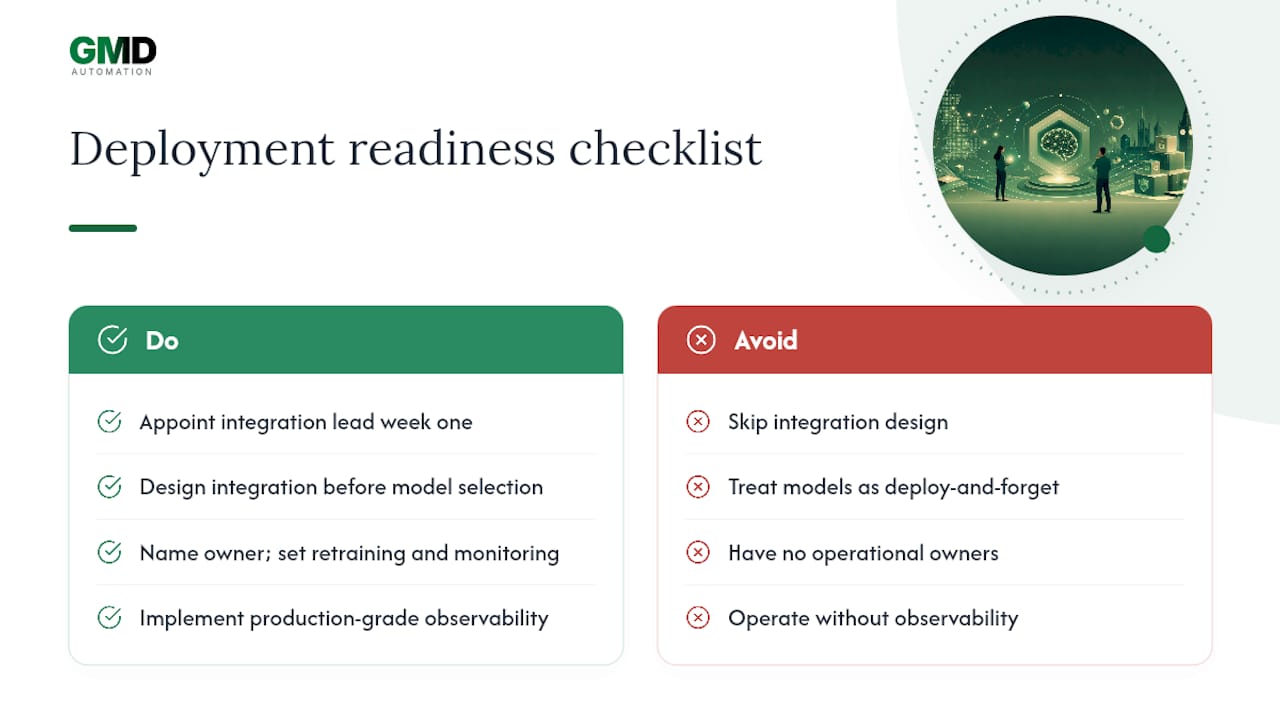
Skipping integration design. Teams select a model, build a demo, and then discover that connecting it to production systems takes longer than building the demo. The fix is to treat integration design as a prerequisite for model selection, not a follow-on task.
Treating models as products. A model is not a product you deploy and forget. It degrades as data distributions shift, as upstream systems change, and as usage patterns evolve. Every deployment needs a named owner and a retraining and monitoring plan from day one.
Under-budgeting TCO. Pilot costs are not representative. Inference at scale, glue-code maintenance, and operational engineering are the real cost drivers, and they are rarely modelled before a business case is approved.
Missing operational owners. A deployment with no named owner for data quality, security, and incident response will accumulate technical debt silently until a production incident forces a reckoning. Assign owners before go-live, not after the first incident.
Insufficient observability. Teams that cannot answer "what did the agent do, in what order, with what inputs" within five minutes of an incident are flying blind. Observability is not optional; it is the minimum viable operations capability.
Underestimating change management. The people who use the system, or whose work is changed by it, need training, clear escalation paths, and visible leadership support. Deployments that skip this step see low adoption and high escalation rates that erode the business case.
The corrective action for all six is the same: appoint an integration lead with cross-team authority in week one and give them the mandate to block a go-live that fails the production-readiness checklist. For organisations that lack the internal capacity to staff that role, engaging a managed partner with production-grade integration experience is the fastest path to risk reduction.
*— Ravi
What UK enterprises should expect from a managed AI automation partner
The integration risks described throughout this article — credential sprawl, fragmented data, legacy API gaps, insufficient observability — are solvable. The question is whether to solve them with internal resource or with a partner who has already built the control-plane patterns, credential vaults, and monitoring stacks that production AI requires.
Gmdautomation delivers enterprise-grade AI automation for UK businesses on a subscription model with zero upfront costs. Implementation, operation, maintenance, and ongoing optimisation are included in a single monthly fee, which means the TCO is predictable from day one rather than discovered in year two. The platform is built for compliance and security from the ground up: vaulted credentials, per-agent authorisation, durable session memory, and audit trails are standard, not add-ons. For organisations that need production-ready AI automation without the 16–26-week build cycle, Gmdautomation's managed service is the practical next step. Book a discovery call to assess your integration readiness and get a scoped deployment plan.
Sources
- 2026 MuleSoft Connectivity Benchmark Report
- GenAI project failure
- RAND research report RRA2680-1
- The integration bottleneck: why your agents fail when meeting real systems
- The glue problem in AI development