

Conversational AI IVR replaces static "press one for billing" menus with a system that listens to what a caller actually says, understands the intent behind it, and routes or resolves the call without a human agent. It combines automatic speech recognition, natural language understanding and live data lookups to hold something closer to a conversation than a phone tree.
For most enterprises with meaningful call volume, it's the right next move. The immediate payoff comes in three forms: higher containment (calls resolved without a transfer), faster resolution for callers who no longer navigate nested menus, and the ability to scale support without scaling headcount at the same rate.
It's not universally the first system to touch, though. The best candidates to pilot first are:
- High-volume, repetitive call types: balance checks, appointment booking, order status, password resets.
- Contact centres already recording intent data from existing IVR or agent logs, since that data trains the new system faster.
- Teams with predictable after-hours or overflow volume, where containment gains show up almost immediately.
Key Takeaways
Conversational AI IVR raises containment and lowers cost per resolved call primarily through strong CRM and knowledge-base integration, not through NLU sophistication alone.
| Point | Details |
|---|---|
| Pilot the right calls first | Start with high-volume, repetitive intents like appointment booking, order status, and after-hours FAQs. |
| Integration beats model polish | CRM and knowledge-base connections drive most containment gains; prioritise them before intent breadth. |
| Fix metrics before launch | Define containment rate, intent accuracy, and CSAT delta targets before the pilot begins, not after. |
| Know when to choose hybrid | Use conversational IVR for structured, compliance-heavy flows and a voicebot layer for open-ended tasks. |
| Consider a managed deployment | Gmdautomation offers a zero-capex subscription covering implementation, operation, and optimisation for faster time to production. |
Table of Contents
- What is conversational AI IVR and how does it work?
- What benefits does conversational AI IVR deliver for contact centres?
- Conversational IVR, voicebot, or hybrid: which one fits?
- What does implementation actually require?
- What proof points should you look for in a vendor?
- Where does conversational AI IVR still fall short?
- Where is conversational AI IVR heading next?
- Where should you focus your judgement, not just your budget?
- Get a working conversational IVR pilot without the capital outlay
- Sources
What is conversational AI IVR and how does it work?
Conversational IVR strings together five components, and each one is a place where projects tend to succeed or stall. Traditional IVR used pre-recorded prompts, basic speech recognition, and keypad input to move callers through fixed menus; conversational IVR keeps that telephony backbone but replaces the rigid menu logic with natural language understanding and dynamic routing.
- Automatic speech recognition (ASR) converts speech to text. Accuracy drops with strong accents, background noise, or poor mobile signal, so enterprise deployments need ASR models tuned or tested against the caller demographics they'll actually hear.
- Natural language understanding (NLU) classifies intent and extracts slots (a date, an account number, a product name). Confidence thresholds matter here: set them too low and the system guesses wrong; set them too high and it escalates calls it could have handled.
- Orchestration logic decides what happens next: answer directly, call an API against a CRM or knowledge base, or route to the right ACD queue with context attached so the agent doesn't ask the caller to repeat themselves.
- Text-to-speech (TTS) delivers the response, ideally on a streaming architecture so the caller hears a natural reply rather than a delayed block of audio.
- Fallback handling governs what happens when confidence is low or the caller gets frustrated, typically a fast, dignified handover to a human.
Vendor platforms typically bundle these with speech analytics and voice biometrics, positioning CRM and knowledge-base integration as the main lever for containment.
Pro Tip: Track intent accuracy, containment rate, and transfer rate from day one, even during the pilot. Without that telemetry, you can't tell whether a bad call was a model problem or a routing problem.*
What benefits does conversational AI IVR deliver for contact centres?
The commercial case rests on one uncomfortable historical fact: Gartner found that only a small fraction of customers reported that self-service actually resolved their issue. Static IVR menus were the main self-service tool for decades, and that low resolution rate is exactly what conversational systems are built to fix.
Done well, conversational IVR improves containment, cuts average handle time by removing menu navigation, and reduces abandonment because callers get to the point faster. CSAT tends to rise not because the AI is impressive, but because friction drops.
The fastest returns tend to show up in specific scenarios:
- After-hours coverage where the alternative was a voicemail or a missed call.
- FAQ-heavy queues: order status, opening hours, simple account questions.
- Appointment booking and rescheduling, where the task is structured and repeatable.
The limits are just as real. Complex regulated scripts (certain financial disclosures, clinical triage) and highly bespoke workflows resist automation because the cost of a wrong answer is too high, or the logic branches in ways that are hard to model cleanly. Those calls usually stay with agents, at least for now.
Conversational IVR, voicebot, or hybrid: which one fits?
The terms get used interchangeably, and that's part of why buyers get stuck. Conversational IVR is fundamentally menu-replacement: it understands speech well enough to skip pressing buttons, but it's still oriented around structured flows and known intents. A voicebot goes further, aiming to hold an open-ended, end-to-end conversation and complete a task without leaning on a predefined tree at all.
Industry commentary on the ivr vs voicebot question converges on a simple rule: pick based on how structured the call is, not how impressive the technology sounds.
- Choose conversational IVR when call types are well known, compliance requires consistent scripted language, or callers are used to a menu-style interaction.
- Choose a voicebot when the task is genuinely conversational, such as troubleshooting or negotiation, and the value of natural dialogue outweighs the risk of unpredictability.
- Choose a hybrid when you have both: conversational IVR handles the front door and routing, a voicebot layer takes over for open-ended tasks, and agents pick up anything unresolved.
Three hybrid patterns show up repeatedly in enterprise deployments: IVR-first with voicebot escalation for complex intents, voicebot-first with IVR fallback for compliance-sensitive scripts, and parallel deployment where call type determines which system answers first.
Pro Tip: Judge every option on cost per resolved call, not cost per minute.
What does implementation actually require?
A pilot lives or dies on integration scope, data discipline, and honest metrics, not on how good the demo sounds.
Integrations to scope up front:
- Telephony or CPaaS layer for call routing and streaming audio.
- ACD to hand off contained-but-unresolved calls with context intact.
- CRM and knowledge base, consistently the biggest lever on containment improvements.
- Authentication (PIN, voice biometrics, or knowledge-based verification) for account access.
Related reading on scoping these connections sits in Gmdautomation's guide to enterprise API integration patterns, and for teams working through low-code options, the piece on integrating AI tools with no-code platforms is worth a read before locking the architecture.
- Governance first: define PII handling, call recording policy, retention periods, and consent language before a single call is routed through the system.
- Design the pilot: set target containment rate, intent accuracy, and CSAT delta before launch, not after, so success has a fixed definition.
- Run it long enough to matter: most enterprise pilots run several weeks and need a meaningful sample of real calls, not a demo script, to produce trustworthy numbers.
- Plan the handover UX: agents need full context the instant a call transfers, or containment gains get undone by a frustrating repeat-yourself experience.
Cost drivers are fairly consistent across vendors: platform licences, voice minutes consumed, and any custom intent training beyond the out-of-the-box model. For a wider view of where automation budgets typically go, Gmdautomation's AI automation benefits guide breaks down the usual cost categories.
What proof points should you look for in a vendor?
Security and compliance questions come up in nearly every enterprise procurement conversation around voice AI, and they should. Ask any vendor directly how call data is stored, who can access transcripts, and what certifications back their infrastructure before signing anything.
Gmdautomation runs on a subscription model with zero upfront cost: implementation, operation, maintenance and ongoing optimisation are bundled into one predictable monthly fee rather than a large capital outlay followed by a maintenance contract. That structure exists specifically because rapid deployment and low-friction proof of concept matter more to buyers than owning infrastructure outright.
A proof of concept worth taking seriously usually demonstrates:
- A live demo agent handling realistic call scenarios, not a scripted showcase.
- Concrete integration examples against a CRM or knowledge base similar to your own stack.
- Pilot metrics from a comparable deployment: containment, intent accuracy, transfer rate.
Before you brief a supplier, get three things settled internally: scope (which call types are in and out), stakeholders (IT, CX, compliance, and whoever owns the telephony contract), and acceptance criteria (the numbers that decide whether the pilot becomes production). Gmdautomation's notes on why system integrators adopt managed AI platforms are a useful reference point when building that internal case.
Where does conversational AI IVR still fall short?
No conversational IVR handles every call well, and pretending otherwise sets up a pilot for a credibility problem later. Accent and dialect variation remains a genuine weak point for ASR, particularly with regional speech patterns or heavy background noise from mobile callers, and no amount of NLU sophistication fixes a transcript that was wrong to begin with.

Intent overlap is another persistent issue. Callers phrase the same problem a dozen different ways, and edge cases multiply fast once you're past the top twenty intents. Confidence threshold tuning is ongoing work, not a one-time setup task, and teams that treat it as "done" after launch usually see containment quietly erode over months.
Regulated and highly bespoke workflows resist automation for good reason: the cost of an incorrect answer is too high, or the branching logic is too specific to model cleanly without constant maintenance. Legal disclosures, clinical triage, and complex disputes tend to stay with trained agents.
There's also a caller-trust dimension. Some customers still want to reach a person quickly, particularly for anything emotionally charged, and a system that traps them in automation before offering an easy human escalation damages CSAT rather than protecting it. The fix isn't more automation, it's a visible, fast exit to a human whenever confidence drops or frustration signals appear in tone or repeated rephrasing.
Where is conversational AI IVR heading next?
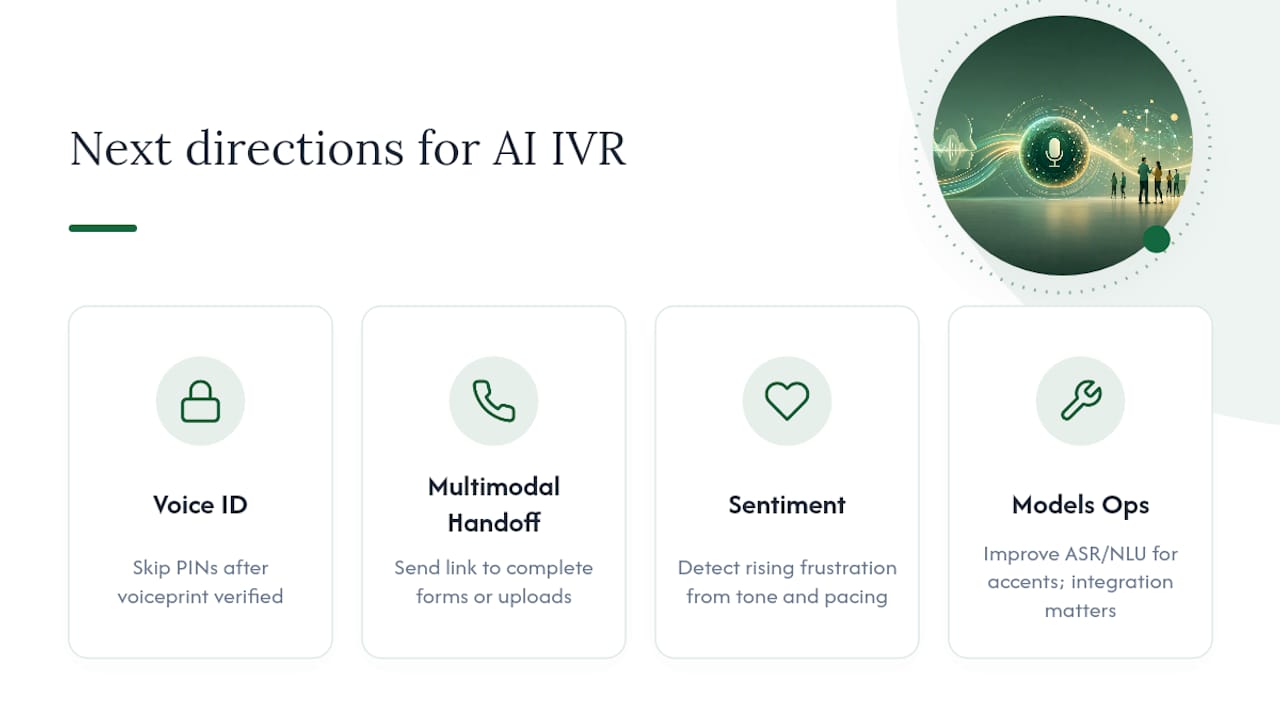
Voice biometrics is moving from a fraud-prevention afterthought to a core authentication layer, letting returning callers skip PINs and security questions entirely once their voiceprint is verified, which shortens calls and reduces one of the more tedious parts of any support interaction.
Multimodal handoff is another shift worth watching: a call starts on voice, then a link to complete a form or upload a document gets sent to the caller's phone mid-conversation, blending the immediacy of a call with the precision of a screen. Expect this to become standard for anything involving document verification or payment.
Real-time sentiment detection is also maturing past novelty status. Systems increasingly flag rising frustration from tone and pacing, not just words, and trigger earlier escalation before a caller has to ask for a human explicitly.
Underneath all of it, the ASR and NLU models themselves keep improving on accented and noisy speech, narrowing the gap that currently pushes some calls to agents purely on transcription confidence. None of this replaces the fundamentals covered above. Integration quality, governance, and honest pilot metrics will still decide whether any of these advances actually show up in your containment numbers.
Where should you focus your judgement, not just your budget?
The conventional advice on this topic spends too much time on model quality and not enough on integration discipline. A brilliant NLU model connected to a stale knowledge base still gives wrong answers confidently, and that's arguably worse for CSAT than a caller who gets transferred quickly.
What the research actually supports is a boring but reliable priority order: get the CRM and knowledge base connections right first, because that's the single biggest lever on containment, then worry about accent handling and intent breadth. Enterprises that reverse this order, chasing broader intent coverage before their integrations are solid, tend to end up with an articulate system that's confidently wrong.
The other place conventional wisdom falls short is timeline expectations. Pilots are sold as quick wins, but the real work is the weeks of intent tuning after launch, not the initial setup. Budget for that iteration phase explicitly rather than treating it as an unplanned overrun.
If you take one thing from this guide, prioritise a pilot design with fixed acceptance criteria before you talk to a single vendor. Everything else is negotiable.
— Ravi
Get a working conversational IVR pilot without the capital outlay
Gmdautomation is the practical route to a production conversational IVR system without the upfront platform spend or the months-long integration project most enterprises brace for. The subscription covers implementation, operation, maintenance and ongoing optimisation for one predictable monthly fee, so the business case doesn't hinge on a large capital request before you've proven containment gains.
That matters most for the exact scenarios this guide flagged as fastest-ROI: after-hours coverage, appointment booking, and FAQ-heavy queues where a managed system can be live and measurable within weeks rather than quarters. Gmdautomation's deployments are built with the integration and compliance groundwork covered above already handled, so your team spends its time on acceptance criteria and pilot metrics, not vendor plumbing.
If you're scoping a pilot, the next step is straightforward: visit Gmdautomation to see a live demo agent and talk through integration examples against your own CRM and telephony stack before you commit to a full rollout.
Sources
- Gartner press release on self-service resolution rates
- Interactive voice response — Wikipedia
- Conversational IVR Software for Smarter Self-Service | Sprinklr