

Artificial intelligence in procurement operations is the application of machine learning, natural language processing, and agentic AI systems to automate routine buying tasks, surface data-driven insights, and transform how organisations source goods and services. Procurement productivity rises by over 60% when AI is fully integrated, with annual ROI improvements reaching up to fivefold and cost savings of 3–7% becoming typical. These are not aspirational figures. They reflect what early adopters are already achieving across sourcing, contract management, and supplier risk monitoring. For procurement executives, the question is no longer whether AI belongs in the function. It is how quickly you can build the foundations to make it work.
What is AI in procurement operations and how does it work?
AI in procurement operations is defined as the use of autonomous and assisted AI agents to execute, monitor, and improve procurement workflows without constant human intervention. Agentic AI now leads 25% of procurement activities and assists on another 70%, reducing sourcing cycle times by more than 50%. That single statistic reframes what procurement teams are capable of delivering.
Agentic AI refers to AI systems that can plan, act, and adapt across multi-step tasks. In procurement, this means an AI agent can receive a purchase request, identify qualified suppliers, run a preliminary risk assessment, draft a request for proposal, and flag anomalies in submitted bids, all without a human touching each step. The agent gathers data from internal systems, market feeds, and supplier databases to make each decision.
Tasks that AI now handles fully or partially include:
- Intake and triage: Classifying spend requests, routing approvals, and flagging policy exceptions automatically.
- Sourcing: Identifying and shortlisting suppliers based on price, quality, lead time, and risk profile.
- Contract management: Drafting standard clauses, tracking obligations, and alerting teams to renewal deadlines.
- Supplier monitoring: Continuously scanning news, financial filings, and ESG data for risk signals.
- Invoice processing: Matching purchase orders to invoices and flagging discrepancies before payment.
Pro Tip: Before deploying AI agents on sourcing tasks, map your current intake process in detail. AI performs best when the workflow it automates is clearly defined. Ambiguous handoffs produce ambiguous outputs.
The impact on buying cycle times is the most immediate operational gain. A sourcing event that previously took six weeks can complete in days when AI handles supplier identification, data gathering, and initial scoring. That speed compounds across hundreds of categories.
Why AI adoption fails without process redesign
Applying AI to a broken procurement process does not fix the process. It accelerates the mistakes. AI transformation is a business transformation, and organisations that treat it as a technology deployment without redesigning workflows consistently see limited returns.
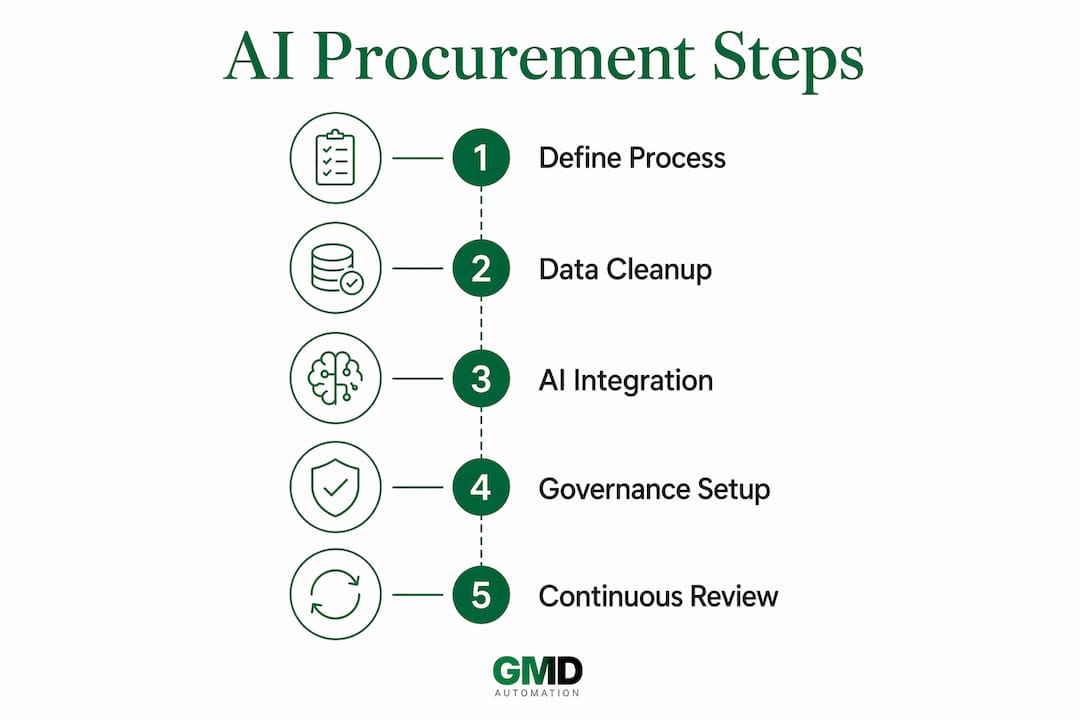
The most common failure pattern is layering AI tools onto legacy approval chains, fragmented supplier data, and unclear decision rights. The AI produces outputs, but no one trusts them because the underlying data is inconsistent. Most organisations prioritise AI tools before establishing clean, reliable data foundations, which is precisely why so many pilots stall after the proof-of-concept stage.
Three conditions must exist before AI delivers reliable procurement outcomes:
- Clean, connected data. Supplier master data, contract repositories, and spend classifications must be accurate and accessible in a single environment. AI trained on fragmented data produces fragmented recommendations.
- Redesigned workflows. Decision rights, approval thresholds, and escalation paths must be redefined around AI capabilities. A workflow built for manual review will not benefit from an AI that can process a thousand data points in seconds.
- Executive sponsorship. Cross-functional trade-offs between procurement, finance, and operations require authority that sits above any single function. Enterprise-wide AI optimisation frequently requires CEO-level approval to resolve competing priorities.
The biggest value from AI in procurement comes from rethinking how the work gets done, not from automating what already exists. Organisations that redesign their operating model around AI capabilities consistently outperform those that simply bolt AI onto existing processes.
Governance matters as much as technology. Procurement teams need clear rules about which decisions AI makes autonomously and which require human sign-off. High-value contracts, sole-source awards, and supplier terminations should remain human-driven. Routine reorders, standard approvals, and compliance checks are ideal candidates for full automation.
What are the measurable benefits of AI in procurement?
The benefits of AI in procurement fall into four categories: speed, cost, risk, and talent reallocation. Each is measurable, and each compounds over time as AI systems learn from more data.

| Benefit area | What AI delivers | Scale of impact |
|---|---|---|
| Sourcing speed | Reduces cycle times by automating supplier identification and scoring | Over 50% reduction in sourcing cycle time |
| Cost savings | Identifies savings opportunities across categories through spend analytics | 3–7% typical annual savings |
| ROI | Drives returns through efficiency and better supplier terms | Up to fivefold annual ROI improvement |
| Risk management | Monitors supplier financial health, ESG signals, and contract compliance continuously | Fewer non-compliant contracts and faster risk response |
One large-scale agentic AI implementation projected savings of up to $180 million. That figure reflects what happens when AI is applied at scale across a full procurement function, not just a single category or process.
AI agents accelerate contract lifecycle management, reduce non-compliance, and improve supplier relationship management. These are not marginal gains. Faster contract cycles mean faster time to value from new supplier agreements. Fewer non-compliant contracts reduce legal exposure. Better supplier data enables more informed negotiations.
The talent benefit is often underestimated. When AI handles intake, data gathering, and routine approvals, procurement professionals shift their time to category strategy, supplier development, and innovation sourcing. These are the activities that create competitive advantage. They are also the activities that skilled procurement professionals find most rewarding.
Pro Tip: Track AI-driven savings separately from negotiated savings in your reporting. This distinction helps you demonstrate the specific ROI of your AI investment to the board and builds the case for expanding AI across additional categories.
AI in supply chain operations also enables a capability that manual procurement cannot replicate: continuous category strategy. AI can monitor market conditions, supplier capacity, and commodity prices in real time, alerting category managers when conditions favour renegotiation or dual sourcing. That kind of always-on intelligence was previously available only to the largest organisations with dedicated market intelligence teams.
How should procurement leaders prepare for AI implementation?
Preparation determines whether AI deployment delivers value or becomes an expensive experiment. Procurement leaders who succeed with AI treat implementation as a phased programme, not a single project.
- Assess your data readiness first. Audit your supplier master data, contract repository, and spend classification accuracy before selecting any AI tool. Poor data quality is the leading cause of failed AI deployments in procurement.
- Prioritise use cases with clear ROI. Start with invoice matching, spend analytics, or supplier risk monitoring. These use cases have well-defined inputs and outputs, making it straightforward to measure AI performance against a baseline.
- Build cross-functional teams. Effective AI procurement programmes combine procurement domain knowledge with data science capability. Neither group succeeds without the other. Procurement professionals understand what good looks like; data scientists understand how to build systems that deliver it.
- Define AI guardrails from day one. Specify which decisions AI makes autonomously and which require human review. Document these rules and review them quarterly as AI capabilities and your confidence in the system grow.
- Establish continuous performance tracking. Set KPIs for each AI use case before go-live. Measure cycle time, error rate, compliance rate, and cost savings monthly. Use the data to refine the system and build the business case for the next phase.
A practical AI strategy framework helps procurement leaders sequence these steps without losing momentum. Scaling AI without proportional headcount growth is achievable when use cases are prioritised by impact and implementation is phased by complexity. The organisations that move fastest are those that start narrow, prove value quickly, and expand from a position of demonstrated success.
Scalable AI architecture for UK enterprises requires particular attention to data sovereignty, GDPR compliance, and integration with existing ERP and procurement platforms. UK procurement leaders should factor these requirements into vendor selection and implementation planning from the outset.
The uncomfortable truth about AI and procurement transformation
Procurement has always been a function that punches below its weight in boardroom conversations. AI changes that, but not automatically.
The organisations I see getting the most from AI in procurement are not the ones with the most sophisticated technology. They are the ones that used AI adoption as a forcing function to fix their data, clarify their decision rights, and redesign their operating model. The technology was the catalyst. The transformation was organisational.
Applying AI selectively where it complements human judgement, rather than replacing it wholesale, is the approach that holds up under scrutiny. High-stakes supplier negotiations, sole-source decisions, and strategic partnership agreements need human judgement, context, and relationship intelligence that AI cannot replicate today. Routine approvals, compliance checks, and market monitoring do not. The procurement leaders who draw that line clearly are the ones who build trust in their AI systems quickly.
The risk I see most often is not that AI will replace procurement professionals. It is that procurement teams will automate their current processes without questioning whether those processes are worth automating. A slow, manual approval process that becomes a fast, automated approval process is still a bad approval process. The redesign conversation is harder than the technology conversation, but it is the one that determines whether AI delivers lasting value.
Start early, start narrow, and treat every AI deployment as a learning exercise. The real-world productivity gains from AI in procurement are real, but they accrue to the organisations that iterate, not the ones that wait for a perfect solution.
— Ravi
How Gmdautomation supports AI-driven procurement for UK businesses
Procurement teams across the UK are under pressure to do more with the same headcount and tighter budgets. Gmdautomation builds enterprise-grade AI systems that address exactly that challenge, with no upfront capital cost and a predictable monthly subscription that covers implementation, operation, and ongoing optimisation.
Gmdautomation deploys AI systems tailored to your procurement workflows, from spend analytics and supplier monitoring to contract management and intake automation. Every system is built for UK compliance requirements, integrates with existing platforms, and is ready to scale as your confidence in AI grows. Procurement executives who want to move from pilot to production without the usual implementation risk can explore AI automation solutions built specifically for UK enterprises.
Key takeaways
AI in procurement operations delivers the greatest value when organisations redesign their workflows and data foundations alongside the technology, not after it.
| Point | Details |
|---|---|
| AI productivity gains are substantial | Procurement productivity rises by over 60% with full AI integration, with sourcing cycle times cut by more than 50%. |
| Agentic AI handles most tasks | AI agents now lead 25% of procurement activities and assist on 70%, covering intake, sourcing, and contract management. |
| Data quality is the prerequisite | Clean, connected, and governed data must exist before AI deployment to avoid unreliable outputs and failed pilots. |
| Process redesign unlocks real ROI | Automating broken workflows limits returns; redesigning decision rights and operating models is what drives fivefold ROI gains. |
| Start narrow and measure everything | Prioritise use cases with clear baselines, track KPIs monthly, and expand AI coverage from a position of proven results. |
FAQ
What is AI in procurement operations?
AI in procurement operations is the use of machine learning, natural language processing, and agentic AI systems to automate routine tasks, analyse supplier data, and support decision-making across the sourcing and buying cycle.
How much can AI reduce procurement costs?
AI typically delivers annual cost savings of 3–7% in procurement, with large-scale implementations projecting savings of up to $180 million, according to Bain & Company research.
What procurement tasks can AI fully automate?
AI can fully automate invoice matching, spend classification, purchase order routing, supplier risk monitoring, and standard contract drafting, while complex negotiations and high-value decisions remain human-led.
Why do AI procurement projects fail?
Most AI procurement projects fail because organisations deploy AI tools before establishing clean data foundations and redesigned workflows, producing unreliable outputs that teams do not trust or act on.
How should a procurement team start with AI?
Start by auditing your data quality, then select one high-volume, well-defined use case such as invoice processing or spend analytics, measure performance against a clear baseline, and expand from there.