

Most business executives assume that when an AI model responds to a request, it is directly doing the work. Fetching data, booking a meeting, updating a record. That assumption is wrong, and it costs organisations real money when it shapes their AI strategy. What is AI function calling explained simply? It is the mechanism by which a language model tells your application what to do, rather than doing it itself. Understanding this distinction is not a technical nicety. It is the foundation of every reliable AI automation system, and the executives who grasp it make better deployment decisions from day one.
Table of Contents
- What is AI function calling and how does it work?
- Key architectures and best practices for implementing AI function calling
- Common challenges and deep insights from deploying AI function calling in production
- Practical applications of AI function calling in UK enterprises
- Why mastering AI function calling is essential for future-proof UK enterprises
- Streamline your AI function calling with GMD Automation
- Frequently asked questions
Key Takeaways
| Point | Details |
|---|---|
| Function calling defined | AI function calling allows models to request specific functions to execute via structured calls, separating reasoning from execution. |
| Implementation patterns | Major AI platforms support function calling with defined schemas, state management, and multi-function orchestration for enterprise use. |
| Enterprise challenges | Robust orchestration, clear function definitions, state handling, and security controls are key for reliable production systems. |
| Business applications | UK enterprises can streamline operations and enhance automation by integrating AI function calling with their systems. |
| Strategic importance | Mastering AI function calling is vital for future-proofing AI-driven automation and unlocking real-world AI potential. |
What is AI function calling and how does it work?
AI function calling is best understood as a translation layer. Your business system speaks in code and APIs. Your employees speak in natural language. The AI model sits between them, interpreting intent and producing structured instructions that your application can act upon.
As Microsoft's documentation confirms, AI function calling involves the model deciding which external function to invoke and outputting a structured JSON call that the application executes, rather than the AI running APIs directly. The model never touches your database or your calendar system. It simply says, in a structured format: "call this function, with these parameters."
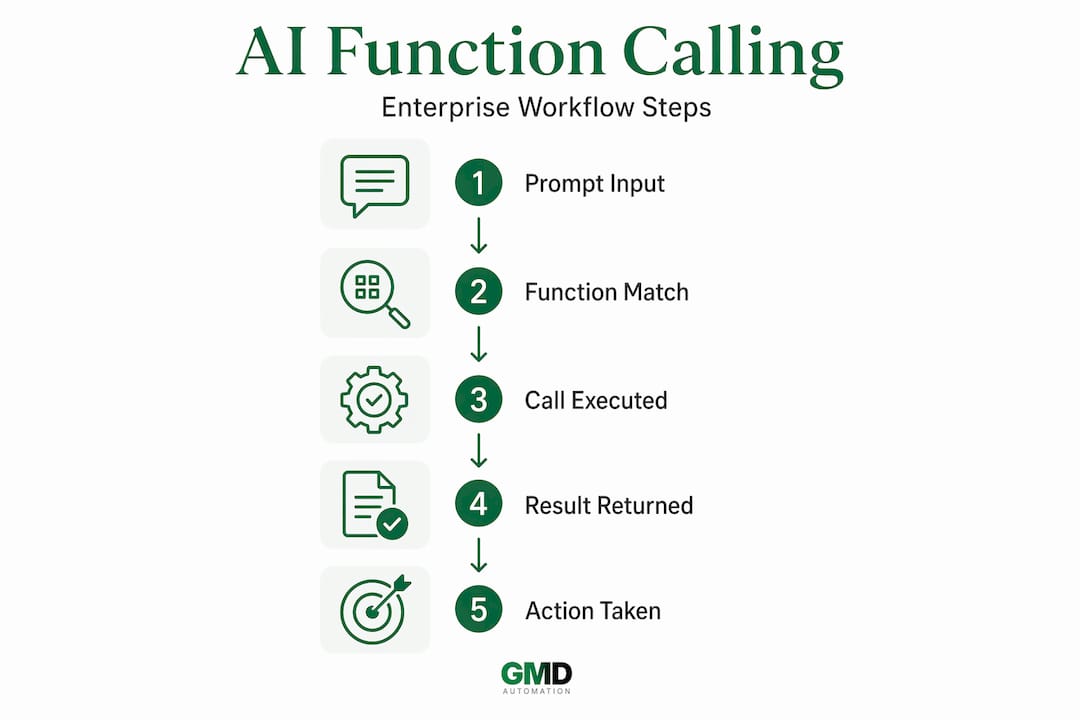
The typical workflow for understanding AI function calls follows a clear sequence:
- Define function declarations. Your development team describes the available functions to the AI, including their names, purposes, and expected parameters. Think of this as giving the AI a menu of what it is permitted to request.
- Send a user prompt. A user asks a question or makes a request in plain language.
- AI returns a structured call. Rather than answering directly, the model returns a JSON object specifying which function to call and what arguments to pass.
- Your application executes the function. Your system runs the actual code, queries the database, or calls the external API.
- Results return to the AI. Your application sends the output back to the model.
- AI generates the final response. The model uses the real data to construct a coherent, accurate reply for the user.
Google's Gemini workflow defines exactly this cycle: sending prompts with function declarations, receiving structured function calls, executing them in the application, and returning results for a final response. This is not one provider's quirk. It is the standard pattern across the industry.
Why does this architecture matter for your business? Because it keeps AI reasoning and business logic separate. The model handles ambiguity, language, and intent. Your systems handle execution, security, and data. By exploring ai automation solutions built on this principle, enterprises gain AI that is genuinely reliable rather than a black box guessing at outcomes.
Key benefits of this separation include:
- Auditability. Every function call is a discrete, loggable event.
- Control. Your application decides what actually runs, not the AI.
- Flexibility. You can swap out the underlying model without rewriting your business logic.
- Reduced hallucination risk. The AI retrieves real data rather than generating plausible-sounding fiction.
Pro Tip: When defining clear function declarations, treat them like a legal contract between the AI and your systems. Vague descriptions produce vague calls. Precise descriptions produce reliable, repeatable automation.
Key architectures and best practices for implementing AI function calling
With an understanding of how AI function calling works in theory, let us compare major platform implementations and their best practices.
Different providers have converged on the same core pattern, but the specifics of schemas, state management, and execution control vary enough to matter at enterprise scale.
| Provider | Function calling name | State management | Key distinction |
|---|---|---|---|
| Google Gemini | Function calling | Application-managed | Supports parallel and sequential calls in one turn |
| Microsoft (.NET AI) | Tool calling | Application-managed | Emphasises multi-round loops and security boundaries |
| Oracle OCI | Function tools | API-managed or user-managed | Two distinct state tracking methods |
| OpenAI | Tool use / function calling | Application-managed | Broad ecosystem and schema documentation |
Oracle OCI supports two distinct conversation state management methods: API-managed state tracking, where the provider handles conversation history, and user-managed tracking, where your application maintains the full history. Each approach carries different implications for reliability and auditability in regulated UK industries such as financial services or healthcare.

Microsoft's framework allows multiple rounds of function calls within a single interaction and is explicit that your application controls execution and security and execution control boundaries. This is critical. No responsible enterprise should allow a language model to call functions without explicit permission lists baked into the application layer.
Best practices for your implementation team:
- Use strict JSON schemas. Ambiguous parameter types produce unpredictable model behaviour.
- Restrict the function list per context. A customer-facing chatbot should not have access to administrative functions, even if the underlying model theoretically could call them.
- Version your function declarations. When business logic changes, your function schemas must change too, with proper version control.
- Log every call and result. For compliance in regulated sectors, a full audit trail of every function invocation is non-negotiable.
- Validate outputs before execution. Never pass raw model output directly to an execution layer without schema validation.
When writing structured function definitions, be precise about required versus optional parameters and include clear descriptions of what each parameter represents. The model uses these descriptions to populate arguments correctly, not just the parameter names.
Pro Tip: Restrict the mode in which the AI can select tools. Most platforms allow you to force the model to call a specific function, prevent it from calling any functions, or let it choose freely. Use forced modes during onboarding workflows where you know exactly what the next step should be.
Common challenges and deep insights from deploying AI function calling in production
Understanding best practices sets the stage for appreciating the nuanced challenges enterprises face when implementing AI function calling.
The gap between a working prototype and a production-grade deployment is wider with function calling than with almost any other AI feature. Here is where that gap lives.
Orchestration complexity. Robust orchestration logic is critical, as function calling often requires handling multiple tool calls per turn in loops until the task is complete. A customer service agent resolving a billing query might need to call an account lookup function, then a transactions function, then a refund eligibility function, all within one user interaction. Each call must complete, validate, and feed into the next.
Parameter precision as a reliability contract. Precision in input parameters acts as a contract between the AI and your runtime, reducing the need for error repairs and increasing overall reliability. When a parameter description is vague, the model will sometimes infer correctly and sometimes not. At scale, that inconsistency becomes a support burden.
State management as an operational concern. Conversation state management affects auditing, replayability, and failure recovery in AI-assisted workflows. If a multi-step transaction fails midway and you cannot reconstruct the state, you have a problem that goes beyond technical inconvenience. In financial services, it is a compliance issue.
"Function calling is not just a technical feature but the linchpin that transforms language models into practical AI agents, enabling real-world impact." This framing is worth internalising before any deployment decision.
Challenges your enterprise ai automation team will encounter in production:
- Handling partial function call failures without corrupting the conversation state
- Managing timeout scenarios where external APIs are slow or unavailable
- Preventing prompt injection attacks where malicious user input attempts to manipulate function calls
- Dealing with the model requesting functions that do not exist when declarations are poorly scoped
- Ensuring idempotency so that retried function calls do not produce duplicate database writes or duplicate transactions
None of these problems are insurmountable. But each requires deliberate engineering choices made before go-live, not discovered in production.
Practical applications of AI function calling in UK enterprises
Having explored deployment challenges, we now look at concrete business applications to bring these concepts to life.
AI function calling enables workflows including scheduling, invoice creation, data retrieval, and controlling external systems, all without the AI directly executing any code. For UK enterprises, the practical value concentrates in a handful of high-impact areas.
Common enterprise use cases:
- Customer service automation. An AI agent handles an inbound query, calls a CRM lookup function to retrieve the customer's account, calls a case history function, then generates a personalised response. The agent never accesses the database directly.
- Internal knowledge retrieval. Employees ask questions in plain English. The AI calls a document search function across internal SharePoint or similar repositories, retrieves relevant policy documents, and synthesises a clear answer.
- Operational scheduling. A logistics team uses an AI assistant that calls availability functions, resource allocation functions, and notification dispatch functions to coordinate delivery slots automatically.
- Financial reporting. An AI system calls data extraction functions against ERP systems, formats the retrieved figures, and generates narrative summaries for finance teams.
- Supplier and inventory management. AI calls stock level functions and supplier API functions to flag reorder requirements or identify supply chain risks without human prompting.
Cloudflare's production example illustrates how to integrate function calling with real-time external data retrieval in live applications, demonstrating that this is not theoretical architecture but something actively running at scale today.
| Business function | Functions called | Value delivered |
|---|---|---|
| Customer onboarding | ID verification, CRM creation, welcome email | Reduces manual processing time |
| Expense approvals | Policy lookup, manager notification, ERP update | Consistent policy application |
| IT service desk | Ticket creation, asset lookup, escalation routing | Faster resolution without analyst involvement |
| Contract review support | Document retrieval, clause comparison, flag generation | Reduced legal review burden |
Building automation for business continuity around function calling means your processes do not depend on a single employee's availability or knowledge. The AI orchestrates the workflow. Your systems do the work. Your team focuses on judgement calls that genuinely require human expertise.
For UK business automation, the function calling pattern also handles legacy system integration particularly well. Rather than rebuilding old systems to be "AI-native," you wrap their existing APIs or database procedures in function declarations. The AI never knows or cares that it is talking to a system built in 2003.
Why mastering AI function calling is essential for future-proof UK enterprises
There is a common misconception that the value of AI in enterprise comes from the sophistication of the language model itself. It does not. The model is table stakes. The real transformation lives in the quality of your function calling architecture.
Function calling is the linchpin that transforms language models into practical AI agents with real-world impact. Strip away the function calling layer and you have a very expensive autocomplete tool. Build it well and you have a system that genuinely changes how your organisation operates.
What we observe consistently in enterprise deployments is that organisations that invest time in precise tool definitions, robust error handling, and strict security boundaries around function calling outperform those that do not, regardless of which model they are using. A well-architected GPT-3.5 deployment with excellent function calling will outperform a poorly architected GPT-4 deployment every single time.
The importance of AI function calling also extends to what is coming next. Model Context Protocol, or MCP, is an emerging standard attempting to normalise how models discover and invoke tools across different providers. It may eventually reduce the bespoke engineering effort required today. But right now, MCP is early-stage and production deployments still require careful, provider-specific implementation. Betting your enterprise roadmap on MCP standardisation today would be premature.
What is not premature is investing in security and resilience in ai automation around your function calling implementation. UK enterprises operating under FCA oversight, NHS data frameworks, or ICO regulations cannot treat security boundaries as an afterthought. They must be designed in from the start.
The function calling pattern is also where AI agents become genuinely agentic. Single-turn interactions are useful. Multi-step, multi-function workflows that complete complex tasks autonomously are transformative. That transformation only happens if your function calling layer is engineered for it.
Streamline your AI function calling with GMD Automation
AI function calling is powerful in principle and demanding in practice. Getting the schemas right, managing conversation state, enforcing security boundaries, and building orchestration logic that handles real-world edge cases requires both AI expertise and deep knowledge of business operations.
GMD Automation's AI solutions are built specifically for UK enterprises that want this done properly, without a lengthy and expensive build cycle. Their subscription model covers the full implementation, from function declaration design and security architecture through to ongoing maintenance and optimisation as your business requirements evolve. There are no upfront capital costs, no ambiguity about what is included, and no need to build an in-house AI engineering team before you can begin seeing results. If you are ready to move from understanding AI function calling to deploying it, GMD Automation is a practical starting point.
Frequently asked questions
What exactly does AI function calling do in an enterprise AI system?
AI function calling enables the model to suggest which external functions to execute by outputting structured JSON calls, while your application performs the actual execution and returns results to the AI for the final user-facing response.
How does conversation state affect AI function calling implementations?
Conversation state determines how function calls and their results are linked across multiple interactions. Oracle's OCI supports both API-managed and user-managed state tracking, each with different implications for auditing and failure recovery.
Are there security risks with letting AI models choose tools to execute?
Yes. Allowing a model to select functions requires your application to enforce permissible tools and permissions, validating all outputs strictly before execution to maintain control and prevent misuse.
Can AI function calling handle multiple function calls in one interaction?
Yes. Models can call multiple functions in parallel or in sequence within a single turn, and your application must process each call and return all results before the model generates its final response.
What are the main provider differences in AI function calling implementation?
While the core mechanism is consistent, tool definitions, schemas, and state handling vary by platform. OpenAI, Google, Anthropic and others use different schemas and naming conventions, with MCP emerging as a potential standardisation layer but not yet ready for primary reliance in production.