

An AI automation ROI business case is the financial and strategic document that quantifies the expected return from deploying AI in business operations, and it is the single most important artefact a decision-maker can produce before committing capital. Organisations that skip this step routinely discover that total AI programme costs run three to five times higher than the licence fees they budgeted for. Platforms like Zip and Algolia have published Forrester-verified returns of 386% and 213% respectively, proving that disciplined cases produce real results. The challenge is not whether AI delivers value. The challenge is whether your organisation can measure, govern, and capture that value before the budget runs out.
What must a strong AI automation ROI business case include?
A credible AI automation ROI business case goes well beyond a spreadsheet showing hours saved. Finance committees require a document that accounts for every cost category, anchors benefits to a measurable baseline, and includes explicit criteria for stopping the project if it underperforms.
The full cost model is non-negotiable. Most leaders budget for software licences and miss the costs that follow: inference compute, API integration, data governance, security compliance, and change management. Hidden AI programme costs routinely push total spend three to five times above the visible licence line. A business case that ignores these categories will fail its first CFO review.
Value drivers must be named explicitly. IMD research identifies four primary value drivers for AI initiatives: productivity gains, revenue expansion, improved relevance, and workforce empowerment. Each driver requires a different measurement approach. Productivity gains need time-and-motion data. Revenue expansion needs pipeline attribution. Mixing them in a single benefits column creates confusion and undermines credibility.
The core metrics your business case must track include:
- Baseline KPIs measured before deployment, not estimated retrospectively
- Adoption rate as a percentage of eligible users or transactions actually processed by the AI
- Accuracy or quality rate for the specific task being automated
- Cost per unit before and after automation, adjusted for full programme cost
- Downstream output metrics that confirm hours saved converted to actual business output
- Termination criteria that define the conditions under which the project is stopped
Governance and termination criteria deserve particular emphasis. High-performing AI initiatives enforce pre-agreed kill criteria so that underperforming projects are stopped rather than extended indefinitely on the hope of future improvement.
Pro Tip: When a pilot produces impressive ROI numbers, apply a 40 to 60 percent haircut before presenting to finance. Pilots run under ideal conditions with motivated users. Production environments have lower adoption, more edge cases, and higher support costs. A conservative estimate that proves correct builds far more trust than an optimistic one that misses.

How to build an AI ROI business case that convinces finance
Building a board-ready business case follows a specific sequence. Skipping steps produces documents that look thorough but collapse under scrutiny.
-
Define the performance gap. Identify one specific process where current performance is measurably below an achievable standard. Quantify the gap in monetary terms: cost per transaction, error rate multiplied by remediation cost, or revenue lost per delayed decision.
-
Select a single value driver. AI initiatives frequently fail because leaders do not clearly identify which value driver to prioritise. Choose one: cost reduction, revenue growth, quality improvement, or risk reduction. Build the entire financial model around that driver.
-
Map the operational levers. List every workflow step that the AI will change. For each step, estimate the volume of transactions, the current time or cost per transaction, and the expected post-automation figure. This creates a traceable chain from AI capability to financial outcome.
-
Quantify benefits with adoption and accuracy adjustments. Raw capacity savings must be discounted by realistic adoption rates and task accuracy. Redeployed hours saved via AI do not convert to realised ROI unless workflows and incentives are restructured. Model three scenarios: conservative (50% adoption, 80% accuracy), base (70% adoption, 90% accuracy), and optimistic (90% adoption, 95% accuracy).
-
Account for all cost categories. Include licence fees, inference compute, integration development, data preparation, security and compliance, training, ongoing support, and change management. Use the three-to-five times multiplier as a sanity check against your licence-only estimate.
-
Set monitoring metrics and kill criteria. Define which KPIs will be reviewed at 30, 90, and 180 days post-deployment. State the specific thresholds that would trigger a project review or termination.
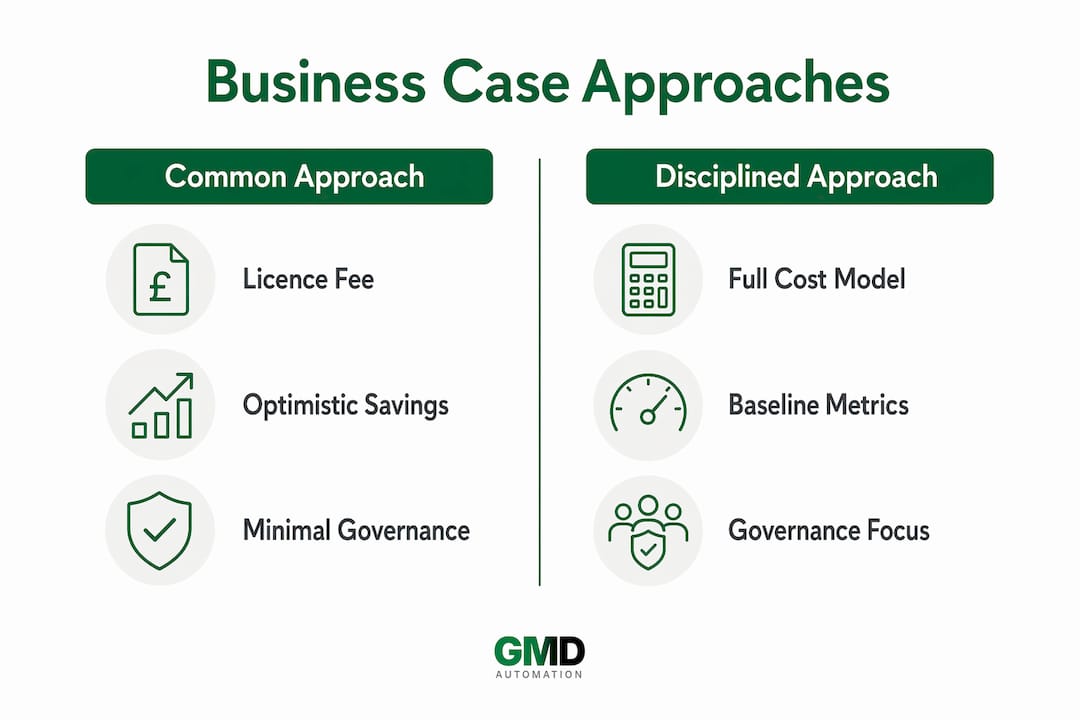
The table below contrasts the assumptions most business cases make with the disciplined approach finance teams actually respect.
| Assumption area | Common approach | Disciplined approach |
|---|---|---|
| Cost estimation | Licence fee only | Full programme cost including inference and governance |
| Benefit calculation | Hours saved at average salary | Adoption-adjusted output metrics tied to revenue or cost |
| Baseline measurement | Estimated retrospectively | Measured before deployment with controlled comparison |
| Risk modelling | Single optimistic scenario | Three scenarios with sensitivity analysis |
| Governance | Reviewed annually | Monthly KPI reviews with pre-agreed kill criteria |
Pro Tip: Ask your finance director what discount rate they apply to capital projects before you build your model. Aligning your ROI calculation to the organisation's standard hurdle rate removes one of the most common objections at board level.
Common pitfalls in AI automation ROI business cases
Most AI business cases fail not because the technology underperforms, but because the financial model was built on assumptions that were never tested. Around 90% of firms report that financial returns lag behind AI spending, and the root cause is almost always measurement failure rather than technical failure.
The most damaging pitfalls are:
- Overestimating adoption. A tool that 30% of eligible users actually use delivers 30% of the projected benefit, regardless of its technical capability.
- Ignoring inference and governance costs. These categories are invisible at the procurement stage but become the largest cost items in production at scale.
- Confusing productivity with monetised ROI. Hours saved do not equal money saved unless the organisation explicitly reallocates or reduces headcount, or demonstrably increases output with the same resource.
- Neglecting continuous measurement. A business case that is presented once and never revisited cannot detect when an AI system's accuracy degrades or when process changes have eroded the original benefit.
- Baseline anchoring failures. AI initiatives frequently fail financial scrutiny because benefits are not anchored to a pre-deployment baseline, making attribution impossible.
"Speed of AI deployment does not guarantee financial impact. Only a minority of organisations, those that Roland Berger labels 'Industrializers', consistently convert AI activity into predictable, measurable value."
The discipline to stop a failing project is as important as the discipline to start a promising one. Organisations that embed termination criteria into their governance frameworks recover capital faster and redeploy it to higher-performing initiatives. Those that do not tend to extend failing projects indefinitely, compounding losses while reporting activity as progress.
What do real AI automation ROI case studies show?
Two Forrester Total Economic Impact studies published in 2026 provide the clearest publicly available benchmarks for what disciplined AI automation can deliver.
| Platform | ROI | Payback period | Primary benefit |
|---|---|---|---|
| Zip AI procurement | 386% ROI | Under 6 months | 3.3% average spend savings across procurement workflows |
| Algolia AI search | 213% ROI | Under 6 months | $12 million annual revenue increase from improved search relevance |
Zip's result is particularly instructive for procurement and finance leaders. The 386% figure was not driven by a single large saving but by consistent 3.3% spend reductions compounded across a large transaction base. This is the pattern that finance committees find credible: a modest, repeatable improvement applied at scale rather than a headline transformation claim.
Algolia's case demonstrates the revenue expansion value driver in practice. The $12 million annual revenue increase came from improved search relevance converting more site visitors into buyers. The ROI model was anchored to a pre-deployment conversion baseline, which is precisely why the attribution held up under Forrester's scrutiny.
Finance-focused automation in contract review reports 50 to 70 percent time reductions with measurable compliance improvements. These gains translate to ROI only when the time freed is tracked against output metrics, not simply reported as hours saved.
The lesson across all three cases is consistent: the organisations that achieved verified ROI built their business cases around specific, baseline-anchored metrics and maintained governance throughout the deployment. You can explore further real-world automation outcomes across industries to see how this pattern repeats.
Pro Tip: When referencing published Forrester TEI studies in your own business case, note that these studies are commissioned by the vendor and represent best-case enterprise deployments. Use them as ceiling estimates, not as the central scenario for your own model.
Key takeaways
A credible AI automation ROI business case succeeds when it combines realistic cost modelling, baseline-anchored metrics, and pre-agreed governance criteria rather than relying on optimistic projections alone.
| Point | Details |
|---|---|
| Full cost modelling | Budget for inference, integration, governance, and change management, not licence fees alone. |
| Single value driver | Anchor the entire financial model to one explicit driver: cost, revenue, quality, or risk. |
| Adoption-adjusted benefits | Discount projected savings by realistic adoption and accuracy rates before presenting to finance. |
| Continuous governance | Set monthly KPI reviews and pre-agreed kill criteria to catch underperformance early. |
| Verified benchmarks exist | Zip's 386% ROI and Algolia's 213% ROI show what disciplined, baseline-anchored cases can achieve. |
Why most AI business cases miss the point entirely
I have reviewed a significant number of AI business cases over the years, and the pattern that undermines most of them is not a spreadsheet error. It is a fundamental confusion between demonstrating that AI works technically and proving that it creates financial value for the organisation.
Technical success is relatively easy to achieve. You can show that a model classifies documents with 92% accuracy or that a chatbot resolves 60% of queries without human intervention. What most teams fail to do is connect that technical performance to a line on the P&L. The gap between "the AI is working" and "the AI is paying for itself" is where most initiatives quietly stall.
The organisations that consistently close this gap, what Roland Berger calls Industrializers, treat AI as capital allocation rather than technology experimentation. They ask the same questions of an AI investment that they would ask of a new factory line or a distribution centre: what is the expected return, when does it pay back, and at what point do we stop if it does not perform? That framing changes everything about how a business case is built and how it is governed.
The other insight I would offer is that governance frameworks are not bureaucratic overhead. They are the mechanism by which you actually capture the value you projected. An AI system that is deployed and then left to run without measurement will drift. Accuracy degrades. Adoption plateaus. The process it was built to support changes. Without a governance cadence, you will not notice until the CFO asks why the savings never materialised. Embedding AI security and governance into the operational model from day one is not optional for organisations serious about ROI.
— Ravi
How Gmdautomation helps UK businesses build and realise AI ROI
Gmdautomation works with UK businesses to design and deploy AI automation systems that are built around measurable financial outcomes from the outset. Every engagement starts with a clear value driver, a baseline measurement, and a governance framework that tracks performance against the business case throughout the deployment lifecycle.
The subscription model Gmdautomation uses covers implementation, operation, maintenance, and ongoing optimisation under a single predictable monthly cost. This directly addresses the hidden cost problem that undermines most AI business cases, because every cost category is visible and fixed before deployment begins. For organisations that want to understand how AI pays for itself before committing, Gmdautomation offers a demo agent built on the same systems used in production. Visit Gmdautomation to see how UK businesses are achieving verified returns from AI automation without large upfront capital expenditure.
FAQ
What is an AI automation ROI business case?
An AI automation ROI business case is a structured financial document that quantifies the expected costs, benefits, and return on investment from deploying AI in a specific business process. It includes baseline metrics, a full cost model, adoption assumptions, and governance criteria.
What ROI can businesses realistically expect from AI automation?
Verified Forrester studies show returns of 213% to 386% over three years for well-governed deployments, with payback periods under six months. Conservative internal estimates should apply a 40 to 60 percent discount to pilot results before presenting to finance.
What are the most important AI efficiency metrics to track?
The most important metrics are adoption rate, cost per unit before and after automation, task accuracy rate, and downstream output metrics that confirm hours saved converted to actual business value. Baseline measurement before deployment is non-negotiable for credible attribution.
Why do most AI automation investments fail to deliver expected ROI?
Around 90% of firms report returns lagging behind AI spending because of superficial measurement, overestimated adoption, and failure to account for full programme costs. The absence of continuous monitoring means underperformance goes undetected until significant capital has been lost.
Can smaller UK businesses build a credible AI ROI business case without large investment?
Yes. The same principles apply regardless of scale: define one value driver, measure a baseline, account for all costs, and set governance criteria. Subscription-based AI automation models, such as those offered by Gmdautomation, remove upfront capital barriers and make the full cost model transparent from the start.