

Most business leaders assume AI adoption is fundamentally a technology problem. Buy the right model, deploy the right tool, and results follow. That assumption is why businesses choose AI partners rather than going it alone. The real barriers to AI value are organisational: data quality, governance gaps, skills shortages, and the stubborn difficulty of moving from a working pilot to enterprise-wide change. An experienced AI partner doesn't just supply technology. They bridge the gap between what AI can do and what your business can actually sustain at scale.
Table of Contents
- Key takeaways
- Why businesses choose AI partners over going alone
- Strategic benefits of AI partnerships
- Governance, compliance, and security through AI partners
- Workforce readiness and sustained AI adoption
- Orchestrating AI economics: model deployment and data structuring
- My honest view on choosing the right AI partner
- How Gmdautomation supports UK businesses as AI partners
- FAQ
Key takeaways
| Point | Details |
|---|---|
| Partners solve more than tech problems | The biggest AI adoption barriers are governance, skills, and data quality, not model selection. |
| Cost reductions are measurable | AI-driven process transformation cuts costs by 20% on average, rising to 29% in financial services. |
| Governance must be embedded, not added | Partners who build compliance into platforms from the start reduce risk far more than afterthought approaches. |
| Workforce enablement determines scale | Without change management baked into the partnership, most AI programmes stall well beyond the pilot stage. |
| Orchestration unlocks AI economics | Routing tasks to the right model based on risk and cost is as important as choosing the right model in the first place. |
Why businesses choose AI partners over going alone
The instinct to build AI capability in-house is understandable. But the evidence tells a different story. Around 30% of firms cite lack of usefulness as their primary barrier to AI adoption, while a further 20% point to implementation failures: system incompatibility, skill shortages, and poor data infrastructure. These are not technology failures. They are organisational ones.
The typical pattern looks like this. A business runs a proof-of-concept. It works well enough to get internal approval. Then the project stalls when the team tries to connect the AI to live data systems, train staff to trust its outputs, or get legal sign-off on the outputs it produces. Without a partner who has seen this pattern dozens of times, the pilot simply sits there, neither cancelled nor expanded.
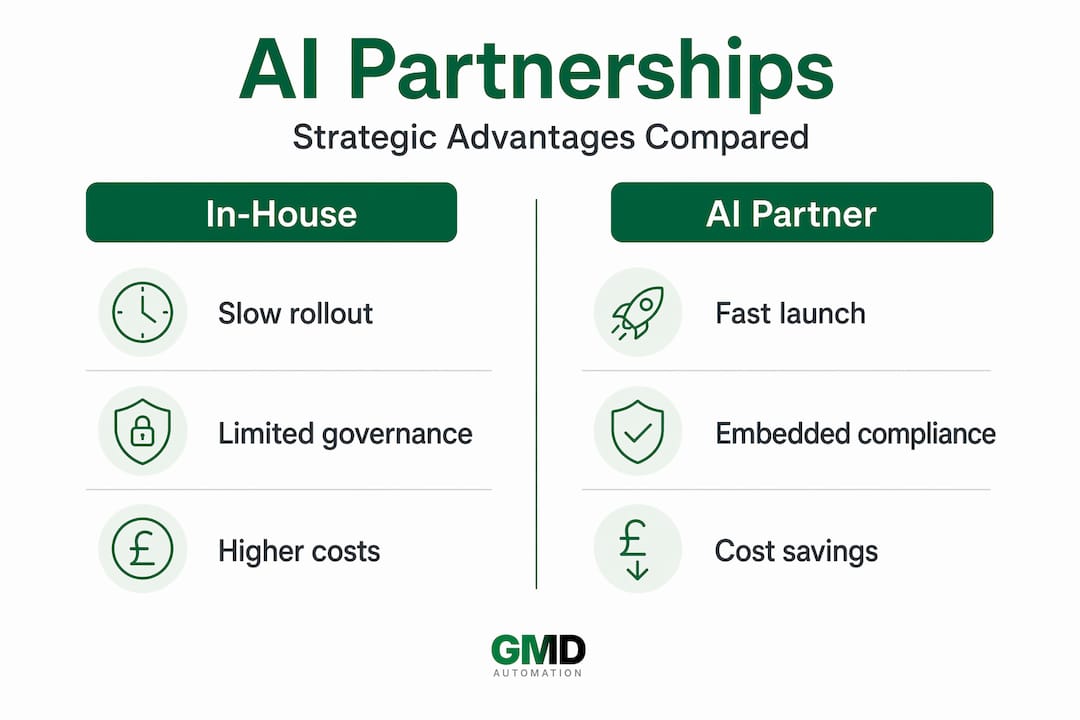
AI partners bring the implementation architecture that most internal teams lack. That includes data pipeline design, system integration, governance frameworks, and the kind of change management experience that distinguishes a pilot to production journey from a failed experiment.
- Data readiness: Partners audit existing data quality, identify gaps, and structure inputs before deployment begins.
- System compatibility: Experienced partners know how to connect AI tooling to legacy infrastructure without requiring full system replacement.
- Skills transfer: Structured onboarding and documentation reduce dependency on external support over time.
- Risk reduction: Proven deployment frameworks mean fewer surprises during live rollout.
Pro Tip: Before selecting an AI partner, ask them specifically how they handle data quality issues discovered mid-implementation. Their answer will tell you whether they have real delivery experience or just sales confidence.
Strategic benefits of AI partnerships
The business case for partnering with AI providers is not theoretical. PwC benchmarking shows average cost reductions of 14% to 29% depending on sector, with decision quality improvements of 83% to 88% in enterprises that deploy AI at scale. Those numbers don't come from deploying a chatbot. They come from redesigning workflows with a partner who understands both the technology and the business process.
The distinction matters enormously. Value derives not from layering AI on top of legacy processes but from redesigning workflows holistically with a partner who can see what needs to change and what needs to stay. Most internal teams are too close to existing processes to challenge them objectively.
"Organisations that achieve enterprise AI success select partners capable of institutionalising data governance, security, and change management, not just pilot projects." — IDC
| Benefit | Without an AI partner | With an AI partner |
|---|---|---|
| Time to production | 12 to 18 months typical | 3 to 6 months with proven frameworks |
| Governance coverage | Patchy, often added post-deployment | Embedded from day one |
| Cost optimisation | Ad hoc, difficult to attribute | Structured, benchmarkable against industry |
| Workforce adoption | Slow, driven by individual enthusiasm | Managed through formal enablement programmes |
| Scalability | Limited by internal capacity | Designed for growth from the outset |
The AI collaboration benefits that persist over time are the ones built on redesigned processes rather than bolt-on tools. That requires a partner relationship, not a vendor transaction.
Governance, compliance, and security through AI partners
Regulated industries face a specific challenge. The EU AI Act now requires organisations to maintain an AI registry, document decision logic, and demonstrate ongoing compliance with risk classifications. Doing this retrospectively is costly and difficult. Doing it with the right partner from the start is far more manageable.
The principle that embedding governance into delivery platforms from the outset enhances both productivity and cyber resilience is no longer a theoretical claim. It is the operating model of the most successful enterprise AI deployments. When governance is built into the platform layer, compliance becomes a continuous output rather than a periodic audit.
Partners who specialise in enterprise AI security bring structured frameworks for access control, data lineage, audit trails, and incident response. These are not optional extras in a regulated environment. They are the conditions under which AI adoption is permitted at all.
Key governance advantages that experienced AI partners provide include:
- Audit trails by default: Every AI decision or output is logged against the data inputs and model version that produced it.
- Role-based access controls: Data exposure is limited according to user role and business function, reducing breach risk significantly.
- EU AI Act readiness: Partners maintain compliance documentation and risk classifications as the regulatory environment evolves.
- Incident response planning: Pre-built protocols for model drift, data poisoning, and unexpected output behaviours are included in partnership agreements.
Organisations that achieve enterprise AI success do so by selecting partners who treat governance as infrastructure, not as a reporting obligation.
Workforce readiness and sustained AI adoption
Technology rarely fails enterprise AI programmes. People do. Not through incompetence, but because change management is consistently underestimated in scope and budget. A workforce that doesn't trust AI outputs, doesn't understand how to collaborate with AI tools, or simply hasn't been trained will find ways to work around the system. That phenomenon wastes both the investment and the opportunity.

The Microsoft and EY $1B initiative to help clients scale AI enterprise-wide is instructive precisely because it places workforce enablement at the centre of the model, not at the edges. Integrated change management is what separates AI programmes that scale from those that plateau after the initial deployment.
Here is what a structured workforce enablement approach looks like in practice:
- Baseline assessment: Partners map current skill levels, identify AI-adjacent roles, and segment the workforce by adoption readiness before any deployment begins.
- Phased training: Role-specific training is delivered in stages aligned with deployment milestones, not as a single pre-launch event.
- Champion networks: Internal advocates are identified and supported by the partner to sustain adoption momentum between formal training cycles.
- Feedback loops: Regular structured reviews capture where staff are struggling to trust or use AI outputs, feeding directly back into model and interface refinements.
- Ongoing enablement: As AI capabilities expand, the partnership agreement includes continuous upskilling rather than treating training as a one-time deliverable.
Pro Tip: Ask prospective AI partners to show you their workforce enablement methodology before you ask about model performance. If they don't have one, that tells you everything.
Orchestrating AI economics: model deployment and data structuring
Here is the insight that most discussions of AI partnerships miss entirely. The orchestration layer sitting between AI model vendors and enterprise deployments is arguably more important than the models themselves. Without it, businesses either over-spend by routing every task through expensive frontier models, or under-deliver by applying lightweight models to high-consequence decisions.
Effective orchestration means routing low-volume, high-stakes tasks to advanced reasoning models, while directing high-volume, lower-risk tasks to faster, cheaper alternatives. The cost and risk optimisation this enables is substantial, but it requires a partner with the technical architecture to implement it, and the business understanding to map tasks to the right risk tier.
| Task type | Appropriate model tier | Primary driver |
|---|---|---|
| High-volume document classification | Lightweight, fast model | Cost efficiency |
| Contract review and legal summarisation | Advanced reasoning model | Accuracy and risk |
| Customer query routing | Mid-tier model | Speed and reliability |
| Financial anomaly detection | Advanced model with audit trail | Compliance and trust |
| Internal knowledge search | Lightweight retrieval model | Volume and latency |
Alongside orchestration, AI-ready data governance requires partners to implement metadata, data lineage, quality signals, and policy layers that create what Gartner describes as a context layer. This is the infrastructure that allows AI agents to act with genuine business understanding rather than simply pattern-matching on available data. It is rarely built well in-house. It is the kind of capability that separates a genuine AI technology partnership from a subscription to a software tool.
My honest view on choosing the right AI partner
I've seen organisations spend eighteen months selecting an AI model and thirty days selecting the partner responsible for deploying it. That ratio is backwards, and it's why so many AI programmes deliver disappointing results.
In my experience, the businesses that achieve lasting value from AI partnerships are the ones that evaluate partners on delivery methodology, governance architecture, and workforce enablement credentials, rather than on the impressiveness of their demo environment. Any partner can demonstrate a compelling prototype. Very few can show you a client who moved from pilot to enterprise-wide deployment in six months and maintained that performance a year later.
What I've learned is that the most honest signal of a capable partner is their willingness to discuss failure. Ask them what went wrong on their last three implementations and what they changed as a result. The ones who answer that question specifically and without defensiveness are the ones worth talking to seriously.
The strategic case for AI adoption is well established. The tactical question of who executes it with you is where most leaders under-invest their attention. That is where the real decision lives.
— Ravi
How Gmdautomation supports UK businesses as AI partners
If this article has clarified what to look for in a genuine AI partnership, Gmdautomation is built around exactly those principles. UK businesses working with Gmdautomation's AI automation get enterprise-grade deployment with governance embedded from day one, a predictable monthly subscription that covers implementation, maintenance, and optimisation, and zero upfront capital commitment.
Gmdautomation deploys AI systems designed for security, compliance, and scale, with onboarding frameworks that bring your workforce along rather than leaving them behind. Whether you are moving from a stalled pilot or evaluating your first enterprise deployment, the team works as a delivery partner, not just a software vendor. Explore what a genuine AI technology partnership looks like for your organisation.
FAQ
Why do businesses choose AI partners rather than building in-house?
Most in-house teams lack the deployment architecture, governance frameworks, and change management expertise needed to move AI from pilot to production. Around 20% of firms report implementation failures including skill shortages and system incompatibility as their primary AI barriers.
What are the main benefits of AI partnerships for enterprises?
The primary benefits include faster time to production, measurable cost reductions, embedded governance, and structured workforce enablement. PwC research shows cost improvements of 14% to 29% in organisations that deploy AI through structured partnerships.
How do AI partners help with compliance and regulation?
Experienced partners embed audit trails, access controls, and risk documentation into the deployment platform from the outset, making compliance a continuous output rather than a retrospective exercise. This is particularly important under the EU AI Act, which requires ongoing risk classification and AI registry maintenance.
What is AI orchestration and why does it matter?
Orchestration refers to the layer that routes different tasks to appropriate AI models based on cost, risk, and performance requirements. Without it, businesses either overspend on frontier models for simple tasks or under-invest in capability for high-stakes decisions, both of which erode return on investment.
How do businesses know if an AI partner is genuinely capable?
Ask for specific evidence of deployments that progressed from pilot to enterprise scale, and ask directly what went wrong during those implementations. IDC research confirms that partners who institutionalise governance, security, and change management, not just pilots, are the ones that deliver sustained enterprise value.