

Enterprise AI automation is the strategic integration of artificial intelligence into core business workflows to enable intelligent decision-making, predictive analytics, and continuous operational optimisation at scale. Unlike point solutions or isolated software tools, it represents a system-level capability that touches every layer of an organisation. Enterprise AI automation integrates machine learning, natural language processing, generative AI, and orchestration frameworks into governed workflows, producing outputs that adapt and improve over time. Platforms such as Red Hat AI, IBM Watson, and AtScale have each demonstrated how this approach moves beyond simple task automation into genuinely intelligent process management. For business leaders weighing digital transformation investments, understanding what enterprise-grade AI actually involves is the prerequisite to deploying it well.
What is enterprise AI automation and how does it work?
Enterprise AI automation is best understood as an end-to-end operational system, not a collection of individual models. Its architecture combines four distinct layers: AI capabilities, system integration, orchestration, and governance. Each layer depends on the others, and weakness in any one of them undermines the whole.
The AI capabilities layer includes machine learning models that identify patterns in historical data, NLP systems that interpret unstructured text and voice inputs, and generative AI that produces content, summaries, or recommendations on demand. These models do not operate in isolation. They are connected to enterprise systems such as ERP platforms, CRM databases, and document management tools through API integration layers, which allow AI to read, write, and act on live business data.

Above the integration layer sits the orchestration layer, which Accenture describes as an "intelligent digital brain" that coordinates multiple AI models and agents, selecting between them based on accuracy, cost, and performance requirements. Agents within this layer act as active neurons: perceiving inputs, planning responses, and executing actions across connected systems. This is what separates enterprise AI from a chatbot or a single-purpose classifier.
The foundation beneath all of this is governed enterprise data. Consistent business definitions and data classification standards are what allow AI models to produce reliable, auditable outputs. Without them, even sophisticated models generate inconsistent results that erode trust and create compliance risk.
- Machine learning: Identifies patterns, forecasts demand, flags anomalies
- Natural language processing: Interprets contracts, customer queries, and internal communications
- Generative AI: Drafts reports, summarises data, generates code or content
- Orchestration agents: Route tasks, coordinate models, and manage workflow sequencing
- Governance layer: Controls access, enforces policy, and captures audit trails
Pro Tip: When evaluating enterprise AI platforms, ask vendors specifically how their orchestration layer handles model selection and failover. A platform that cannot explain this clearly is likely routing all requests to a single model, which limits both performance and cost control.
How does enterprise AI differ from traditional automation?
Traditional business process automation, as implemented through tools like robotic process automation platforms, operates on static, rule-based logic. A rule-based system follows a fixed decision tree: if condition A is met, execute action B. It cannot handle exceptions, learn from new data, or adapt when business conditions change. This makes it effective for highly predictable, repetitive tasks but brittle in complex or variable environments.
Enterprise AI automation learns from data and adapts dynamically, which enables continuous improvement and better handling of evolving business workflows. When an AI-powered invoice processing system encounters a new supplier format it has not seen before, it can infer the correct field mappings from context rather than failing or requiring manual intervention. That adaptive capability is the defining difference.
| Dimension | Traditional automation | Enterprise AI automation |
|---|---|---|
| Logic type | Static, rule-based | Adaptive, data-driven |
| Exception handling | Fails or escalates | Infers and adapts |
| Learning capability | None | Continuous from feedback |
| Decision complexity | Simple, binary | Multi-variable, predictive |
| Cross-system scope | Single workflow | Orchestrated across platforms |
The practical implication for decision-makers is significant. Traditional automation requires extensive rule-writing and maintenance every time a process changes. Enterprise AI automation requires investment in data quality and governance upfront, but then scales without proportional increases in maintenance overhead. For organisations managing hundreds of processes across multiple business units, that difference in scaling economics is decisive.
Pro Tip: Do not retire your existing rule-based automation immediately. The most effective enterprise AI deployments use rule-based logic for high-certainty, low-variability tasks and AI for everything that requires judgement or pattern recognition. Mixing both reduces cost and risk.
What governance practices are essential for scaling enterprise AI?
Governance is the single most common reason enterprise AI pilots succeed but production deployments fail. A proof-of-concept running on clean, curated data with a small team monitoring it closely will perform well. The same system deployed across thousands of daily transactions, multiple business units, and varying data quality will degrade without a formal governance structure.
Governance components include identity management, data classification, model selection criteria, auditability, and policy enforcement. Each of these must be addressed before scaling, not after problems emerge. The practical mechanism for enforcing governance at scale is the gateway: a control point that sits between users or applications and the AI models they access.
Gateways serve as the central control plane for security, routing, audit capture, and cost controls. Rather than each application implementing its own security and logging, the gateway centralises these functions, which reduces complexity and prevents gaps. For UK enterprises operating under GDPR and sector-specific regulations, this centralisation is not optional. It is the architecture that makes compliance tractable.
Beyond gateways, scaling enterprise AI requires four operational practices:
- Continuous monitoring: Track model outputs in real time to detect performance degradation before it affects business decisions.
- Observability frameworks: Without observability, AI systems degrade unnoticed, producing unreliable outputs that risk business operations. Observability tools surface model drift and anomalies before they cause harm.
- Human-in-the-loop feedback: Closed-loop systems incorporating human signals and automatic quality assessment are fundamental to operational AI maturity. They ensure models improve rather than drift.
- Lifecycle management: Every AI model requires a managed lifecycle from creation through to retirement. Security patches, retraining schedules, and deprecation plans must be defined before deployment, not improvised later.
"Scaling enterprise AI requires strong governance to answer critical questions about data access, model usage, and auditability, avoiding repetitive pilot challenges." — Axiom Studio
For leaders building an enterprise AI security architecture, the governance layer is not a compliance checkbox. It is the operational infrastructure that determines whether AI delivers consistent value or becomes a liability.
What business benefits does enterprise AI automation deliver?
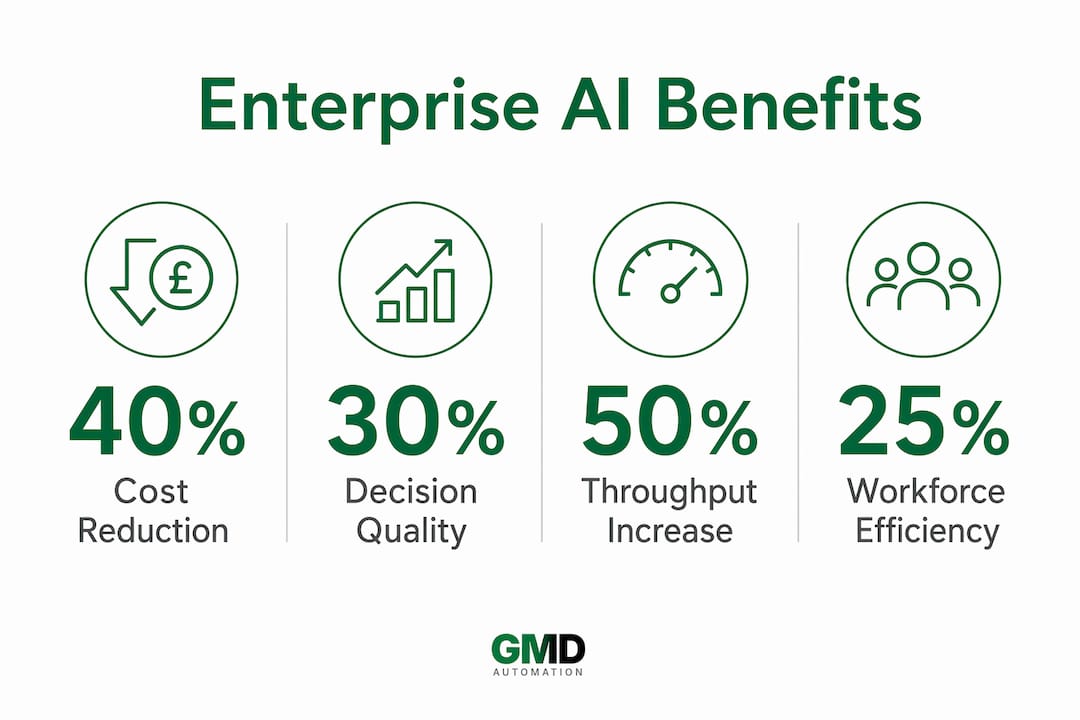
The business case for enterprise AI automation rests on four categories of measurable impact: cost reduction, decision quality, operational throughput, and workforce focus.
Cost reduction is the most immediately quantifiable. Invoice processing automation can reduce manual data entry by up to 90%, which in a mid-sized finance function translates to significant headcount reallocation rather than redundancy. The same principle applies to contract review, compliance checking, and customer query triage. Tasks that previously required skilled staff to execute repetitively are handled by AI, freeing those staff for higher-value work.
Decision quality improves because AI systems process far more variables than human analysts can hold in working memory simultaneously. A demand forecasting model drawing on sales history, macroeconomic indicators, supplier lead times, and seasonal patterns will consistently outperform spreadsheet-based forecasting. The improvement is not marginal. It compounds across every decision that depends on that forecast.
Operational throughput scales without proportional cost increases. A customer support AI agent handles ten thousand queries with the same infrastructure cost as one thousand. For organisations experiencing growth or seasonal demand spikes, this elasticity removes a structural constraint that previously required either overstaffing or service degradation.
The workforce impact is perhaps the most strategically significant. When AI handles repetitive, data-intensive tasks, human teams shift their attention to relationship management, strategic analysis, and creative problem-solving. These are the activities that differentiate organisations competitively. Real-world AI automation implementations consistently show that the most valuable outcome is not cost savings alone but the reallocation of human capability to work that machines cannot replicate.
Across sectors from financial services to manufacturing, industries benefiting from AI automation in 2026 share a common pattern: the organisations achieving the greatest returns are those that treated AI automation as a system-level transformation rather than a departmental tool deployment.
Key takeaways
Enterprise AI automation succeeds only when AI capabilities, system integration, orchestration, and governance are built as a unified operational system rather than assembled as separate components.
| Point | Details |
|---|---|
| System-level design | Enterprise AI requires orchestration, integration, and governance working together, not isolated models. |
| Governance before scaling | Identity, data classification, gateways, and lifecycle management must be in place before production deployment. |
| Adaptive over rule-based | AI automation handles exceptions and learns from data; traditional automation cannot adapt to change. |
| Measurable business impact | Invoice automation alone can cut manual data entry by up to 90%, with compounding gains across decisions. |
| Continuous improvement | Closed-loop feedback and observability frameworks are what separate reliable AI systems from degrading ones. |
Why most enterprise AI projects stall before they scale
Most enterprise AI projects I have observed do not fail because the technology is wrong. They fail because the organisation treated the AI model as the product. The model is not the product. The system around the model is the product.
I have seen well-funded teams deploy genuinely capable models that produced excellent results in testing, then watched those same models degrade quietly over six months in production because nobody had built observability into the architecture. The outputs drifted. The business kept trusting them. The damage was invisible until it was not.
The other pattern I find consistently underestimated is data governance. Leaders often assume their data is good enough because their existing reports look reasonable. Enterprise AI exposes every inconsistency that human analysts were silently correcting. When a model encounters conflicting business definitions across two data sources, it does not ask for clarification. It makes a choice, and that choice may be wrong in ways that are very difficult to trace.
My recommendation to any business leader evaluating enterprise AI automation is this: before you ask what AI can do for your organisation, ask whether your data infrastructure and governance practices are ready to support it. The technology is mature. The organisational readiness is usually the constraint. Start with a single, well-governed process, instrument it properly, and build from there. The organisations that scale successfully are the ones that treated their first deployment as infrastructure, not a pilot.
— Ravi
How Gmdautomation helps UK businesses deploy enterprise AI
Gmdautomation builds and deploys enterprise AI automation systems specifically for UK businesses, with a model designed to remove the barriers that stall most projects. There are no upfront capital costs. Implementation, operation, maintenance, and ongoing optimisation are covered under a single monthly subscription, which means your finance team can plan with certainty rather than manage unpredictable project expenditure.
Every system Gmdautomation deploys is built with the governance, security, and observability practices described in this article. Scalability is designed in from day one, not retrofitted when growth demands it. If you are ready to move from evaluating enterprise AI to deploying it, explore AI automation solutions built for the operational realities of UK enterprises.
FAQ
What is enterprise AI automation in simple terms?
Enterprise AI automation is the use of artificial intelligence to handle complex business processes across an organisation, combining machine learning, NLP, and orchestration to make decisions, predict outcomes, and improve over time without manual intervention.
How does enterprise AI differ from standard automation tools?
Standard automation follows fixed rules and cannot adapt to new inputs. Enterprise AI automation learns from data patterns, handles exceptions, and continuously improves, making it suitable for complex, variable business processes that rule-based systems cannot manage.
What governance does enterprise AI require?
Effective enterprise AI governance includes identity management, data classification, policy enforcement through gateways, real-time observability, and lifecycle management covering model updates and retirement. These controls are what allow AI systems to operate reliably at scale.
What business processes benefit most from enterprise AI automation?
Invoice processing, customer query handling, demand forecasting, contract review, and compliance monitoring are among the highest-return applications. These processes share a common trait: high volume, data-intensive, and previously dependent on repetitive human effort.
Is enterprise AI automation suitable for mid-sized UK businesses?
Yes. Subscription-based deployment models, such as those offered by Gmdautomation, make enterprise-grade AI accessible without significant capital expenditure, allowing mid-sized organisations to deploy production-ready systems with predictable monthly costs and built-in support.