

AI call centre automation uses speech recognition, natural language understanding and large language models to handle or assist customer contacts across voice and digital channels, resolving repeatable enquiries automatically and giving human agents real-time guidance on the rest. The measurable payoff is fewer contacts needing full agent handling and faster resolution on the ones that do. The right first move isn't a platform purchase. It's a small pilot on one journey, with clear go/no-go thresholds set before you switch it on.
TL;DR:
- Successful AI call center pilots should focus on one journey and channel at a time, with clear success thresholds and a quick rollback plan.
- Core technology components include speech recognition, natural language understanding, dialogue management, and integration with existing telephony and CRM systems.
- Automation works best for high-volume, well-defined inquiries like order status or scheduling, avoiding overly complex or emotive calls.
- Key metrics for evaluating pilot success are completion rate, repeat contact rate, service level, customer satisfaction, and error or rollback rates.
- Operating a reliable AI system requires careful governance, including confidence thresholds, audit trails, compliance measures, and a managed service option to reduce operational overhead.
Table of Contents
- What does call centre automation with AI actually cover?
- Which use cases are companies actually automating?
- What technology sits underneath a working system?
- What return should decision-makers actually expect?
- How should a pilot actually be structured?
- What integration and architecture choices actually matter?
- How do you know if the pilot is actually working?
- What are the main risks and how do you govern them?
- Practical pilot checklist before you go live
- Priorities that actually move the needle
- How Gmdautomation reduces the risk of getting this wrong
- Sources
What does call centre automation with AI actually cover?
"Call centre automation AI" is the search term, but the industry itself splits the work into distinct layers, and mixing them up is the fastest way to buy the wrong thing. Contact-centre AI is the umbrella term covering any AI applied to customer contact handling, voice or digital. Inside that umbrella sit several different tools.
- Autonomous AI agents hold a full conversation and complete a task end to end, such as rebooking a delivery or resetting a password, with no human involved unless something goes wrong.
- Agent assist sits alongside a human adviser, listening to the call and surfacing suggested answers, policy snippets or next-best actions in real time.
- Conversational IVR replaces the old "press 1 for billing" menu with natural speech, so a caller can just say what they want and get routed correctly first time.
Voice is where most of the difficulty lives. Text-based chat gives you a transcript to reason over instantly; voice needs accurate speech recognition first, then language understanding, then a spoken reply that sounds natural, all within the second or two a caller will tolerate before assuming the system hasn't understood them. That's why a lot of automation programmes that work well in chat stumble when the same logic gets pointed at a phone line.
Set expectations accordingly. AI-driven call handling isn't a replacement for every human interaction. It's a way to lift high-volume, well-defined enquiries off agents' desks so the harder, more emotive calls get a person's full attention. Businesses that assume it will handle everything on day one are usually the ones that abandon the project by month three.
Which use cases are companies actually automating?
Not every call is a candidate for automation, and not every business starts in the same place. The journeys getting automated successfully tend to share one trait: they're repeatable, and the "correct" outcome is well-defined.
- Self-service voice and chat for high-volume enquiries. Order status, opening hours, balance checks, appointment rescheduling. These make up a disproportionate share of inbound volume in most operations and have a single right answer, which makes them the natural starting point.
- Agent assist for live calls. Real-time transcript analysis suggests responses, flags compliance requirements and generates a call summary automatically at wrap-up, cutting the after-call work that quietly eats into average handle time.
- Autonomous transactions. Bookings, cancellations, address changes, simple account updates. These need integration into back-end systems rather than just a knowledge base, because the AI has to actually change something, not just answer a question.
- QA, analytics and proactive outreach. AI can score 100% of calls against compliance and quality criteria instead of the 2 to 5% a human QA team typically samples, and the same technology increasingly drives outbound qualification calls, chasing renewals or confirming appointments before a human ever gets involved. Businesses exploring how to automate customer service workflows usually start with one of these four categories, not all of them at once.
Outbound use cases carry their own regulatory weight, particularly around consent and calling hours, and deserve a compliance-first pilot design rather than a "just switch it on" approach, something covered in more detail in guidance on outbound calling AI.
What technology sits underneath a working system?
Four components decide whether an automation platform actually functions in production, and technical buyers should interrogate each one before signing anything.
- ASR and NLU. Automatic speech recognition converts audio to text; natural language understanding then works out intent from that text. Accuracy on both drops sharply with accents, background noise and interruptions, so demo-day performance on a clean line tells you very little about a real call centre floor.
- Dialogue management. Mature systems use a hybrid model: deterministic, rule-based flows for anything regulated or high-stakes (payments, identity verification), with a large language model handling the flexible, conversational parts. Pure LLM freeform generation without guardrails is where hallucinated answers creep in.
- Retrieval-augmented generation. Rather than letting a model invent an answer, RAG grounds every response in your actual knowledge base or policy documents, pulling the relevant passage before generating a reply. This is the difference between a system that quotes your refund policy correctly and one that confidently invents a plausible-sounding but wrong one.
- Routing, telephony and CRM integration. The AI needs to sit inside your existing carrier or cloud contact-centre platform, pull customer context from the CRM before the conversation starts, and hand off cleanly when it can't help. Intelligent call routing that reads intent and sentiment before connecting a caller does more for perceived service quality than almost any other single feature.
Underneath all of it, insist on observability and per-resolution audit trails: a log of what the system said, what data it accessed and why it made the decision it did, on every single interaction. Without that, you can't investigate a complaint, prove compliance, or work out why a metric moved.
What return should decision-makers actually expect?
Five metrics anchor most contact-centre business cases, and getting the definitions straight matters more than most people assume.
- First Contact Resolution (FCR): the percentage of enquiries solved without a follow-up contact.
- Average Handle Time (AHT): how long a contact takes from start to finish, agent time plus any automated portion.
- Deflection rate: the share of contacts resolved by self-service or automation with no human agent required.
- Cost per contact: total operating cost divided by contact volume, the number that ultimately justifies the investment.
- CSAT: customer satisfaction, usually a post-contact survey score, and the metric most likely to catch a problem the other four miss.
Automation typically shifts workforce mix rather than simply cutting headcount: fewer agents on repetitive first-line queries, more capacity on complex escalations and retention work, which is where human judgement earns its keep.
Reported resolution rates vary widely. Some vendor case notes report varied autonomous resolution rates for mature deployments, depending on journey and definition. That range depends heavily on how "resolution" is defined and which journeys were included, so treat any single number as a starting hypothesis to test on your own traffic, not a guarantee.
Forrester's guidance on this is worth building into any model from day one: ROI calculations for CX transformation should pair operational metrics with customer outcome data, not just cost savings. A system that cuts handle time but tanks CSAT hasn't actually delivered a return. For a UK-specific view on how these numbers typically flow through a business case, see AI automation business benefits for UK firms.
How should a pilot actually be structured?
The single biggest mistake in contact-centre AI rollouts is trying to automate too much, too fast, across too many channels. Sierra's operating guide is blunt about the fix: baseline one journey and one channel, define your evidence window and success thresholds before launch, without specifying exact durations, and only expand once the numbers actually clear the bar you set.
Before you touch a dial, get these in place:
- A named journey owner accountable for the pilot's outcomes, not a committee.
- An operating review group that meets weekly during the pilot, pulling in ops, IT and compliance.
- A defined evidence window (commonly two to four weeks of live volume) long enough to smooth out day-to-day noise.
- Explicit go/no-go thresholds agreed in advance: minimum FCR, maximum CSAT drop tolerated, maximum error rate before rollback.
- A rollback procedure that can be triggered within minutes, not days, if the thresholds are breached.
Testing has to go beyond happy-path scripts. Run it against poor voice quality (mobile lines, background noise), edge-case account states (suspended accounts, disputed charges), and every transfer and fallback path, deliberately trying to break it before customers do. Improving routing and giving agents fuller context before a handoff measurably shortens customer wait times, but only if the fallback itself is tested as rigorously as the happy path.
Governance isn't a document you write once and file away. It needs an audit trail on every resolution, clear operator controls to pause or override the system instantly, and a named owner for incident response when something goes wrong at 2am on a bank holiday weekend.
Pro Tip: Run your pilot's rollback test before your pilot's success test. If you can't cleanly revert to human handling within minutes, you're not ready to go live, no matter how good the demo looked.
What integration and architecture choices actually matter?
Reliability and time to value hinge on a handful of architecture decisions made early, not on the AI model you pick.
- Telephony and carrier integration. Confirm your cloud contact-centre platform or carrier supports the connectors the AI vendor needs; retrofitting this later is expensive and slow.
- CRM and order-system wiring. The AI needs real-time API access to customer records and order systems, plus event-driven updates when something changes mid-call, not a nightly batch sync.
- Identity and authentication continuity. Context and authentication need to travel with the caller across every handoff, so a human agent picking up an escalated call sees the full history rather than starting from zero.
- Data retention and failover. Decide upfront how long call data and transcripts are kept, what happens on a platform outage, and how quickly you can fail back to fully human handling.
Some integrations are genuinely incremental, a chatbot bolted onto an existing knowledge base can go live in weeks. Others need deeper platform replacement, particularly where the current telephony stack simply can't pass the data an AI system needs. If your stack already handles email-based workflows, tools built for AI agents that manage inbox and email tasks illustrate how far this kind of integration now extends beyond voice alone. For a broader map of connection patterns, enterprise API integration approaches are worth reviewing before committing to a vendor's default architecture.
How do you know if the pilot is actually working?
Three categories of metric decide whether a pilot has earned the right to scale: completion (did the automated interaction actually resolve the enquiry), repeat contact (did the customer have to call back about the same issue), and service level (did queue times for everyone else improve or worsen while the pilot ran).
Baselines have to be measured before launch, not estimated from memory, and the evidence window needs enough volume to be statistically meaningful rather than a handful of anecdotal calls. Gartner's research is a useful reminder here: a majority of customer service channel transitions are high-effort for the customer, so a pilot metric that looks good on paper but pushes more people into a frustrating transfer isn't actually a win.
| Metric | What it tells you | Typical review cadence |
|---|---|---|
| Completion rate | Whether the AI resolved the enquiry without escalation | Daily during pilot |
| Repeat contact rate | Whether the resolution actually stuck | Weekly |
| Service level / queue time | Whether the pilot affected non-pilot traffic | Daily |
| CSAT / customer effort | Whether the experience felt acceptable to the customer | Weekly |
| Error / rollback rate | Whether the system stayed within safe operating limits | Daily |
Reporting should be role-based: operations leads need the daily dashboard, executives need the weekly trend line, and compliance needs the audit log on demand. Pairing this with dedicated analytics tooling built for AI-driven QA can catch drift in call quality before it shows up in a monthly CSAT report.
What are the main risks and how do you govern them?
Every automated system needs a defined fallback for the moments it can't cope: degraded voice quality, a misrouted call, or a knowledge base that simply doesn't have the answer. The safe response is always the same principle: hand off cleanly to a human with full context, never leave the caller stuck in a loop.
- Set confidence thresholds below which the system defers to a human automatically, rather than guessing.
- Keep a human-in-the-loop rule for anything touching payments, complaints or vulnerable customers.
- Maintain a full audit trail on every automated decision for compliance review.
- Test specifically for hallucination, bias in routing decisions, and transfer failures, not just for correct answers.
Call recording and data handling under UK GDPR need specific attention here, particularly around consent and retention. Guidance on UK call recording compliance is worth reading before any voice pilot goes live, not after.
Practical pilot checklist before you go live
Treat this as the minimum bar, not an aspirational list.
- Pre-pilot: confirm a named journey owner, the systems the AI needs to touch, a realistic sample volume, and sign-off from legal and data protection on the data being processed.
- Pilot runbook: document acceptance criteria and thresholds in writing, set up daily monitoring, define the rollback trigger and procedure, and agree a stakeholder update cadence before day one.
- Post-pilot: recalibrate thresholds based on what actually happened, adjust staffing to the new workforce mix, and use a written expansion decision template rather than a gut call.
A working demo agent built on production deployment infrastructure is a useful way to see this runbook applied in practice before committing your own team's time to building one from scratch.
Priorities that actually move the needle
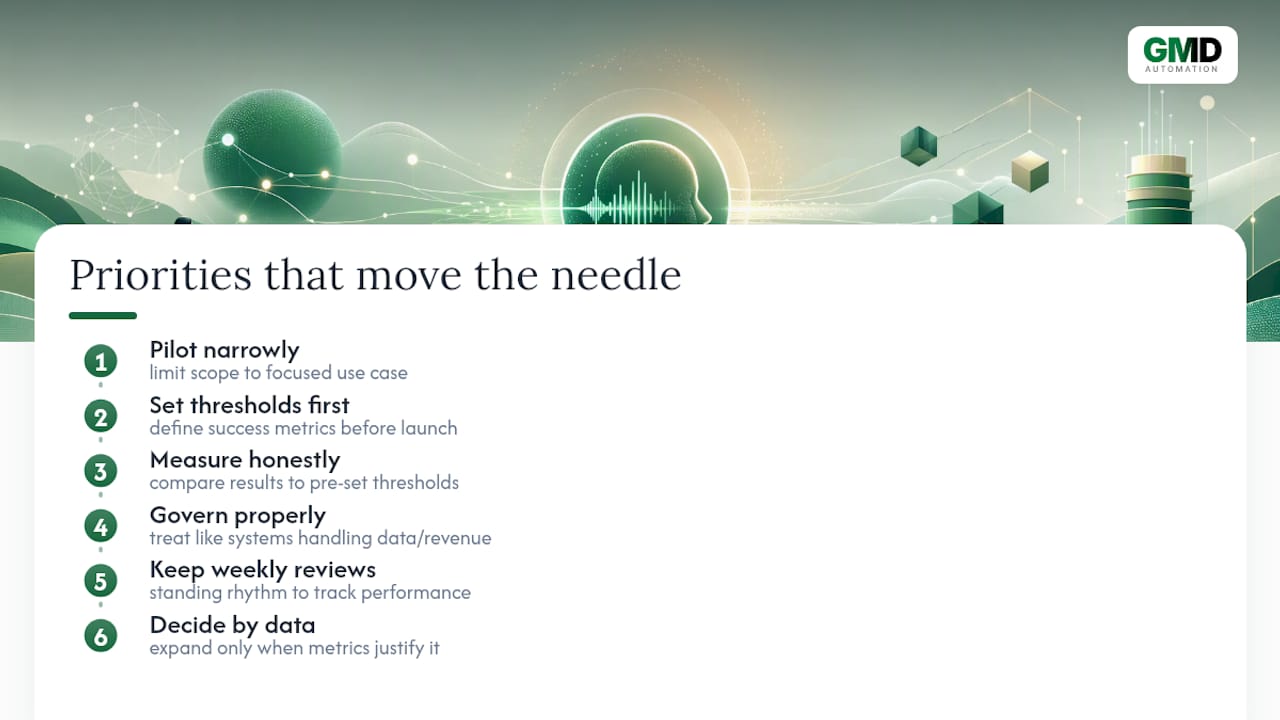
Most contact-centre AI conversations obsess over model choice and feature lists. That's the wrong focus. The organisations getting real value are the ones treating this as an operating change: pilot narrowly, measure honestly against thresholds set before launch, and govern it like any other system that touches customer data and revenue.
The habit worth building isn't a one-off pilot. It's a standing review rhythm, weekly at first, that keeps looking at completion rates and repeat contacts long after the excitement of launch has faded. Do that, and expansion becomes a data-backed decision rather than a hopeful one.
— Ravi
How Gmdautomation reduces the risk of getting this wrong
A managed service option is available for operations leaders who want the pilot discipline covered in this guide without building a governance team to manage it. The subscription typically covers implementation, live operation, and ongoing optimisation for a fixed monthly fee, often with no upfront capital spend and streamlined maintenance after going live.
That structure matters because most of the risk in contact-centre AI isn't the model, it's the operational overhead: monitoring thresholds, maintaining audit trails, handling incident response at odd hours, retraining when a knowledge base changes. A managed service model can fold operational overhead into one predictable monthly cost rather than leaving your team to staff it internally. Systems are designed for security and compliance from the start, with scaling handled as call volume grows rather than requiring a re-platform later.
If you want to see how a voice-led AI agent actually handles a live call before committing to a pilot, book a demo through the service provider's website and walk through the rollout plan with a specialist against your own journey data.
Sources
- Gartner newsroom — 62% of customer service channel transitions are high-effort
- Sierra — AI for call centers: an operating and rollout guide
- Microsoft UK Stories — customer service waiting times improvements