
AI call routing matches every caller to the resolver best suited to their query, in the time it takes to say a sentence, either resolving the call outright or sending it to the right human agent. Set up properly, it cuts wait times, slashes internal transfers, and lifts first-call resolution well above what a traditional IVR tree ever managed.
The immediate business case is straightforward:
- Fewer transfers, because the system reads intent before it picks a destination
- Shorter queues, since routine queries get resolved by an AI agent rather than queued for a human
- Higher first-call resolution, because whoever (or whatever) answers already has the caller's context
The reality check: an automatic call distributor has been routing calls by rule since the 1970s. What's changed is that the rules are now written by a model that reads intent and sentiment in real time, not by a static decision tree. Gmdautomation builds this as a managed layer on top of your existing telephony, and Ravi, who writes the technical notes referenced later in this piece, has watched the same integration mistakes sink otherwise promising pilots.
Key Takeaways
AI call routing works when intent detection, real-time CRM lookups, and transparent reporting operate together, not as separate bolted-on features.
| Point | Details |
|---|---|
| Resolve before you route | Let AI agents close routine, high-volume intents so those calls never enter the human queue at all. |
| Integration depth decides accuracy | API-level CRM/CTI integration is what separates a durable deployment from one that regresses within weeks. |
| Demand routing visibility | Insist on reporting that explains why a call routed a certain way, not just the outcome. |
| Pilot narrow, then expand | Start with two or three high-volume, low-complexity intents before wider rollout. |
| Managed deployment reduces risk | Gmdautomation offers a zero-upfront, subscription-based route to deploy AI call routing with CRM integration and ongoing tuning included. |
Table of Contents
- How does AI call routing work?
- What types of AI call routing exist?
- Which metrics prove AI call routing is working?
- What does integration and deployment actually require?
- What governance and monitoring does AI routing need?
- What does a managed AI routing deployment look like in practice?
- Ready to see AI call routing running on real infrastructure?
- A note from Ravi on what actually breaks these deployments
- Sources
How does AI call routing work?
The process runs in five stages, and each one is a point where a poorly built system can quietly lose accuracy.
- Greeting and speech capture. The call is answered, usually by a voice agent rather than a menu, and speech-to-text converts what the caller says into structured text within a second or two.
- Intent detection and sentiment scoring. A language model classifies what the caller wants (billing query, complaint, booking, sales enquiry) and simultaneously scores tone. An irritated customer repeating themselves scores differently to a first-time caller asking a simple question.
- Parallel data lookup. While intent is being classified, the system queries the CRM and any CTI record tied to the caller's number, pulling account status, recent tickets, or purchase history. This runs in parallel, not after, to avoid adding latency.
- Scoring and destination selection. A scoring engine weighs intent, sentiment, account value, and agent availability, then decides whether the call should be resolved by an AI agent on the spot, handed to a specific human specialist, or pushed into a workflow (a callback queue, for instance).
- Handover and logging. If a human picks up, they receive the context package instantly, not a transferred call with no notes. Once the call ends, the system logs the outcome and updates the CRM automatically, closing the loop for reporting.
This is where the "resolve or route" model matters. When the AI agent can close a routine interaction, such as an appointment change or a status check, that call never touches the human queue at all, which is where most of the operational saving comes from.
Pro Tip: Ask any vendor to show you the scoring logic behind a specific routing decision, not just the outcome. If they can't explain why a call went where it went, you won't be able to fix it when it goes wrong.
What types of AI call routing exist?
Not every call needs the same treatment, and the strongest deployments mix several routing methods rather than relying on one model for everything.
- Intent-based routing replaces the IVR menu entirely, listening to what the caller says and routing on meaning rather than keypad choices.
- Skills-based routing matches calls to agents with the right specialism and checks real-time availability before connecting, useful for technical support or regulated advice lines.
- Predictive or performance routing sends sales or renewal calls to the agent statistically most likely to convert that type of enquiry, a common tactic in outbound and retention teams.
- Sentiment and VIP routing flags distressed callers or high-value accounts for priority handling or immediate escalation to a senior agent.
- Self-service AI agents handle high-volume transactional calls, such as order status or appointment booking, without involving a human at all.
Genuine omnichannel routing applies the same intent-scoring logic across voice, chat and messaging, so a customer who starts on WhatsApp and calls later gets picked up with the same context rather than starting again.
Which metrics prove AI call routing is working?
Five figures tell you almost everything: first-call resolution (FCR), average handle time (AHT), abandonment rate, automation rate, and customer satisfaction (CSAT). Watch these together, not one in isolation, because a vendor chasing a higher automation rate can quietly let FCR slip if resolution quality isn't monitored.
The baseline problem: most improvement claims from vendors are meaningless without knowing what you started from. A 20% reduction in average handle time sounds impressive until you learn the baseline was already unusually slow because of a broken legacy IVR.
What to demand before you sign anything:
- A pre-deployment baseline for FCR, AHT, and abandonment rate, measured over at least a full month
- Reporting that shows why a call routed where it did, not just that it did, since visibility into routing logic is what lets your team fix misroutes rather than guess at them
- A automation rate target scoped to specific intent types, not a blanket percentage across all call volume
Realistic targets vary by sector, but a contact centre moving from IVR to AI routing typically expects meaningful reductions in abandonment and a visible rise in first-call resolution within the first full reporting cycle, provided the CRM integration is solid enough to give the router something to work with.
What does integration and deployment actually require?
Integration depth, not the number of features on a data sheet, is what determines whether AI call routing performs on day one or degrades within a few weeks. Vendors sometimes advertise deployments measured in hours, but routing accuracy depends on API-level CRM integration giving the AI customer history before an agent ever picks up.
A practical checklist for IT teams evaluating a router:
- Confirm API-first connectivity with your existing PBX and CTI stack, not a bolt-on that only reads call metadata.
- Check language and channel coverage against your actual customer base, since many platforms now support dozens of languages and route voice, chat, and SMS through the same logic.
- Map exactly what data the router needs at minimum, such as caller ID, account number, and recent ticket history, and confirm how that data moves and where it's stored.
- Plan a phased rollout: start with a focused pilot on high-volume, low-complexity intents like appointment booking, expand once accuracy is proven, then move to continuous optimisation rather than treating go-live as the finish line.
Guides on enterprise AI API integration patterns and AI function calling are worth reading before any procurement conversation, since they explain what "API-first" should actually mean in a contract. Partners such as Call Time also offer useful reference points on telephony integration and callback scheduling if your rollout includes a callback queue for overflow calls.
What governance and monitoring does AI routing need?
The technology is the easy part. The harder work is building the organisational habits that keep it accurate six months after go-live, and this is where most deployments quietly stall.
Supervisors need a dashboard that explains the "why" behind every routing decision, not just a log of outcomes. Deployments that skip this tend to struggle to diagnose misroutes, and accuracy improvements slow to a crawl because nobody can see what's actually going wrong. A closed feedback loop matters just as much: agents flagging a misrouted call in the moment should feed directly into model retraining or rule adjustments, not sit in a ticket queue for weeks.
- Give supervisors a live view of routing decisions, including the confidence score behind each one.
- Build a simple mechanism for agents to flag a bad route the moment it happens.
- Retrain staff on the new handover format, since agents now receive pre-loaded context rather than a bare transferred call.
- Confirm data handling meets UK data protection obligations, particularly around how long call transcripts and CRM lookups are retained.
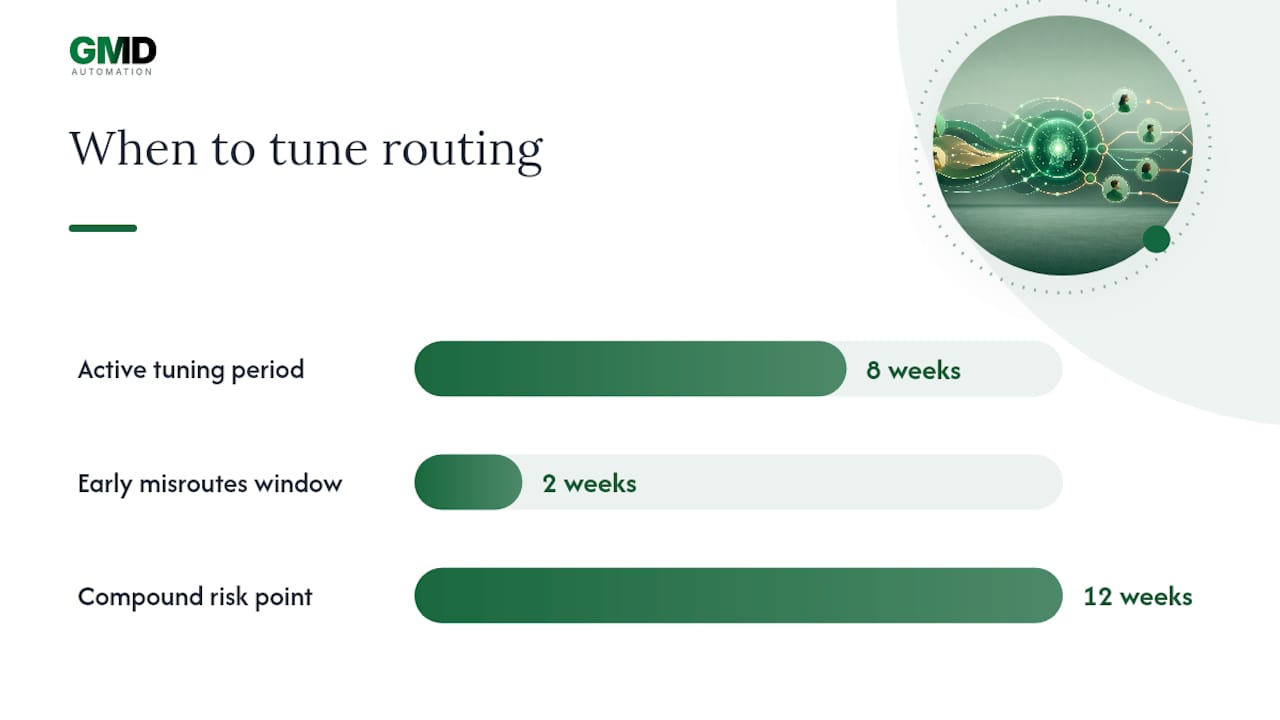
Pro Tip: Treat the first eight weeks post-launch as an active tuning period, not a "set and forget" rollout. The misroutes you catch in week two are the ones that would otherwise compound by week twelve.
Workflow automation extends naturally from here, and post-call automation for customer service is usually the next logical step once routing itself is stable.
What does a managed AI routing deployment look like in practice?
A UK retail contact centre piloting AI call routing with Gmdautomation might start with a single high-volume intent, order status enquiries, and expand from there once accuracy holds. The onboarding model is built to remove the capital risk that stalls most AI projects at the approval stage.
- Zero upfront cost, with a single monthly subscription covering implementation, hosting, and ongoing tuning
- A pilot phase focused on two or three transactional intents before wider rollout
- Continuous optimisation included in the subscription, rather than billed as a separate change request
Readers wanting the deeper technical mechanics behind this can review AI function calling in enterprise contexts and see a working demo agent built on the same deployment framework described throughout this piece.
Ready to see AI call routing running on real infrastructure?
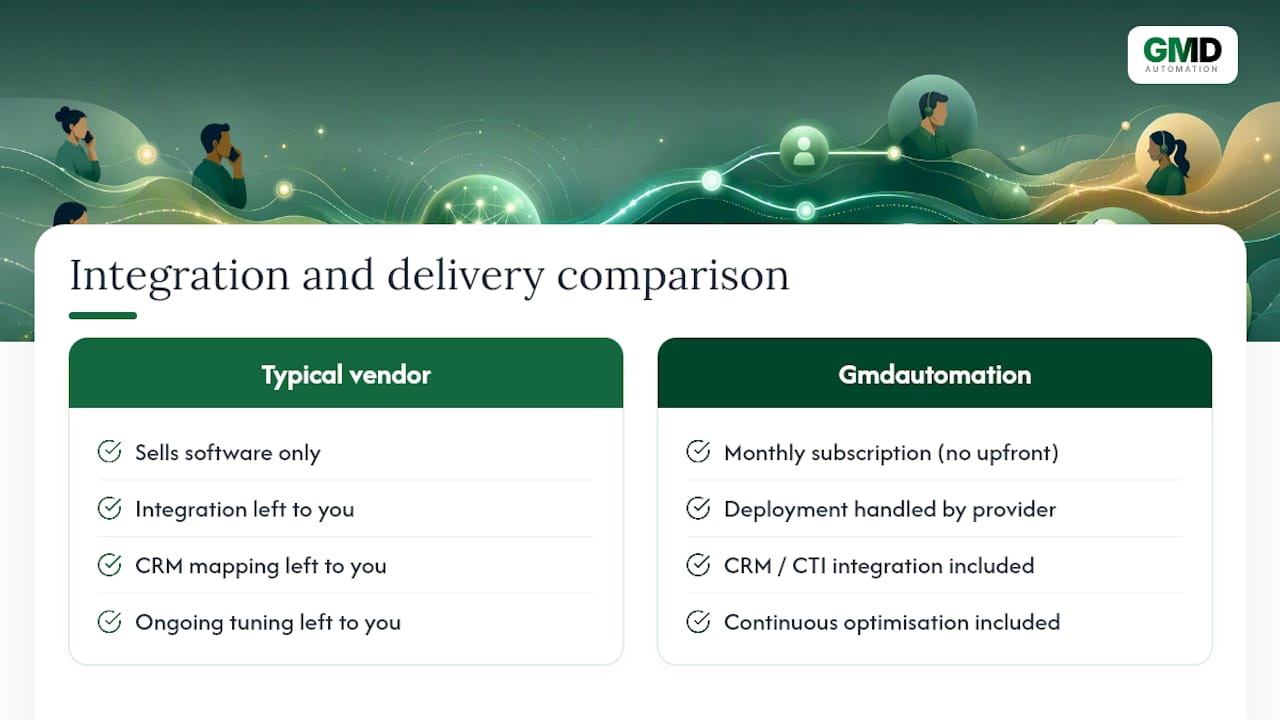
Most AI routing vendors sell you the software and leave the integration, the CRM mapping, and the ongoing tuning as your problem. Gmdautomation is the alternative for UK businesses that want routing live without a six-figure integration project sitting on the IT roadmap for a year: one monthly subscription covers deployment, CRM/CTI integration, hosting, and continuous optimisation, with nothing paid upfront.
That structure matters because the biggest failure mode in this category isn't the AI model, it's shallow integration that looks fine in a demo and falls apart against real customer data. Gmdautomation's pilots typically start narrow, one or two high-volume intents such as appointment booking or order status, so your team sees measurable results before committing to a wider rollout. Guides on system integrators adopting AI platforms explain the integration model in more depth if your IT team wants the technical detail before a call.
If you want to see how this looks against your own call volumes, book a technical scoping call with Gmdautomation and ask them to map a pilot against your two highest-volume intent types.
A note from Ravi on what actually breaks these deployments
The failure mode I see most often isn't the AI getting intent wrong. It's teams buying a router with no visibility into its own decisions, then having no way to fix it when something drifts three months in. Fast deployment is genuinely possible now, but speed without deep CRM integration just gets you a fast way to misroute calls.
If you're scoping a pilot, start with your two most repetitive, highest-volume call types, not your most complex one. Confidence builds faster on the boring wins. For the mechanics behind the scoring engine, the demo agent and the AI function calling breakdown are worth your time before any vendor conversation.
— Ravi
Sources
- Automatic call distributor — Wikipedia
- AI call routing: How it works and why it matters — RingCentral