

Leasing AI systems is the practice of accessing enterprise-grade AI hardware and infrastructure through a fixed-term agreement rather than purchasing assets outright. It is the fastest-growing sourcing model for AI infrastructure in the UK, and the financial logic is clear: GPU clusters lose 40% in value when a new generation releases, making ownership a depreciating liability from day one. Why businesses lease AI systems rather than buy them comes down to three forces: capital efficiency, hardware obsolescence, and operational agility. This article explains each in plain terms, so you can make a better decision for your organisation.
What financial advantages do businesses gain by leasing AI hardware?
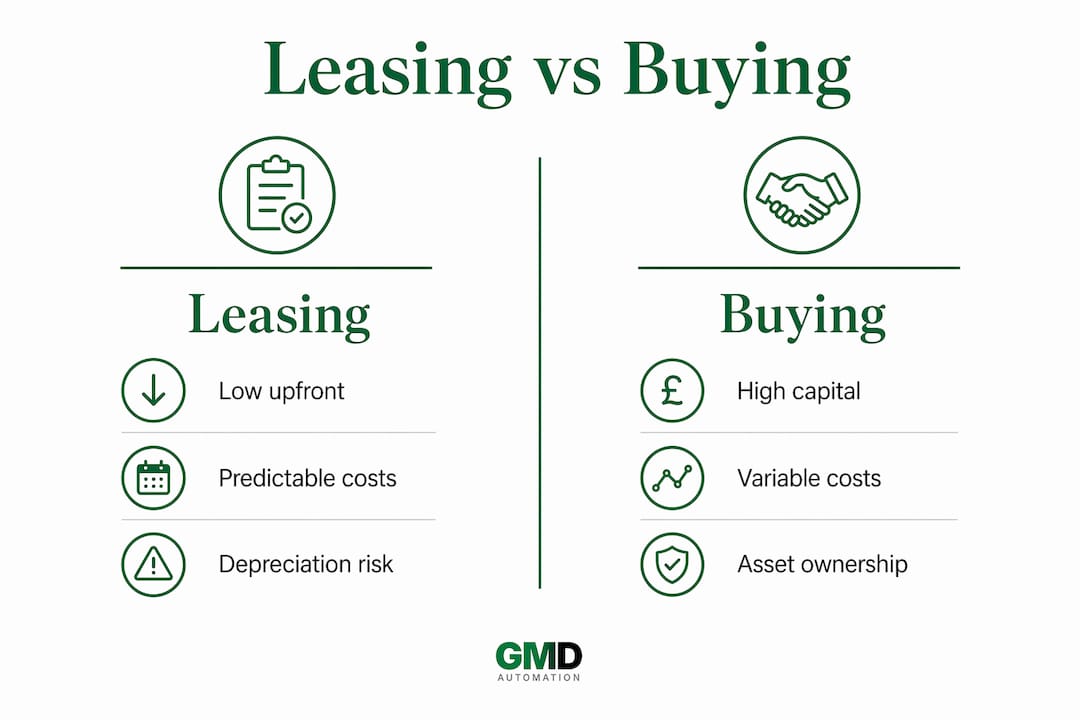
Leasing AI hardware converts an unpredictable capital expenditure into a predictable operating cost. That shift matters enormously for budget planning, board reporting, and cash flow management.
The key distinction is between an operating lease and a capital lease. A capital lease treats the asset as owned, placing it on your balance sheet with associated depreciation. An operating lease keeps the asset off your balance sheet entirely. For AI hardware, operating leases under Fair Market Value terms shift residual value risk to the lessor at the point of signing. You pay for use, not ownership.
The depreciation numbers make this concrete. Hardware that cost £1,200 three years ago may be worth £150 today. Leasing transfers residual value risk to the lessor, so your organisation never absorbs that collapse in asset value. The lessor prices that risk into the monthly rate, but the rate remains far lower than the capital cost of ownership.

Pro Tip: Ask your leasing provider to show you the residual value assumption built into your monthly payment. A lower residual value assumption means the lessor is absorbing more depreciation risk on your behalf.
| Factor | Leasing | Buying outright |
|---|---|---|
| Upfront capital required | None or minimal deposit | Full purchase price |
| Depreciation risk | Transferred to lessor | Absorbed by your business |
| Balance sheet impact | Off-balance-sheet (operating lease) | Asset recorded, depreciation applied |
| Hardware refresh | Built into lease cycle | Requires new capital expenditure |
| Cash flow predictability | Fixed monthly payment | Variable, dependent on refresh timing |
The table above shows why leasing AI systems is the preferred model for finance directors who need cost certainty. Buying locks capital into an asset that loses value faster than almost any other category of enterprise equipment.
How does leasing AI systems improve deployment speed and flexibility?
Speed is the most underrated benefit of leasing AI infrastructure. Renting AI infrastructure allows teams to avoid months-long hardware procurement delays and adapt quickly to changing workload needs. Purchasing enterprise GPU clusters involves procurement cycles, customs clearance, data centre provisioning, and vendor lead times that can stretch to six months or longer.
Leasing collapses that timeline. Enterprise equipment financing approvals for AI infrastructure can be completed in as little as 24 hours, for amounts ranging from £20,000 to £5 million. That speed lets your team test an AI workload in weeks rather than quarters.
The operational benefits of leasing AI systems extend well beyond procurement speed:
- Instant workload testing. You can spin up leased GPU capacity to test a new AI model without committing capital. If the model underperforms, you return the hardware at end of term.
- Dynamic scaling. Leasing lets you add capacity when demand spikes and reduce it when workloads shrink, avoiding the cost of idle hardware sitting in a rack.
- Obsolescence protection. AI hardware leases run 24–36 months, aligned with GPU generational refresh cycles. You upgrade at end of term rather than writing off owned assets.
- Disposal cost elimination. End-of-term flexibility removes the burden of disposing of obsolete hardware, which carries both cost and environmental compliance obligations.
- Cash flow alignment. Monthly lease payments align with the revenue benefits the AI system generates, rather than front-loading cost before any return is realised.
Pro Tip: Track your leased AI hardware utilisation monthly. If utilisation consistently falls below 60%, you are paying for idle capacity. Use that data to renegotiate lease volume or redirect workloads before the next renewal.
The ability to test, scale, and refresh without capital commitment is why leasing AI infrastructure accelerates innovation cycles. Organisations that own hardware tend to over-commit to existing systems because the sunk cost is already on the books.
What strategic factors should leaders weigh when deciding to lease AI systems?
The most useful framework for AI infrastructure decisions is the "Own the Moat, Rent the Utility" principle. The logic is direct: own AI systems that create genuine competitive advantage, and lease commodity AI tools that perform generic functions. A proprietary customer intelligence model trained on your data is a moat worth owning. A general-purpose language model running routine tasks is a utility worth renting.
Applying this framework requires honest answers to four questions about each AI workload in your portfolio. The strategic considerations for leasing AI systems are:
- Workload predictability. Leasing suits variable or experimental workloads. Ownership makes sense only when utilisation is consistently high and demand is stable over three or more years.
- Competitive differentiation. If the AI system processes proprietary data or generates unique outputs, ownership protects that IP. If it runs commodity tasks, leasing is the rational choice.
- Vendor lock-in risk. Leased systems can create dependency on a single provider's hardware or software stack. Splitting AI infrastructure between owned differentiating assets and rented commodity capacity reduces that risk.
- Data ownership and compliance. Leasing agreements must specify where data is processed and stored. For UK businesses, this intersects with UK GDPR obligations. Verify data residency terms before signing.
- Contract exit options. Short lease terms of 24–36 months give you natural exit points aligned with hardware generations. Longer terms reduce monthly cost but reduce flexibility. Negotiate early termination clauses before you need them.
- Innovation optionality. Leasing preserves your ability to adopt next-generation hardware without writing off existing assets. That optionality has real financial value in a market where AI accelerator performance doubles roughly every two years.
The strategic case for leasing is strongest when your AI workloads are evolving, your utilisation is variable, or your organisation is still determining which AI capabilities will deliver lasting competitive value. Committing capital to hardware before that clarity exists is a common and costly mistake.
How do market pricing and vendor models shape the AI leasing landscape?
The AI leasing market has developed distinct pricing tiers that reflect hardware performance and lease term length. Understanding these tiers helps you benchmark vendor proposals and avoid overpaying.
Operating leases for high-end GPU clusters typically cost £900–£1,500 per month per unit. That range reflects the residual value assumptions and depreciation risk that lessors price into each agreement. NVIDIA's hardware generations, particularly the H100 and successor accelerators, drive these pricing cycles because each new release resets residual values across the market.
| Model | Monthly cost | Control level | Flexibility | Best for |
|---|---|---|---|---|
| Cloud rental (AWS, Azure, GCP) | Variable, usage-based | Low | Very high | Short-term, unpredictable workloads |
| Operating lease (FMV terms) | £900–£1,500 per unit | Medium | Medium | 24–36 month predictable workloads |
| Capital lease or finance | Higher monthly rate | High | Low | Long-term, stable high-utilisation use |
| Outright purchase | Zero ongoing cost | Full | None | Highly stable, proprietary workloads |
Cloud rental models offer fast access, scaling, and integrated support, but the per-unit cost at sustained high utilisation exceeds leasing costs significantly. Leasing sits between cloud rental and ownership: more control than cloud, less capital commitment than buying. For most UK businesses running AI workloads at moderate scale, the operating lease is the most cost-effective AI solution across a 24–36 month horizon.
Financing approval speed is also a competitive differentiator among leasing providers. Approvals in 24 hours for amounts up to £5 million mean that leasing can respond to business opportunities at the speed of software procurement rather than capital expenditure cycles.
What practical steps help businesses implement AI leasing successfully?
Implementing an AI leasing strategy requires preparation before you sign any agreement. The decisions you make at contract stage determine your flexibility and cost exposure for the full lease term.
The practical steps that reduce risk and improve outcomes are:
- Audit your workload utilisation first. Measure current and projected AI compute demand before selecting lease volume. Overprovisioning is as costly as underprovisioning.
- Evaluate residual value terms carefully. Fair Market Value leases offer lower payments but require you to understand what the lessor assumes the hardware will be worth at end of term.
- Align lease terms with your technology roadmap. A 24-month lease makes sense if you expect to adopt next-generation hardware within two years. A 36-month term reduces monthly cost but extends your commitment.
- Integrate leased systems with your existing technology stack. Confirm compatibility with your data pipelines, security architecture, and compliance frameworks before deployment. For UK businesses, this includes verifying alignment with UK GDPR and sector-specific regulations.
- Plan your exit before you enter. Negotiate early termination clauses and end-of-term options at the outset. Lessors are more flexible on these terms before the contract is signed than after.
Pro Tip: Request a technology refresh clause in your lease agreement. This allows you to upgrade to next-generation hardware mid-term if a significant performance improvement is released, without paying a full early termination penalty.
Intelligent cost management does not stop at the lease agreement. Intelligent routing and cost optimisation applied to AI query workloads can reduce operational spending by 70%–96%. One enterprise reduced monthly AI spend from £63,000 to £8,400 through tiered routing alone. Leasing gives you the infrastructure; intelligent workload management gives you the efficiency.
Key takeaways
Leasing AI systems is the most cost-effective sourcing model for UK businesses running variable or evolving AI workloads, because it transfers depreciation risk, eliminates upfront capital, and preserves the flexibility to upgrade as hardware generations advance.
| Point | Details |
|---|---|
| Depreciation risk transfer | Operating leases shift residual value risk to the lessor, protecting your balance sheet from GPU value collapse. |
| Deployment speed | Enterprise AI lease approvals can complete in 24 hours, cutting procurement delays from months to days. |
| Lease term alignment | 24–36 month FMV lease terms align with GPU generational refresh cycles, reducing obsolescence risk. |
| Strategic framework | Own AI systems that create competitive advantage; lease commodity AI tools that perform generic functions. |
| Cost optimisation | Intelligent workload routing combined with leasing can reduce total AI operational spend by over 70%. |
The case for leasing is stronger than most leaders realise
Most of the business leaders I speak with arrive at the leasing question from the wrong direction. They ask whether leasing is cheaper than buying. That is the wrong comparison. The right question is: what is the cost of being wrong?
If you buy GPU clusters and the next hardware generation arrives 18 months later with double the performance per pound, you are locked into depreciating assets with no clean exit. The capital is spent, the hardware is on your books, and your competitors who leased are already running the new generation. That asymmetry is what makes leasing so compelling right now, not the monthly payment comparison.
The "Own the Moat, Rent the Utility" principle is the most useful mental model I have encountered for AI infrastructure decisions. The businesses that apply it consistently are the ones that avoid the trap of treating AI hardware as a status asset rather than a cost centre. Your competitive advantage comes from what your AI does with data, not from which GPU brand sits in your data centre.
The one caution I would add is this: leasing does not eliminate the need for rigorous workload analysis. Leaders who lease without measuring utilisation simply move from one form of waste to another. The discipline of tracking compute utilisation monthly, and adjusting lease volume accordingly, is what separates organisations that genuinely benefit from leasing and those that just have a different line item on their P&L.
For UK businesses in particular, the combination of UK GDPR compliance requirements and the pace of AI hardware development makes leasing the structurally sound choice for the next three to five years. Own what makes you different. Lease everything else.
— Ravi
How Gmdautomation supports cost-effective AI deployment for UK businesses
Gmdautomation builds and deploys enterprise-grade AI automation systems for UK businesses, with zero upfront capital required. The model is a predictable monthly subscription that covers implementation, operation, maintenance, and ongoing optimisation. That structure mirrors the financial logic of leasing: convert capital expenditure into a manageable operating cost, and align payment with the value the system delivers. Gmdautomation's scalable AI automation architecture is designed to integrate with existing enterprise technology stacks, so deployment is fast and disruption is minimal. For leaders ready to move from evaluation to deployment, Gmdautomation's AI automation platform offers a practical starting point with transparent pricing and full UK compliance support.
FAQ
Why do businesses lease AI systems instead of buying them?
Businesses lease AI systems to avoid the capital cost of ownership and transfer depreciation risk to the lessor. GPU hardware loses approximately 40% of its value when a new generation releases, making leasing the lower-risk financial choice.
How much does it cost to lease an AI GPU cluster?
Operating leases for high-end GPU clusters typically cost £900–£1,500 per month per unit. Exact pricing depends on hardware specification, lease term length, and the residual value assumptions built into the agreement.
What is a Fair Market Value lease for AI hardware?
A Fair Market Value lease is an operating lease structure where the lessor absorbs residual value risk at the point of signing. The lessee pays for use of the hardware without carrying the asset or its depreciation on their balance sheet.
How long are typical AI hardware lease terms?
AI hardware leases commonly run for 24–36 months. These terms are shorter than traditional server leases because AI accelerators become obsolete faster, and shorter terms align with GPU generational refresh cycles.
What is the "Own the Moat, Rent the Utility" strategy?
It is an AI capital strategy that recommends owning AI systems that create genuine competitive advantage while leasing commodity AI tools that perform generic functions. The approach balances equity creation with operational agility.