

AI system redundancy is defined as the deliberate embedding of backup components, failover mechanisms, and alternative workflows within AI infrastructure to maintain continuous operation during failures or outages. The industry term for this practice is fault-tolerant AI architecture, and understanding it is now a baseline requirement for any organisation running AI in production. Nearly 75% of organisations automate multiple business functions with AI yet lack concrete continuity plans. That gap is not a technical oversight. It is a business risk that grows every time a new AI workflow goes live without a fallback strategy.
What is AI system redundancy and how does it work?
AI system redundancy works by layering multiple backup mechanisms across every critical point in an AI workflow. Where a traditional IT system might rely on server replication, an AI system must also account for model availability, inference state, vector databases, and fine-tuned adapters. Each of these components can fail independently, so redundancy must be applied at each layer.

The most practical mental model is graceful degradation. Rather than treating uptime as binary, redundancy enables systems to remain usable at reduced capability when a primary component fails. A customer-facing AI assistant, for example, might switch from a frontier language model to a lighter fallback model during an outage, still resolving basic queries rather than returning an error page.
Multi-model strategies pair premium models for complex tasks with smaller fallback models for routine ones. Automatic routing switches between them without user intervention. This approach prevents a single model provider's outage from taking down an entire service.
Circuit breakers add another layer of protection. Separate circuit breakers for hard failures, soft failures, and latency spikes stop repeated calls to a failing provider before they cascade into a wider system collapse. Rate limiting works alongside circuit breakers to prevent overload on backup systems during a failover event.
What redundancy architectures exist for AI systems?
Cross-region disaster recovery gives organisations the most control over recovery time. Active-active, active-passive, and hybrid architectures each offer different trade-offs between cost, complexity, and recovery speed.
| Architecture | Recovery speed | Relative cost | Best suited for |
|---|---|---|---|
| Active-active | Near-instant | High | Mission-critical, real-time AI services |
| Active-passive | Minutes to hours | Moderate | Standard business applications |
| Hybrid | Configurable | Variable | Mixed criticality workloads |
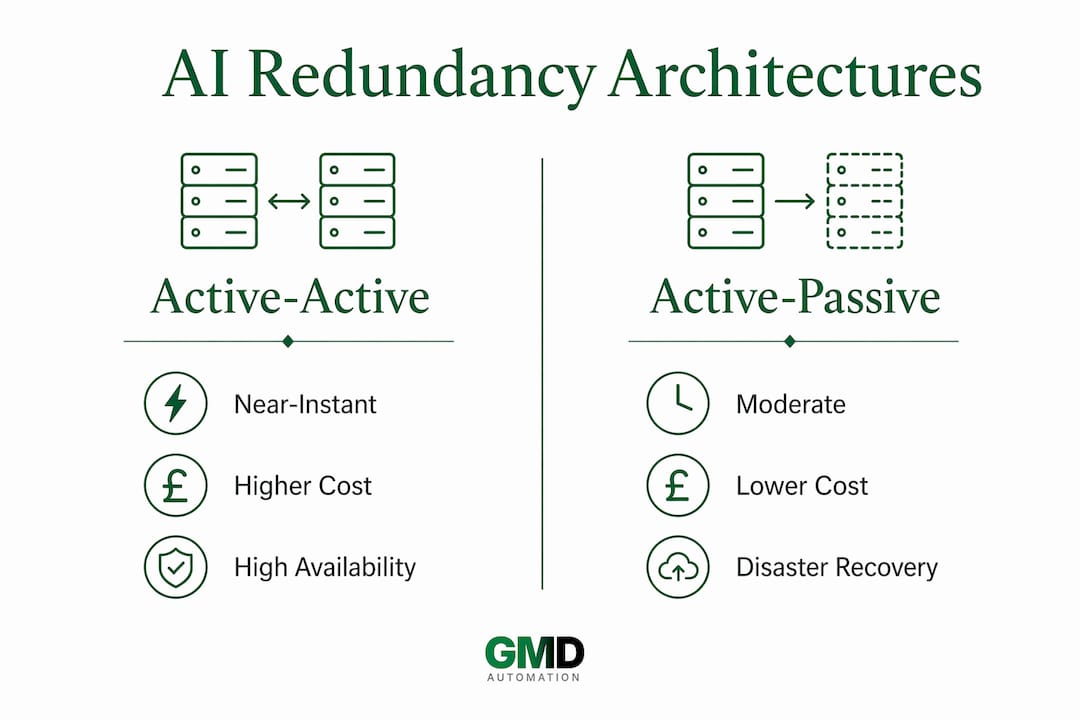
Active-active runs identical AI workloads across two or more regions simultaneously. Failover is near-instant because traffic simply reroutes to the surviving region. Active-passive keeps a warm standby that activates only when the primary fails. Active-passive architectures reduce infrastructure costs by approximately 30–40% compared to active-active, making them the default choice for most mid-market organisations. Hybrid models split workloads by criticality, running the most sensitive processes in active-active and less critical ones in active-passive.
Beyond infrastructure topology, a tiered model ladder provides application-level redundancy. A well-designed ladder runs from frontier models at the top, through mid-tier models, to deterministic templates, and finally to async fallback queues. This tiered approach enables controlled degradation under model outages rather than abrupt service failure.
Why is AI redundancy essential for failure prevention?
A single AI provider dependency is a structural vulnerability. When that provider experiences an outage, every workflow tied to it stops. Using multiple parallel AI providers reduces vendor lock-in and preserves operational continuity by distributing dependency across independent systems.
The risks of a single point of failure extend beyond downtime. They include reputational damage, contractual penalties, and loss of customer trust. For regulated industries such as financial services or healthcare, an AI outage can also trigger compliance obligations. Redundancy addresses all three categories simultaneously.
Operational sovereignty over AI systems requires the ability to substitute one provider for another without rebuilding the entire workflow. Multi-model routing layers and abstracted inference APIs make that substitution possible without rewriting application logic.
The benefits of AI redundancy also include cost predictability. Unplanned outages are expensive to remediate under pressure. Planned redundancy, by contrast, has a known and manageable cost profile. Organisations that build redundancy in from the start spend less on incident response than those that retrofit it after a failure.
Key failure scenarios that redundancy directly addresses:
- Model provider outage: Automatic routing to a secondary provider or fallback model.
- Infrastructure failure: Cross-region replication keeps inference available.
- Data corruption: Versioned model manifests and off-server snapshots enable clean restoration.
- Latency spikes: Circuit breakers and rate limiting prevent degraded performance from becoming a full outage.
- Vendor discontinuation: Multi-provider strategies preserve continuity when a provider retires a model.
How do organisations implement AI redundancy effectively?
Effective implementation starts with backing up AI-specific assets correctly. Naive filesystem snapshots often corrupt live inference states, so snapshots must be triggered post-training rather than mid-operation. Model manifests should be version-controlled separately from model weights to allow precise, targeted restoration.
Fine-tuned adapters and vector indexes are critical but fragile. They must be backed up immediately after any change, not on a fixed schedule that might miss recent updates. Treating these assets with the same discipline as production databases is the correct standard.
A practical implementation sequence for IT teams:
- Audit current AI assets. List every model, adapter, vector index, and inference endpoint in production.
- Classify by criticality. Assign each asset a recovery time objective (RTO). A 1-hour RTO is best practice for self-hosted inference, achievable through build manifests and off-server snapshots.
- Implement an inference routing layer. Abstract model selection behind a routing policy so the application layer never calls a specific provider directly.
- Configure circuit breakers. Set thresholds for hard failure, soft failure, and latency separately.
- Test failover regularly. Run scheduled drills that deliberately disable the primary model and verify that the fallback activates correctly.
- Apply lifecycle management to redundant artefacts. Delete outdated checkpoints and logs on a defined schedule to control storage costs.
Pro Tip: Version-control your model manifests in a separate repository from your model weights. If a weight file becomes corrupted, you can rebuild the inference environment from the manifest without restoring the entire server.
Monitoring is the operational backbone of any redundancy strategy. Without visibility into latency, error rates, and provider health, circuit breakers cannot trigger at the right thresholds. Pair monitoring with an AI business continuity plan that defines who owns each recovery action and what the escalation path looks like.
What trade-offs arise when designing AI redundancy?
Redundancy is not free, and the costs are not always obvious. Explainability requirements generate redundant artefacts such as logs, checkpoints, and attribution vectors that accumulate rapidly and inflate storage and energy consumption. Without lifecycle management, these artefacts become an unsustainable overhead.
| Trade-off dimension | Lower redundancy | Higher redundancy |
|---|---|---|
| Infrastructure cost | Lower | Higher |
| Recovery speed | Slower | Faster |
| Operational complexity | Lower | Higher |
| Vendor dependency risk | Higher | Lower |
| Explainability artefact volume | Lower | Higher |
Synchronisation across regions is a genuine technical challenge. When a model is updated in one region, the update must propagate to all standby regions before the next failover test. Inconsistent model versions across regions produce inconsistent outputs, which is a compliance risk in regulated environments.
Energy consumption rises with redundancy depth. Running active-active across three regions consumes roughly three times the compute of a single-region deployment. Organisations must weigh that cost against the revenue impact of downtime for their specific workloads. A low-traffic internal tool warrants a different redundancy level than a customer-facing payment processing AI.
Choosing the right level of redundancy requires honest assessment of business criticality. Not every AI workflow needs active-active cross-region replication. Applying the highest redundancy tier uniformly wastes budget that could fund better monitoring or faster incident response instead.
How does AI redundancy align with compliance and governance?
Compliance requirements shape redundancy design as much as technical constraints do. Regulated organisations need auditable redundancy mechanisms, including immutable logs and continuous write-ahead log (WAL) shipping, to demonstrate that backup systems operated correctly during an incident.
Data protection obligations under UK GDPR affect where backup data can be stored and replicated. Cross-region replication that moves personal data outside the UK requires a lawful transfer mechanism. Redundancy architects must map data flows before selecting replication targets.
Key governance requirements for AI redundancy programmes:
- Immutable audit logs covering every failover event, including which model served which request.
- Documented recovery procedures tested at least quarterly and owned by a named individual.
- Vendor interoperability standards that allow substitution of one provider for another without data loss.
- Feature degradation policies that define which AI capabilities are acceptable to disable during a failover and which must remain available.
- Data residency controls that prevent backup replication from breaching data sovereignty obligations.
Integrating redundancy with business continuity and disaster recovery (BCDR) policies ensures that AI-specific recovery procedures sit within the organisation's broader incident response framework. Organisations using multiple AI APIs for enterprise integration should map each API dependency to a BCDR owner and a defined RTO.
Key takeaways
AI system redundancy requires layered failover across models, infrastructure, and vendors to prevent single points of failure from collapsing entire workflows.
| Point | Details |
|---|---|
| Define RTO per asset | Target a 1-hour recovery time for self-hosted inference using manifests and off-server snapshots. |
| Use multi-model routing | Pair premium and fallback models with automatic switching to maintain service during provider outages. |
| Choose architecture by criticality | Active-passive cuts costs by 30–40% versus active-active; match the tier to the business risk. |
| Manage explainability artefacts | Apply lifecycle controls to logs and checkpoints to prevent storage costs from becoming unsustainable. |
| Embed governance from the start | Immutable audit logs and documented failover procedures are required for regulated industries. |
Redundancy planning: what I've learned from real deployments
The most common mistake I see is treating redundancy as a project to complete rather than a discipline to maintain. Teams build a failover system, tick the box, and never test it again. Six months later, the fallback model is on a deprecated API version and the circuit breakers have never been triggered in a live environment. When the actual outage arrives, the redundancy fails alongside the primary system.
The second mistake is coupling application logic directly to a specific model provider. When that provider changes its API or retires a model, the entire application needs rework. A modular inference layer that abstracts routing decisions from application code is the single highest-return investment in AI resilience. It costs more to build initially and saves enormously when you need to swap providers under pressure.
I have also seen organisations over-engineer redundancy for low-stakes internal tools while under-investing in customer-facing workflows. The right question is not "how much redundancy can we afford?" It is "what is the cost of this specific workflow being unavailable for one hour?" Answer that honestly for each system, and the correct redundancy tier becomes obvious.
Start with observability. You cannot tune circuit breakers or set meaningful RTOs without baseline data on latency, error rates, and provider health. Build monitoring first, then layer in failover mechanisms informed by what the data shows. Incremental implementation beats a grand architecture that never ships.
— Ravi
How Gmdautomation supports AI redundancy for UK businesses
Gmdautomation builds AI automation systems for UK businesses with multi-model support, fallback handling, and monitoring built into every deployment from day one.
Every Gmdautomation deployment includes inference routing that abstracts provider selection, so your workflows keep running when a primary model goes offline. Failover logic, circuit breakers, and performance monitoring are configured as part of the standard implementation, not added later as optional extras. The subscription model covers ongoing maintenance and optimisation, meaning redundancy configurations stay current as models and providers evolve. For UK businesses that need reliable AI automation without the capital cost of building fault-tolerant infrastructure in-house, Gmdautomation provides a production-ready path to operational continuity.
FAQ
What is AI system redundancy in simple terms?
AI system redundancy is the practice of building backup models, infrastructure, and routing logic into an AI system so it keeps working when any single component fails.
How does AI redundancy differ from standard IT backup?
Standard IT backup focuses on data and servers. AI redundancy also covers model weights, fine-tuned adapters, vector indexes, and inference routing, all of which require specialised backup approaches beyond filesystem snapshots.
What is a realistic recovery time objective for AI systems?
A 1-hour RTO is best practice for self-hosted AI inference, achievable by maintaining build manifests and off-server snapshots rather than attempting full system restores.
Why do most organisations lack AI redundancy plans?
Nearly 75% of organisations automate multiple functions with AI but have no fallback strategy, typically because redundancy is treated as an infrastructure concern rather than an AI-specific design requirement.
What is graceful degradation in AI redundancy?
Graceful degradation means an AI system continues serving requests at reduced capability during a failure, for example switching from a frontier model to a lighter fallback, rather than returning an error to the user.