

AI system load balancing is the practice of distributing inference requests across GPU clusters and model replicas so that no single node becomes a bottleneck while others sit idle. Unlike traditional load balancing, which assumes uniform request sizes and stateless backends, AI workloads vary greatly in processing time depending on input sequence length, making naïve round-robin distribution actively harmful. Get it right and you can achieve high GPU utilisation; get it wrong and poor request distribution can waste substantial compute capacity.
What is AI system load balancing, and why does it differ from traditional approaches?
Traditional load balancing treats every request as roughly equivalent and every backend as stateless. Send a request to any server, get a response, done. AI inference breaks both assumptions simultaneously.
A large language model (LLM) processes requests through distinct prefill and decode phases, each with different compute and memory demands. A short prompt might resolve in milliseconds; a long-context generation task can take seconds. Standard web load balancers cause bottlenecks in AI inference precisely because they ignore this heterogeneity, routing requests without any awareness of GPU queue depth, KV cache state, or thermal throttling.

AI system load balancing addresses this by incorporating workload-aware routing, real-time GPU telemetry, and cache affinity logic. The goal is not just distributing traffic but distributing it intelligently, to the right GPU at the right moment.
Key characteristics that distinguish AI load balancing from conventional approaches:
- Workload-aware routing: considers variable processing times and request sizes rather than treating all requests as equal
- KV cache affinity: routes requests to GPU instances already holding relevant cached context, reducing redundant computation
- Real-time telemetry integration: uses GPU utilisation, queue depth, latency percentiles, and temperature as routing signals
- Heterogeneous hardware support: accounts for performance differences across GPU types (A100, H100, V100) and memory configurations
- Stateful serving awareness: preserves session context for multi-turn interactions without sacrificing distribution efficiency
- Dynamic failover: pre-emptively shifts traffic away from degrading nodes before hard failures occur
- Throughput and latency balancing: manages the trade-off between batching efficiency and response time SLAs
How does AI load balancing work? Key techniques and algorithms
The core of any AI load balancing system is its routing algorithm, and no single algorithm fits every workload. The choice depends on hardware homogeneity, latency requirements, and whether the serving infrastructure supports stateful sessions.
Routing algorithms in practice
Weighted round-robin assigns traffic proportional to each GPU's processing capacity. AWS SageMaker uses weighted round-robin for multi-instance endpoints, achieving 15% better utilisation than naïve round-robin. It handles heterogeneous hardware well but requires accurate weight calibration to avoid over-routing to slower nodes.
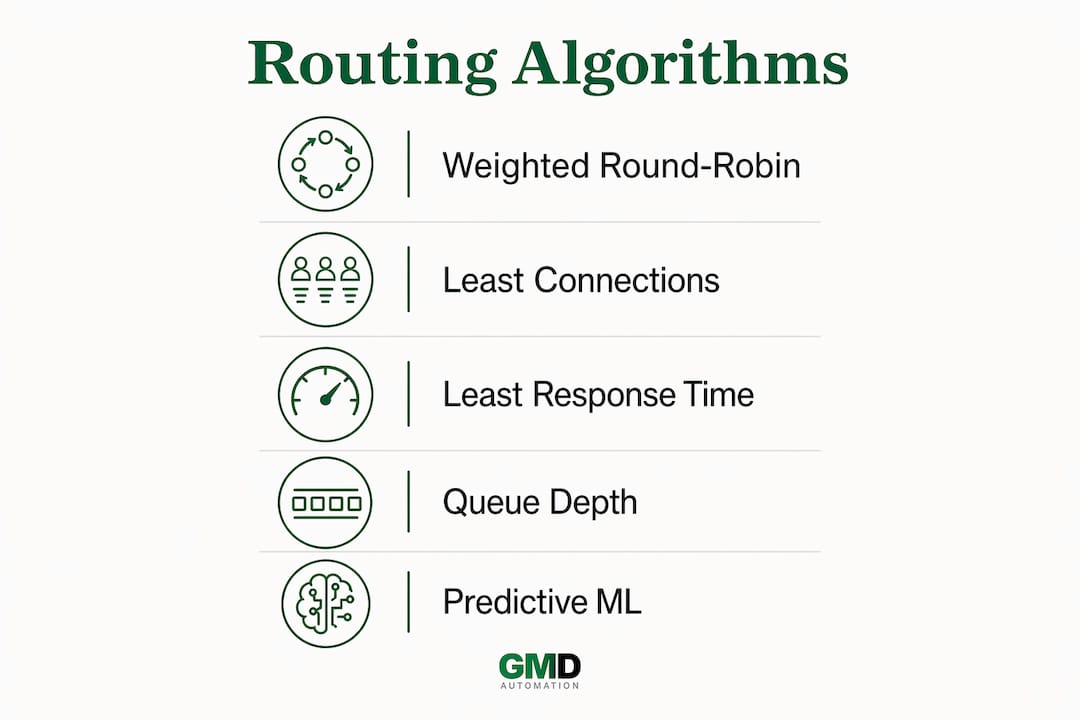
Least connections routes each new request to the GPU with the fewest active connections. Simple to implement, but connection count correlates poorly with actual GPU load when request sizes vary widely. A single long-context generation request occupies one "connection" but consumes far more GPU memory than ten short queries.
Least response time selects the GPU with the lowest recent response time, using moving averages to smooth temporary spikes. This adapts well to changing conditions but can oscillate under sustained load.
Queue depth balancing considers pending requests at each GPU rather than active connections. Because it reflects actual backlog rather than a proxy metric, it tends to produce more accurate routing decisions for LLM workloads.
Predictive ML-enhanced routing uses machine learning to forecast optimal assignment based on request features and historical patterns. Research published at EuroMLSys 2025 demonstrates that a reinforcement learning router achieves over 11% lower end-to-end latency than existing methods on mixed public datasets by modelling the adverse effects of mixing diverse workload types at a single instance.
Telemetry signals that drive routing decisions
Effective AI load balancing depends on observability that goes well beyond standard network metrics. Telemetry must extend to GPU and model serving specifics, including KV cache occupancy and batch queue depth, to prevent bottlenecks.

| Telemetry signal | Why it matters |
|---|---|
| GPU utilisation (%) | Identifies overloaded or underutilised nodes |
| Queue depth | Reflects actual request backlog per instance |
| P95/P99 latency | Captures tail latency that averages obscure |
| KV cache occupancy | Guides cache-affinity routing decisions |
| Token generation rate | Predicts near-term GPU saturation |
| Thermal state | Detects throttling before performance degrades |
| Error rate | Triggers failover before hard failures occur |
Tail latency metrics such as P95 and P99 matter more than averages for user-facing applications. A load balancer optimising for mean response time can still deliver a terrible experience to the 5% of users hitting slow requests.
Batch formation and the latency-throughput trade-off
Dynamic batching aggregates multiple inference requests into a single GPU operation, improving throughput several times over. The catch is that requests must accumulate in a queue before processing begins, introducing queuing delay. Optimal batch sizes balance throughput gains against latency penalties, and the right threshold shifts depending on current load and SLA requirements.
Pro Tip: Set separate batch formation windows for interactive and batch workloads. Interactive requests should use tight timeout thresholds (10–50ms); background batch jobs can tolerate longer accumulation windows to maximise GPU efficiency.
How AI load balancing works in data centres and cloud infrastructure
In production deployments, an AI load balancer sits between the API gateway and the GPU model serving backends. Incoming inference requests arrive at the gateway, pass through the load balancer for routing decisions, and land on the appropriate GPU instance. The load balancer continuously receives telemetry from each backend and adjusts routing weights in near real time.
Architecture patterns
Centralised architectures route all traffic through dedicated load balancer tiers. Tools such as NGINX, HAProxy, and Kubernetes Gateway API handle request distribution based on configurable algorithms. This simplifies management but introduces a potential single point of congestion at the load balancer layer itself. For scalable AI deployments at the scale of thousands of GPUs, distributed or hierarchical architectures often perform better.
Distributed implementations push routing logic closer to the inference backends, reducing latency in the routing decision itself. Envoy proxy, for example, supports custom load balancing extensions that can incorporate GPU-specific telemetry through sidecar processes.
In Software Defined Networking (SDN) environments, AI load balancing extends to network function optimisation. Traffic steering decisions account not just for GPU state but for network topology, bandwidth constraints, and latency between load balancer nodes and GPU clusters.
Intelligent routers optimise return on investment for AI factories by routing prompts to models that balance cost against complexity, monitoring token consumption and performance alongside throughput. Efficient inference cost management requires more than throughput optimisation alone.
Source: F5 Webinar on AI Factory Tuning
Telemetry integration and health checks
Production AI load balancers integrate with monitoring stacks such as NVIDIA DCGM (Data Center GPU Manager) and Prometheus. NVIDIA's LLM Router monitors DCGM data to pre-emptively shift traffic away from GPUs showing early signs of degradation, before any hard failure occurs. Health checks in AI infrastructure go beyond simple HTTP ping responses; they verify GPU memory availability, queue depth thresholds, and model readiness.
Failover policies in AI systems use error codes and latency thresholds rather than binary up/down signals. Intelligent failover retries requests based on these signals, routing around partial degradations to maintain resilience without requiring a complete node failure to trigger action. This connects directly to AI business continuity planning for UK enterprises, where SLA compliance depends on pre-emptive rather than reactive responses.
Key deployment considerations for AI infrastructure teams:
- Place load balancers with direct access to GPU telemetry APIs, not just network-layer metrics
- Use slow-start mechanisms when adding new GPU nodes to avoid overwhelming them with traffic before they are fully warmed up
- Implement circuit breakers that reduce traffic to a degrading node gradually rather than cutting it off abruptly
- Separate routing logic from instance-level scheduling to allow independent optimisation of each layer
What makes AI load balancing harder than traditional approaches?
The challenges in AI load balancing are not incremental refinements of web load balancing problems. They are categorically different, and several of them have no direct analogue in conventional infrastructure.
Latency variability is the most immediate challenge. Inference request processing times vary by orders of magnitude depending on input sequence length, output length, and model architecture. A load balancer that treats all requests as equivalent will consistently over-route to GPUs that happen to be processing long-context requests, creating queue build-up that cascades into latency spikes.
Stateful LLM serving compounds this. KV cache reuse is one of the most effective ways to reduce inference latency in multi-turn conversations. Routing a follow-up request to a different GPU instance than the one holding the relevant KV cache means that cache must be rebuilt from scratch, wasting GPU memory and adding latency. Cache-affinity routing solves this but constrains the routing decision space, creating tension with pure load distribution goals.
Hardware heterogeneity adds another layer. A100 GPUs process requests faster than V100s in the same cluster. Memory configurations ranging from 16GB to 80GB determine maximum batch sizes. Thermal throttling can reduce GPU performance by a meaningful margin for poorly cooled nodes. A load balancer that ignores these differences will systematically over-route to slower or thermally constrained GPUs.
Gray failures are perhaps the most insidious challenge. These are partial degradations where a GPU or model instance continues to respond but at degraded performance, without triggering standard health check failures. Reactive failover triggered by hard errors is too late to prevent user impact. By the time a node fails outright, users have already experienced degraded responses.
Additional challenges AI infrastructure teams face:
- Sub-second telemetry granularity is required for meaningful routing decisions, which creates significant data volume and processing overhead
- Security and rate limiting must be enforced at the load balancer layer to prevent prompt injection attacks or resource exhaustion from malicious or runaway requests
- Balancing throughput optimisation against latency SLAs requires continuous tuning as workload patterns shift
- AI resource allocation decisions at the load balancer layer have direct cost implications, particularly when routing between GPU tiers with different per-hour costs
Predictive and adaptive AI load balancing: what recent research shows
The most significant shift in AI load balancing thinking over the past two years is the move from reactive to predictive control. Reactive systems wait for latency to rise or errors to spike, then fail over. Predictive systems detect the conditions that precede degradation and act before users notice anything.
Microsoft Research frames this as treating load balancing as an adaptive control problem, with routing decisions made 5–15 minutes ahead of current conditions rather than in response to them. Forecasting near-future saturation using time-series analysis of request rate, queue depth, and latency trends allows the system to pre-emptively reduce traffic to at-risk nodes and pre-warm capacity elsewhere.
The right approach is to treat balancing as an adaptive control problem: choose the policy that matches your workload, and validate it with the signals that predict pain early — tail latency, saturation, retries, queue depth.
Source: Azion — AI load balancing beyond round-robin
Reinforcement learning as a routing policy
Research from EuroMLSys 2025 demonstrates that a heuristic-guided reinforcement learning router, trained to model the latency impact of mixing diverse workload types at a single GPU instance, achieves over 11% lower end-to-end latency than existing methods across 2,000 requests on four LLM instances. The RL agent learns to delay routing decisions slightly when beneficial, choosing the optimal instance based on both current load and the characteristics of incoming requests.
This approach works because it encodes prior knowledge about workload mixing effects directly into the reward function. Routing a long-context generation request to an instance already processing several similar requests creates a compounding memory pressure that simple queue-depth metrics do not capture. The RL router learns to avoid these combinations without requiring explicit rules for every possible workload mix.
Layered control architecture
Effective predictive load balancing does not replace baseline algorithms with AI. It layers on top of them. The recommended architecture follows three stages:
- Baseline algorithm selection: choose the right algorithm for the workload type (weighted round-robin for heterogeneous hardware, queue depth balancing for variable-length requests)
- Outlier detection and slow-start: identify anomalous nodes and gradually introduce new capacity rather than flooding it with traffic
- AI prediction loop: add forecasting and anomaly detection to steer traffic pre-emptively, with guardrails and rollback mechanisms to prevent the AI layer from making catastrophic routing decisions
AI middleware solutions that incorporate adaptive control logic are increasingly available as managed services, reducing the engineering overhead of building predictive routing from scratch.
Key benefits demonstrated by research-backed adaptive approaches:
- Reduced tail latency through pre-emptive traffic steering before saturation occurs
- Lower error rates by detecting gray failures before they affect SLAs
- Improved GPU utilisation by avoiding idle capacity during predicted low-load windows
- Cost reduction through intelligent routing between GPU tiers based on request complexity and cost profiles
Frequently asked questions on AI system load balancing
What is load balancing in simple terms? Load balancing distributes incoming requests across multiple servers or GPUs so that no single resource becomes overwhelmed. In AI systems, it specifically accounts for variable request sizes, GPU state, and cache affinity to distribute inference workloads efficiently.
How does AI system load balancing differ from traditional load balancing? Traditional load balancing assumes uniform request sizes and stateless backends. AI load balancing must handle requests that vary in processing time by up to 100x, manage stateful KV cache affinity for LLMs, and incorporate GPU-specific telemetry that conventional network load balancers do not expose.
What algorithms are most effective for AI load balancing? Queue depth balancing and weighted round-robin are strong baselines for most AI workloads. For mixed LLM workloads with diverse prompt and decode characteristics, reinforcement learning routers that model workload mixing effects achieve the best latency outcomes, as demonstrated in recent EuroMLSys research.
How does AI load balancing affect latency and throughput? Intelligent load balancing improves throughput through dynamic batching and prevents the compute waste that naïve distribution causes. It also reduces tail latency by routing away from degrading nodes before P99 latency breaches SLA thresholds.
What are the main challenges and how are they addressed? The primary challenges are latency variability, KV cache statefulness, hardware heterogeneity, and gray failures. These are addressed through workload-aware routing algorithms, cache-affinity logic, weighted distribution across GPU tiers, and predictive saturation detection that acts before hard failures occur.
How important is telemetry in AI load balancing? Telemetry is the foundation of every routing decision. Without sub-second visibility into GPU utilisation, queue depth, KV cache state, and P95/P99 latency, a load balancer cannot distinguish between a healthy GPU and one that is about to degrade. Predictive approaches extend this further, using time-series forecasting to anticipate saturation 5–15 minutes ahead.
Is your AI infrastructure ready for production-scale load balancing?
Building effective AI load balancing into your infrastructure requires more than selecting the right algorithm. It demands telemetry integration, adaptive control logic, and the engineering capacity to tune routing policies as workloads evolve. For UK businesses deploying AI at scale, that complexity is often the barrier between a proof of concept and a production system that actually performs.
Gmdautomation builds and operates enterprise-grade AI systems for UK organisations, handling implementation, optimisation, and ongoing maintenance under a predictable monthly subscription. No capital expenditure, no infrastructure guesswork. If you want AI that performs reliably at scale, speak to the Gmdautomation team.
Key takeaways
AI system load balancing is the critical control layer that determines whether GPU infrastructure achieves high utilisation or wastes capacity through poor request distribution, with workload-aware routing and predictive telemetry being the two factors that separate effective from ineffective deployments.
| Point | Details |
|---|---|
| AI workloads vary 100x in processing time | Input sequence length drives this variance, making naïve round-robin actively harmful for inference workloads. |
| KV cache affinity reduces latency | Routing requests to instances holding relevant cached context avoids redundant computation and GPU memory waste. |
| Dynamic batching improves throughput significantly | Aggregating requests into GPU batches boosts efficiency, but batch window size must balance against latency SLAs. |
| Predictive routing acts 5–15 minutes ahead | Time-series forecasting of saturation allows pre-emptive traffic steering before users experience degradation. |
| RL routers cut end-to-end latency by over 11% | Reinforcement learning routers that model workload mixing effects outperform heuristic baselines on mixed LLM workloads. |