

AI reporting automation is the use of machine learning and natural language processing to analyse data and produce narrative reports autonomously, replacing hours of manual work with outputs delivered in minutes. Where traditional business intelligence tools surface numbers on a dashboard, AI reporting automation explains what those numbers mean. Platforms such as Microsoft Power BI, Oracle Reports GenAI, and AWS NarrateAI represent the current generation of AI reporting tools that combine data movement, pattern detection, and written commentary into a single workflow. For UK decision-makers, this shift means analysts spend less time assembling reports and more time acting on them.
What is AI reporting automation and how does it work?
AI reporting automation is best understood as two capabilities working together: the automation of data movement and scheduling, and the AI-generated interpretation that explains why data moved or trends appeared. The first capability has existed in automated reporting systems for years. The second is what separates modern AI reporting software from conventional business intelligence.
Machine learning sits at the core of the interpretation layer. It detects patterns across historical data, flags anomalies that fall outside expected ranges, and ranks findings by business significance. Natural language processing then converts those findings into readable prose, producing variance commentary, executive summaries, and trend narratives without a human writer.

A governed semantic layer enforces consistent metric definitions across the system, so when an executive queries revenue in natural language, the AI interrogates the correct data with the correct business rules rather than returning inconsistent raw database results. This architecture is what distinguishes enterprise-grade AI reporting software from simpler tools that produce unreliable outputs.
Oracle's GenAI feature illustrates this well. It generates narrative summaries within reports using conditional text and prompt templates, ensuring every output follows predefined business rules before a human reviews and validates it. The AI is a decision support layer, not a final authority.
Multi-agent AI systems take this further by assigning specialised tasks to distinct agents. Protocols such as IBM ACP and Anthropic MCP allow one agent to retrieve data, another to verify it, and a third to generate the narrative. AWS NarrateAI uses precisely this layered architecture to handle both real-time queries and batch processing at enterprise scale.
Pro Tip: When evaluating AI reporting tools, ask vendors specifically whether they use a governed semantic layer. Without one, natural language queries can return different figures for the same metric depending on how the question is phrased.
How does AI reporting compare to traditional BI reporting?
The practical difference between traditional business intelligence and AI reporting automation comes down to who does the interpretation. In a conventional workflow, a data analyst exports figures, writes commentary, formats a slide deck, and distributes it. That cycle typically takes hours or days. AI reporting automation compresses it to minutes by handling data retrieval, insight identification, and narrative generation automatically.
The table below summarises the key differences:
| Dimension | Traditional BI reporting | AI reporting automation |
|---|---|---|
| Report assembly | Manual, analyst-dependent | Automated, on-demand |
| Narrative generation | Written by humans | Generated by NLP models |
| Insight identification | Requires analyst review | Automated anomaly detection |
| Query method | Fixed dashboards and filters | Natural language querying |
| Cycle time | Hours to days | Minutes |
| Scalability | Limited by analyst capacity | Scales with data volume |
| Dependency on specialists | High | Reduced |
The typical reporting pipeline runs from data sources through a warehouse to a dashboard, with scheduled delivery and AI narrative generation added as a final layer. This means organisations do not need to replace existing infrastructure. They add the AI interpretation layer on top of what they already have.
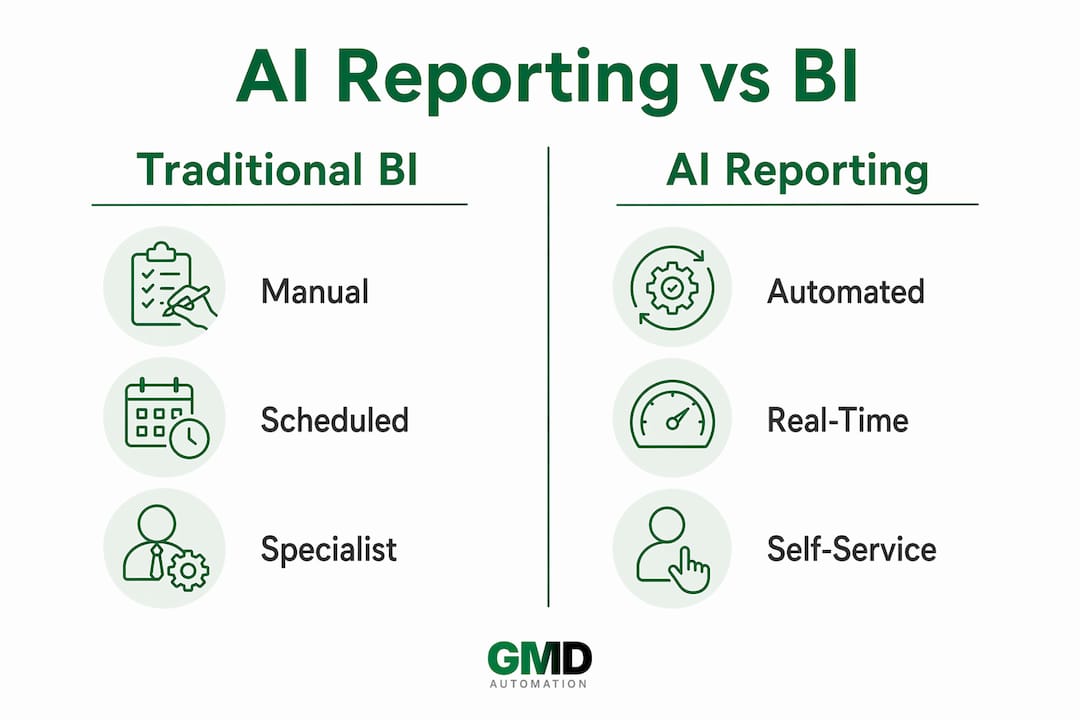
Reduced dependency on data specialists is one of the most significant benefits of AI reporting for UK businesses. When executives can query KPIs in natural language and receive contextual explanations instantly, the bottleneck of waiting for analyst availability disappears. Decisions that previously required a scheduled meeting with a data team can be made in the moment.
What practical use cases demonstrate AI reporting automation's impact?
The clearest evidence for AI reporting automation's value comes from specific business contexts where the shift from manual to automated is measurable.
Finance narrative automation is one of the most mature applications. After a month-end close, finance teams traditionally spend significant time writing variance commentary: explaining why revenue was up 4%, why operating costs exceeded budget, or why a particular cost centre behaved unexpectedly. AI can automate financial narrative writing by drafting those variance explanations directly from structured data, shifting the analyst's role from writing to reviewing. The effort does not disappear, but it moves from creation to validation, which is faster and less error-prone.
Conversational business intelligence for executives is the second major use case. AWS demonstrated this with NarrateAI, an AI-powered assistant that reduced reporting cycle times from hours to minutes for senior leaders. Executives query KPIs in plain English and receive contextual, role-scoped answers. Role-based access control means each user sees only the data relevant to their function, which addresses both security and information overload simultaneously.
Additional use cases where AI reporting automation delivers measurable impact include:
- Automated report scheduling with role-based delivery: Reports are generated and distributed to the right stakeholders at the right time without manual intervention.
- Anomaly detection and alerting: The system flags unexpected movements in KPIs before a human would notice them in a static dashboard.
- Executive summary generation: Multi-page data outputs are condensed into concise written summaries tailored to the reader's seniority and function.
- Cross-department performance reporting: AI generates consistent narratives across sales, operations, finance, and HR data, as explored in cross-department AI automation deployments.
Human review remains non-negotiable across all of these. AI can produce plausible but factually incorrect narratives, particularly when underlying data is ambiguous or when prompt templates have not been calibrated to organisational context. The automation handles volume and speed. Human judgement handles accuracy and accountability.
What are the key considerations for implementing AI reporting automation?
Successful implementation of AI reporting automation depends less on the sophistication of the AI and more on the quality of the foundations beneath it.
-
Prioritise data quality above all else. AI reporting automation can fail silently if data connections or schema change without monitoring. A report that looks correct but draws from a broken pipeline is more dangerous than no report at all. Continuous monitoring and operational alerts are not optional extras; they are prerequisites.
-
Define significance thresholds before deployment. Configurable thresholds control which variances trigger detailed commentary and which are treated as noise. Without these, AI narratives become verbose and lose credibility with readers. Set thresholds based on materiality, not technical defaults.
-
Engineer prompts to match your organisational style. Combining structured data, prompt engineering aligned to your house style, and configurable threshold rules produces the most reliable and scalable AI reporting implementations. A prompt template that reflects how your finance director actually writes will produce outputs that require far less editing.
-
Build governance and auditability into the workflow. Every AI-generated narrative should carry a clear audit trail: which data it drew from, which prompt template it used, and who reviewed it. Oracle's approach of treating AI outputs as decision support only, requiring human verification before distribution, is the right model for regulated industries.
-
Integrate AI outputs with existing review gates. AI reporting automation works best when it fits into existing approval workflows rather than bypassing them. The goal is to arrive at the review stage faster, not to remove the review stage entirely.
Pro Tip: Before selecting AI reporting software, map your existing reporting workflow in detail. The tools that integrate most naturally with your current data warehouse and distribution process will deliver value faster than those requiring significant infrastructure changes.
For organisations considering the architectural side of this, scalable AI automation architecture principles apply directly to how reporting pipelines are designed and maintained at enterprise scale.
Key takeaways
AI reporting automation delivers its greatest value when machine learning and natural language processing are built on a foundation of clean data, governed metrics, and human review gates.
| Point | Details |
|---|---|
| Core definition | AI reporting automation combines data movement with AI-generated narrative interpretation, not just visualisation. |
| Speed advantage | Reporting cycles compress from hours or days to minutes using tools like AWS NarrateAI and Oracle GenAI. |
| Governance is non-negotiable | Silent failures from schema drift and plausible but incorrect narratives make human review and monitoring essential. |
| Threshold configuration matters | Defining significance thresholds before deployment keeps AI narratives focused and credible for business readers. |
| Foundations determine outcomes | Data quality, prompt engineering, and a governed semantic layer determine whether AI reporting scales reliably. |
Why AI reporting automation is more about governance than technology
From my experience working with businesses adopting AI automation, the organisations that struggle most with AI reporting are not the ones with the weakest technology. They are the ones that treat it as a plug-in rather than a process change.
The technology is genuinely impressive. Multi-agent architectures that orchestrate data retrieval, verification, and narrative generation in seconds represent a real step forward from the static dashboards most finance and operations teams still rely on. But I have seen businesses deploy capable AI reporting tools and still produce unreliable outputs six months later, because nobody defined what a significant variance actually means for their business, or because the data pipeline was never properly monitored.
The shift that matters most is the one in roles. When AI handles the writing, analysts become editors and validators. That is a better use of their skills, but it requires a different kind of discipline. Reviewing an AI-generated narrative for accuracy demands more critical thinking than writing one from scratch, because the output looks authoritative even when it is wrong.
The emerging trend of multi-agent AI systems, where distinct agents handle retrieval, verification, and generation separately, will make these tools more reliable over time. But the businesses that benefit most will be those that build governance into the workflow from day one, not those that add it as an afterthought when something goes wrong.
Understanding AI automation at this level of detail is what separates organisations that extract genuine value from those that collect impressive-sounding tools without changing outcomes.
— Ravi
How Gmdautomation supports AI reporting automation for UK businesses
Gmdautomation builds AI automation systems for UK businesses that are ready to move beyond manual reporting without taking on significant technical risk. Their approach covers the full pipeline: data integration, AI narrative generation, role-based access, and ongoing monitoring, all delivered through a predictable monthly subscription with no upfront capital cost. For decision-makers who want to understand what AI reporting automation looks like in practice before committing, Gmdautomation offers a demo built on the same systems they deploy for clients. Visit Gmdautomation to explore how automated reporting can be implemented in your organisation.
FAQ
What is AI reporting automation in simple terms?
AI reporting automation is the use of machine learning and natural language processing to analyse business data and produce written reports automatically, replacing manual data assembly and commentary writing with AI-generated outputs delivered in minutes.
How does AI reporting automation differ from standard automated reporting?
Standard automated reporting handles data integration, transformation, and scheduled delivery. AI reporting automation adds an interpretation layer that identifies trends, flags anomalies, and generates written narrative explanations of what the data means.
Which industries benefit most from AI reporting automation?
Finance, operations, and sales functions see the clearest benefits, particularly for month-end reporting, KPI monitoring, and executive briefings. Any function that produces regular structured reports with written commentary is a strong candidate for automation.
Is human review still necessary with AI reporting automation?
Human review remains essential. AI can produce plausible but incorrect narratives, particularly when data quality is inconsistent or prompt templates are poorly calibrated. AI reporting tools are decision support systems, not final authorities.
What is the biggest risk when implementing AI reporting automation?
Silent failure is the most significant risk. If data pipelines change without monitoring, AI-generated reports can appear correct while drawing from broken or outdated data sources. Continuous operational monitoring is required to prevent this.