

A predictable monthly AI subscription is a single fixed monthly fee covering everything from initial implementation through ongoing operation, maintenance, optimisation, and support, with no upfront capital cost. Gmdautomation, for instance, structures its offering exactly this way, giving UK businesses a production-ready AI system from day one without a large initial invoice.
The five core inclusions you should expect from any credible subscription:
- Implementation: discovery, workflow design, and system build
- Managed operations: day-to-day running of your AI agents and automations
- Maintenance: bug fixes, model updates, and infrastructure upkeep
- Optimisation: performance tuning and prompt or logic refinements over time
- Support: a named contact or team for queries, incidents, and change requests
This guide is written for UK buyers. Where data protection is relevant, the governing body is the Information Commissioner's Office (ICO), and all compliance references below apply to UK law.
Key takeaways
A fixed monthly managed AI subscription is the most practical commercial model for UK businesses that need AI in production without building an internal operations team.
| Point | Details |
|---|---|
| Three-layer pricing | Budget for audit (£460–£1,750), build (—), and a monthly retainer (£1,000–£3,000). |
| Insist on itemised scope | Every recurring task in the retainer should be named, with frequency and accountability stated in writing. |
| Data and exit rights | Confirm code ownership, data export rights, and transition assistance before signing any contract. |
| Measure ROI per workflow | Track time saved and FTE hours recovered against the annualised subscription cost from month one. |
| Gmdautomation | Delivers a zero-upfront, fully managed monthly subscription covering implementation through to ongoing support for UK businesses. |
Table of Contents
- What does a fixed monthly AI subscription actually cover?
- Which UK businesses and teams benefit most?
- What are the decision-level benefits for procurement and IT?
- What should you budget for a monthly AI subscription?
- What should your procurement checklist include?
- What does a typical implementation timeline look like?
- How do you measure ROI and allocate costs internally?
- What are the common pitfalls and hidden costs?
- Gmdautomation's monthly AI subscription for UK businesses
- Why the monthly model is the right call for most UK businesses right now
- Sources
What does a fixed monthly AI subscription actually cover?
The monthly fee in a well-structured managed AI subscription spans several delivery layers. Discovery and audit come first: the vendor maps your workflows, identifies integration points, and produces a written scope. Build and onboarding follow, covering system configuration, API connections, and user acceptance testing. After go-live, the fee covers hosted operational run, meaning the vendor keeps the system running and monitors it. Maintenance handles model drift, dependency updates, and minor logic changes. Optimisation and support round it out, with regular performance reviews and a route to raise issues.
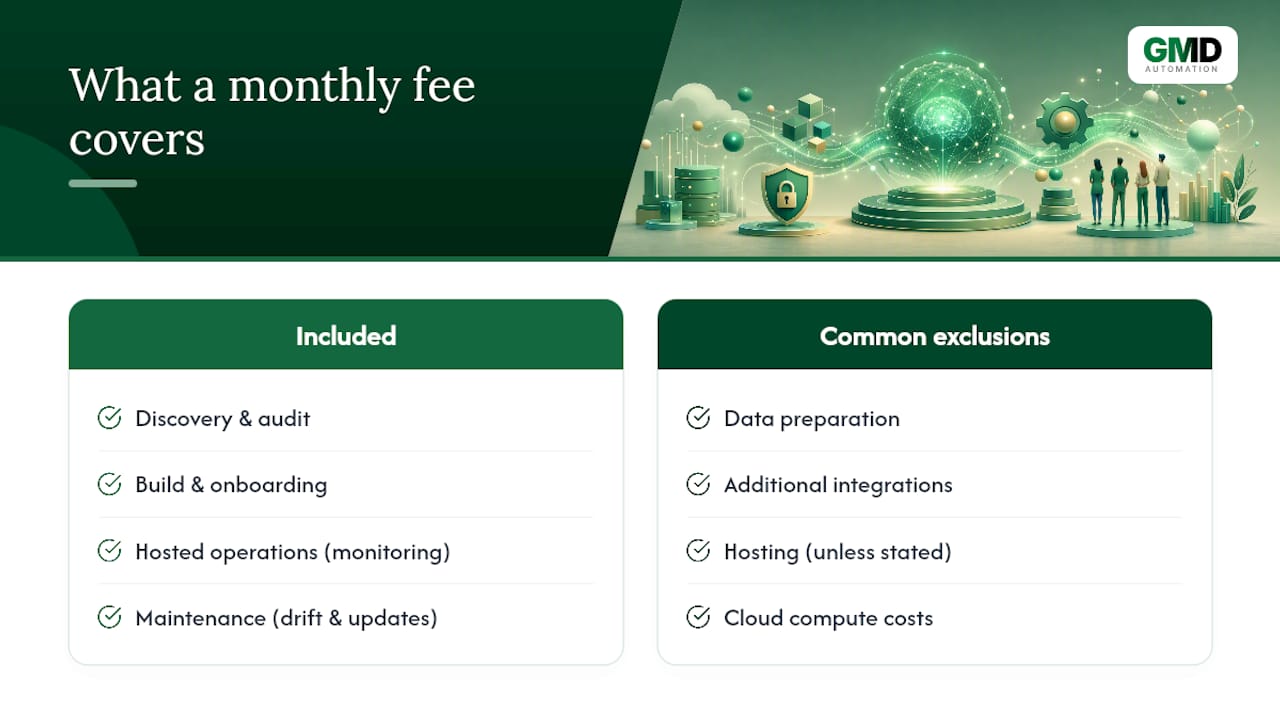
What typically sits outside the headline fee is worth knowing before you sign anything. Managed AI subscriptions commonly use fixed or capped monthly fees but often exclude items such as data preparation, additional integrations, and hosting unless explicitly stated in the contract. Cloud compute costs, third-party software licences (think CRM or telephony platforms), and high-complexity bespoke integrations are the most common extras.
Pro Tip: Vendors frequently label recurring tasks as a 'retainer' or 'managed operations' without specifying what hours or deliverables are included. Insist on a written schedule of services that names each recurring task, the frequency, and who is accountable. A vague retainer label is not a scope.
Which UK businesses and teams benefit most?
The managed monthly model suits organisations that need AI in production but lack the internal team to build, host, and maintain it themselves. A managed intelligence provider combines integration, ongoing optimisation, and stewardship, which is precisely what teams without dedicated AI operations capability need.
Common use cases where the subscription model earns its keep quickly:
- Inbound lead qualification via AI voice agents that handle calls, score leads, and book appointments
- Inbox triage and routing for customer service teams drowning in email volume
- CRM and booking automations that update records and send confirmations without human input
- Customer-facing assistants on websites or messaging channels
- Routine reporting that pulls data, formats it, and distributes it on a schedule
According to UK pricing data, first-year totals vary considerably by size: a single-site business might spend £1,200–£5,000, a small chain £20,000–£50,000, and a mid-market organisation £45,000–£120,000. Those ranges reflect the number of workflows, not just the monthly retainer.
A purely internal office assistant with no customer data or regulated output is one scenario where a full managed retainer may be unnecessary. Customer-facing workflows, regulated data handling, or anything touching financial or health records almost always warrant the vendor stewardship a subscription provides.
What are the decision-level benefits for procurement and IT?
The clearest argument for a fixed monthly subscription is budget predictability. Finance can book the cost as an operating expense rather than a capital project, which simplifies approval and avoids depreciation schedules.
Beyond accounting, the model accelerates operationalisation. Most internal AI projects stall between proof-of-concept and production because the team that built the demo cannot also own monitoring, retraining, and incident response. A managed subscription transfers that operational burden to the vendor.
Treating AI model access as managed infrastructure reduces vendor lock-in and turns model swaps into configuration changes rather than full re-integrations. That matters when the underlying model landscape shifts, which it does frequently. The benefits of managed AI service models for UK businesses include cost control, flexibility, and reduced operational risk, all of which procurement teams can present to a board without needing to explain transformer architectures.
What should you budget for a monthly AI subscription?
UK AI automation pricing typically splits into three layers:
The G-Cloud framework lists certain managed AI service components at £460–£1,750 per unit, illustrating how vendors can quote in 'units' that obscure what you are actually buying. Always ask what one unit means in hours or deliverables.
Some providers publish higher retainer entry points for complex deployments, often running into several thousand pounds per month with minimum contract terms. Those figures are not outliers for complex, multi-workflow deployments.
Two worked examples:
- Single-site retailer, one workflow (AI voice agent for inbound calls): Audit £1,000, build £4,000, retainer £1,200/month. Year-one total: approximately £19,400.
- Mid-market professional services firm, three workflows (lead qualification, inbox triage, reporting): Audit £1,500, build £30,000 across three workflows, retainer £2,500/month. Year-one total: approximately £61,500.
For AI cost optimisation across multiple workflows, rightsizing the retainer to match actual usage is one of the fastest ways to reduce steady-state spend.
What should your procurement checklist include?
Before signing any managed AI contract, get written answers to these questions:
- What exactly does the monthly fee cover, and what triggers an additional charge?
- How are retainer hours accounted for, and do unused hours roll over?
- Who owns the code, models, and data at the end of the contract?
- What are the export and exit rights, and is transition assistance included?
- What SLAs apply, and what remedies exist if they are missed?
- How is scope change handled, and is there a pricing cap on annual increases?
The questions to ask AI vendors checklist covers these in detail. For the contract itself, insist on: a written schedule of deliverables, a data export clause, named security certifications (ISO 27001 is the baseline for UK enterprise), and a defined scope for retainer hours.
Pro Tip: A retainer that is actually an open-ended senior day rate in disguise will have no fixed deliverables, no defined hours, and language like "as required" or "on request." If the contract cannot tell you what you receive each month for the fee, it is a time-and-materials arrangement with a monthly invoice, not a subscription.
Build-versus-buy decisions must factor in total cost of ownership, including people, governance, monitoring, and change-driven maintenance. A managed subscription often wins on TCO when the alternative requires hiring two or three specialist roles.
What does a typical implementation timeline look like?
Most managed AI rollouts follow four phases:
- Discovery and audit: two days to two weeks, depending on workflow complexity and data readiness
- Build: one to six weeks per workflow; a simple voice agent is faster than a multi-system CRM integration
- Testing and handover: half a day to two weeks; client team runs acceptance tests against agreed criteria
- Steady-state operations: ongoing from go-live; vendor owns monitoring, model updates, and incident response
The vendor handles integration work, infrastructure, and model swaps. Your team supplies subject-matter experts for requirements sign-off, clean data exports, and acceptance testing. Three internal preconditions that speed every rollout: a clean CRM export with mapped fields, documented business rules for the workflow, and a named internal sponsor with authority to approve changes.
For technical teams, scalable AI automation architecture guidance explains how managed subscriptions are structured to grow without re-platforming.
How do you measure ROI and allocate costs internally?
Start with a clear success metric for each workflow before go-live. Time saved per week, FTE hours recovered, lead conversion rate, and error reduction are the four most commonly tracked figures.
Tag monthly retainer costs by team or workflow in your finance system. That makes usage visible and supports internal chargebacks if multiple departments share the subscription.
A simple 12-month ROI calculation for a single workflow:
- Baseline cost: staff hours performing the task manually, multiplied by fully loaded hourly rate
- Subscription cost: audit + build (amortised over 12 months) + 12 months of retainer
- Net saving: baseline minus subscription cost
- ROI: net saving divided by subscription cost, expressed as a percentage
What are the common pitfalls and hidden costs?
The most frequent procurement mistakes centre on scope ambiguity. Watch for:
- Repeated data preparation charges: some vendors bill data cleaning as a separate line item every time a workflow is updated
- Opaque hosting fees: compute costs bundled into the retainer without a cap or passed through at cost without notice
- Account-setup fees: charges for trivial configuration that should be part of onboarding
- Vague SLAs: response-time commitments with no defined remedies if missed
- Price change clauses without caps: contracts that allow unlimited annual increases with 30 days' notice
That single addition eliminates the most common source of budget surprises at renewal.*
Gmdautomation's monthly AI subscription for UK businesses
Gmdautomation delivers a fully managed AI subscription with zero upfront cost, covering implementation, managed operations, monitoring, optimisation, and named support in a single monthly fee. The offering maps directly to the procurement checklist above: written scope, defined deliverables, data ownership retained by the client, and transition assistance included.
Whether you need an AI voice agent for inbound calls, automated inbox triage, or social media management, Gmdautomation builds and operates the system while your team focuses on the outcome. Pricing sits within the typical UK bands described in this guide, and the subscription can scale as workflows are added.
To get a written scope and price estimate for your specific workflows, visit Gmdautomation and request a consultation.
Why the monthly model is the right call for most UK businesses right now
The conventional wisdom says AI adoption is a technology decision. Having worked through the numbers with UK clients across retail, professional services, and operations-heavy sectors, the real barrier is almost never the technology. It is the operational commitment that follows go-live: who monitors it, who fixes it at 11pm, who retrains it when the business changes.

A predictable monthly subscription answers that question before it becomes a crisis. It converts an open-ended operational liability into a defined line on a budget. The businesses that struggle with AI are not the ones that chose the wrong model; they are the ones that built something, celebrated the demo, and then discovered nobody owned the production system.
The managed subscription model is not perfect. Vendor quality varies, and a poorly scoped retainer can cost more than an in-house hire. But for most UK businesses evaluating AI automation in 2026, the monthly subscription is the fastest route from evaluation to measurable value, provided the contract is written correctly.
Sources
- AI automation pricing UK 2026: real ranges by business size (Reeve Consult)