

Automation is a revenue multiplier when it targets the friction points that slow selling, delay billing, and erode customer retention. Not a replacement for strategy or talent, but a force that removes the drag between intent and outcome. McKinsey research finds roughly one third of sales tasks are automatable today, with field examples showing cost reductions of 10–15% and sales uplifts of up to 10%. HubSpot's 2024 sales research puts the time reclaimed from administrative tasks at roughly two hours per seller per day. That is time redirected to pipeline, not paperwork.
The highest-impact areas to prioritise first:
- Lead routing and qualification: instant assignment to the right rep at the right moment, before intent cools
- Quote and CPQ automation: proposals generated in minutes rather than days, removing a common deal-stall
- Billing and revenue recognition: automated allocation and reporting that closes the gap between delivery and cash
- Expansion and renewal triggers: behaviour-based signals that prompt upsell or retention action before a customer churns
The rest of this guide unpacks each of these in detail, covers where automation fails, and gives a practical roadmap any UK business can follow.
Table of Contents
- What does revenue automation actually cover?
- How does automation create value at each stage of the customer lifecycle?
- Which capabilities and technologies should you prioritise?
- Where does automation fail, and what is the automation paradox?
- UK case studies and vendor evaluation checklist
- Key takeaways
- The gap between automation's promise and what actually moves revenue
- Ready to run a revenue automation pilot with Gmdautomation?
- Useful sources and further reading
What does revenue automation actually cover?
The term "revenue automation" is used loosely, so a working definition matters. In its specific sense, revenue automation refers to the end-to-end use of software and rules to automatically recognise, allocate, and report revenue, reducing manual spreadsheet work and the compliance risk that comes with it. In its broader sense, it covers every automated process that directly influences whether a deal is won, how fast cash is collected, and whether a customer stays and grows.
General process automation (automating an HR onboarding form, for instance) is adjacent but distinct. Point solutions that automate one narrow task without connecting to the revenue system are also different. Revenue automation connects the dots across sales, finance, and customer success so that data flows and decisions happen without manual handoffs.
| Department | Processes typically included |
|---|---|
| Sales | Outbound sequences, lead scoring, lead routing, CPQ/quoting, contract generation |
| Marketing | Campaign triggers, lead nurturing, intent-signal routing |
| Finance | Billing, invoicing, revenue recognition, DSO management, reporting |
| Customer success | Onboarding workflows, health scoring, renewal alerts, expansion triggers |
| Operations | SLA monitoring, escalation routing, capacity alerts |
What revenue automation does not do:
- Replace a seller's judgement on a complex, high-stakes deal
- Fix a broken go-to-market strategy or a poorly defined ICP
- Compensate for dirty, incomplete, or siloed data
- Eliminate the need for human oversight of automated decisions
Those boundaries matter. Organisations that treat automation as a strategy substitute rather than an execution accelerator consistently underdeliver on their investment.
How does automation create value at each stage of the customer lifecycle?
The role of automation in revenue growth is clearest when you trace it stage by stage. Each phase of the customer journey has a specific friction point; automation removes it and the commercial impact is measurable.
Demand generation
Automated campaign orchestration means the right message reaches the right segment at the right moment without a marketing manager manually scheduling each send. Behavioural triggers, intent data feeds, and dynamic content personalisation all operate at a scale no human team can match. The result is higher conversion from marketing spend, not more spend.
Lead qualification and routing
Speed-to-lead is one of the most underestimated revenue levers in B2B sales. An inbound lead that waits 24 hours for a response converts at a fraction of the rate of one contacted within five minutes. Automated scoring and routing eliminates that lag entirely. The lead hits the CRM, scores against your ICP criteria, and lands in the right rep's queue in seconds. For UK businesses running distributed or hybrid sales teams, this is particularly valuable.
Salesforce's State of Sales report identifies AI agents as the top growth tactic for 2026, projecting a 34% reduction in prospect research time and a 36% reduction in content creation time for sales teams that deploy them well.
Opportunity progression and closing
The mid-funnel is where deals stall. Proposals sit waiting for approval. Contracts go back and forth. Pricing exceptions require a manager who is in three other meetings. CPQ (configure, price, quote) automation addresses all three: it generates accurate, approved proposals in minutes, routes exceptions automatically, and triggers contract generation on verbal agreement. Shorter sales cycles mean more deals closed per quarter without adding headcount.
| Stage | Automation pattern | Revenue impact | KPI to watch |
|---|---|---|---|
| Demand generation | Behavioural triggers, dynamic content | Higher conversion from existing spend | MQL volume, cost per MQL |
| Lead qualification | AI scoring, instant routing | Faster response, higher connect rate | Speed-to-lead, lead-to-opportunity rate |
| Quoting and closing | CPQ, contract automation | Shorter sales cycle, fewer lost deals | Days to quote, win rate |
| Billing | Automated invoicing, revenue recognition | Faster cash collection, fewer errors | DSO, billing error rate |
| Expansion | Health scoring, renewal triggers | Higher NRR, lower churn | Net revenue retention, expansion rate |
Onboarding, billing, and expansion
Post-sale is where revenue automation pays its most overlooked dividend. Slow onboarding delays time-to-value and increases early churn. Manual billing creates errors that damage trust and delay payment. Automated onboarding sequences, billing workflows, and health-score triggers keep customers moving forward and surface expansion opportunities before a competitor does.
Process automation increases productivity, reduces errors, and improves turnaround times, translating directly into faster revenue realisation across the billing and customer success cycle.
Which capabilities and technologies should you prioritise?
Knowing what to build or buy first is where most leaders get stuck. The honest answer is that the technology matters less than the sequence.
Core capabilities in priority order:
- Data unification: a single, clean view of the customer across CRM, billing, and product usage data. Without this, every downstream automation is working from incomplete information.
- CRM and billing integration: the connective tissue between sales activity and financial outcome. If your CRM and billing system do not talk to each other, revenue recognition is always a manual reconciliation exercise.
- Orchestration layer: the rules engine or workflow platform that coordinates triggers, approvals, and handoffs across systems. This is what turns individual automations into a connected revenue process.
- RPA for high-volume, rule-driven tasks: robotic process automation handles repetitive data movement reliably. It is not intelligent, but it is consistent, and consistency in billing and reporting has real financial value.
- AI decisioning and agents: the layer that handles judgement calls at scale, from lead scoring to churn prediction to dynamic pricing recommendations.
Intelligent automation, combining RPA with AI, delivers the strongest results when tied to clear business problems, clean data, and governance. RPA moves data reliably; AI adapts decisions where rules alone are brittle.
Integration checklist before committing to a vendor:
- Does the vendor offer documented APIs for your CRM, billing platform, and data warehouse?
- Is single sign-on (SSO) and role-based access control supported natively?
- What is the data residency model, and does it meet UK GDPR requirements?
- Are SLAs defined for uptime, incident response, and data processing?
- Can the vendor demonstrate a working integration with your existing tech stack, not just a slide deck?
For IT leaders evaluating vendor fit in depth, the API integration guide for AI automation tools covers the technical due diligence in detail.
Where does automation fail, and what is the automation paradox?
Automation scales what already exists. That is its power and its risk in equal measure.
The automation paradox is this: deploying more automation without redesigning the underlying process or centralising your data does not improve performance. It accelerates the existing dysfunction. A broken lead routing process, automated, routes leads badly at higher speed. A billing workflow built on inconsistent product data produces more errors, faster.
Gartner warns that without a centralised context layer, AI agents will create "agent sprawl" and likely underdeliver on productivity. Gartner predicts AI agents will outnumber sellers 10 to 1 by 2028, yet fewer than 40% of sellers will say agents improved their productivity. The problem is not the agents. It is the absence of shared context.
Common failure modes:
- Poor data quality: incomplete CRM records, duplicate contacts, and inconsistent product catalogues corrupt every automated decision downstream
- Fragmented tech stacks: point solutions that do not share data create handoff gaps that automation cannot bridge
- No clear owner: automated decisions need a human accountable for the outcome, not just the configuration
- Weak change management: sellers who distrust automated routing or scoring will work around it, destroying the data feedback loop
Pro Tip: Before deploying any AI agent or automation workflow, run a half-day data readiness audit. Map the fields your automation will read, check completeness rates, and fix the top three gaps. An hour of data hygiene prevents weeks of debugging.
Mitigation priorities:
- Build or designate a centralised context layer before adding agents
- Automate one process at a time, measure it, then move to the next
- Define guardrails for every AI agent: what it can decide autonomously and what requires human approval
- Publish a measurement plan before go-live so success is defined, not debated after the fact
Automation paired with AI and clean data enables personalised experiences at scale and improves employee satisfaction, but only when deployed with genuine change management investment.
UK case studies and vendor evaluation checklist
What revenue impact looks like in practice
A UK-based SaaS business with a 15-person sales team automated lead routing and CPQ in a single 90-day pilot. Before automation, average time to quote was four days; after, it was under four hours. Sales cycle length dropped by roughly three weeks. The team closed the same number of deals with two fewer sales operations staff reassigned to higher-value work.
A professional services firm in the Midlands automated its billing and revenue recognition workflow, eliminating a manual month-end reconciliation that previously took three days. DSO fell, cash flow improved, and the finance team redirected the recovered time to forecasting and commercial analysis.
These are not outliers. They reflect what happens when automation targets a specific, measurable friction point rather than attempting a wholesale transformation. For more real-world AI process automation examples from UK deployments, the case study library covers a range of sectors and team sizes.
Vendor evaluation checklist
Before committing to any automation vendor or managed service, validate these signals:
- Data access: can the vendor connect to your CRM, billing system, and data warehouse without a multi-month integration project?
- Security posture: ISO 27001 certification or equivalent; documented penetration testing; clear data breach notification process
- UK GDPR compliance: data processing agreements in place; data residency confirmed; automated decision-making documented under Article 22 where applicable
- Managed support: is ongoing optimisation included, or does the contract end at deployment?
- Scalability evidence: can the vendor demonstrate the solution running at your target transaction volume?
- Commercial model: subscription (opex) preferred for flexibility; confirm what is included in the monthly fee versus what triggers additional charges
Readiness signals that predict fast ROI:
- CRM data completeness above 80% for key fields (name, company, stage, close date)
- At least one documented, measurable process that is currently manual and high-volume
- A named internal owner for the automation programme with budget authority
- IT team able to provide API access and confirm data residency requirements within two weeks
For UK-specific compliance and procurement considerations, the AI automation benefits guide for UK firms covers GDPR, data residency, and contracting in detail.
Key takeaways
Automation drives measurable revenue growth when it targets specific friction points across the sales, billing, and customer success cycle, backed by clean data and a clear measurement plan.
| Point | Details |
|---|---|
| Revenue-first prioritisation | Target lead routing, CPQ, billing, and expansion triggers before broader process automation. |
| Data readiness is the foundation | CRM completeness above 80% and integrated billing data are prerequisites, not nice-to-haves. |
| Measure before you scale | Baseline every KPI before the pilot; publish results to unlock funding for the next phase. |
| Avoid agent sprawl | Deploy a centralised context layer before adding AI agents, or risk scaling noise rather than performance. |
| Gmdautomation for UK businesses | Gmdautomation delivers fully managed AI automation on a monthly subscription, covering implementation, compliance, and ongoing optimisation with zero upfront cost. |
The gap between automation's promise and what actually moves revenue
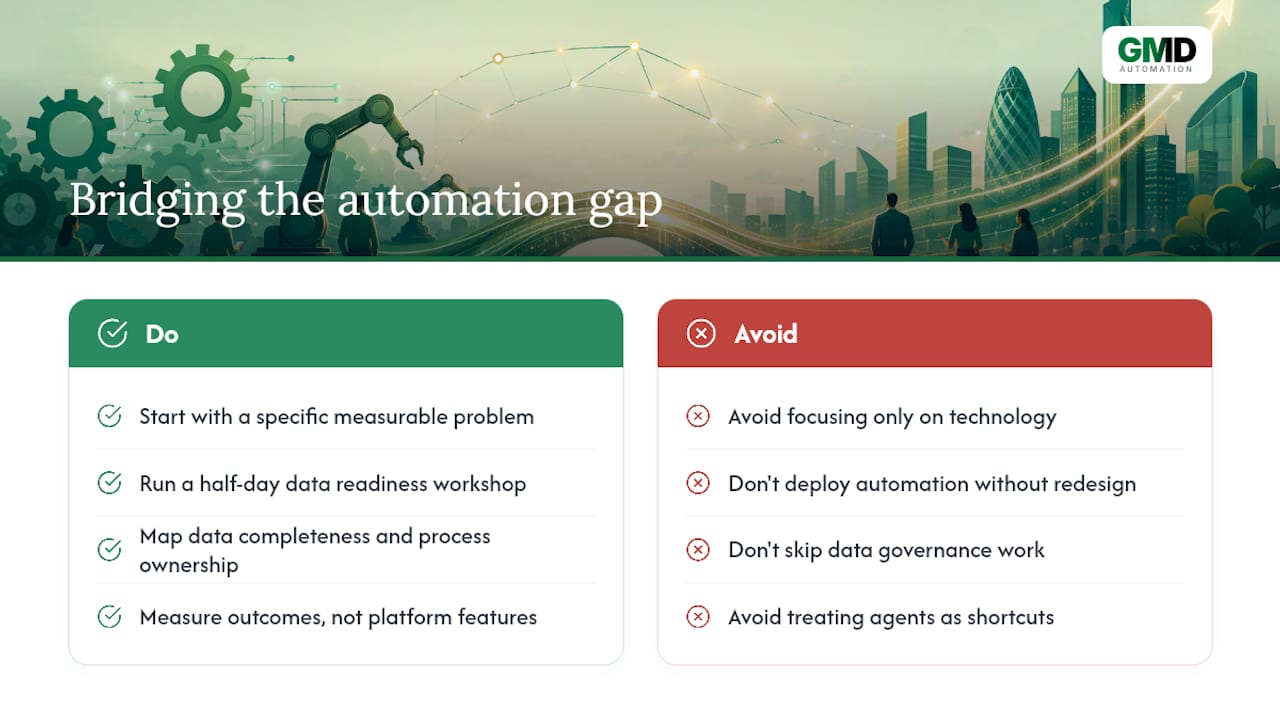
There is a version of the automation conversation that focuses almost entirely on technology: which platform, which AI model, which integration. That conversation misses the point more often than it lands.
The organisations that see genuine revenue impact from automation share one characteristic that has nothing to do with the software they chose. They started with a specific, measurable problem. Not "we want to automate our sales process." Something like: "Our average time to quote is four days and we lose deals to competitors who respond in hours." That specificity is what makes the difference between a pilot that produces a number and a deployment that produces a slide.
The automation paradox is real and it catches out experienced leaders. More automation, deployed without redesigning the process or cleaning the data, scales the existing problem. The Gartner warning about agent sprawl is not a theoretical risk. It is what happens when organisations treat AI agents as a shortcut to skip the harder work of data governance and process design.
The practical implication: the half-day data readiness workshop before any vendor conversation is not a delay. It is the fastest path to a result. Every hour spent mapping data completeness and process ownership before deployment saves weeks of debugging after it.
Automation and business growth are genuinely connected, but the connection runs through specificity, measurement, and governance, not through the feature list of whichever platform is currently being marketed most aggressively.
Ready to run a revenue automation pilot with Gmdautomation?
Most UK businesses that come to Gmdautomation have already tried a point solution or two and found the ROI elusive. The reason is almost always the same: deployment without managed optimisation, and no clear measurement plan from day one.
Gmdautomation's managed subscription model covers the full cycle: implementation, integration, compliance, and ongoing optimisation, all for a fixed monthly fee with no upfront capital cost. That means your pilot is live in weeks, not months, and the team managing it is accountable for outcomes, not just delivery. Every deployment is built to UK GDPR standards with data residency confirmed before a single workflow goes live.
If you have a specific revenue friction point, a slow quote process, a manual billing cycle, a lead routing gap, that is enough to start. Book a discovery call with Gmdautomation and get a scoped pilot proposal within five working days.
Useful sources and further reading
The following sources informed this guide and are worth reading directly for deeper context:
- Sales automation: The key to boosting revenue and reducing costs — McKinsey
- How automation drives business growth and efficiency — Harvard Business Review (sponsored)
- Gartner predicts AI agents will outnumber sellers 10 to 1 by 2028 — Gartner
- Salesforce announces State of Sales report for 2026 — Salesforce
- How AI is driving business growth in 2026 — Cloudxbloom
- Revenue Automation: A Complete Guide — Zuora
- HubSpot Sales Trends report — HubSpot (2024)
- Top 10 benefits of business process automation — Valcon
For UK-specific implementation guidance, the Gmdautomation blog covers measured business outcomes, ROI calculation, and sector-specific examples in detail.