

Budgeting for AI tools is defined as segmenting technology spend into discrete, usage-calibrated line items rather than treating AI as a single licence cost. Most businesses that struggle with AI costs do so because they forecast based on headcount alone, ignoring the consumption-driven reality of modern AI platforms. Tools like ChatGPT Enterprise, Microsoft Copilot, and Anthropic's Claude each bill differently, and a single deployment can involve licences, API compute, governance overhead, and unmanaged shadow usage simultaneously. Per-employee AI spending averages £1,600 per year, yet total programme costs routinely run two to four times that figure once hidden categories surface. Understanding how businesses budget for AI tools properly means building a framework that captures all four cost layers from day one.
What are the main cost categories in business AI budgeting?
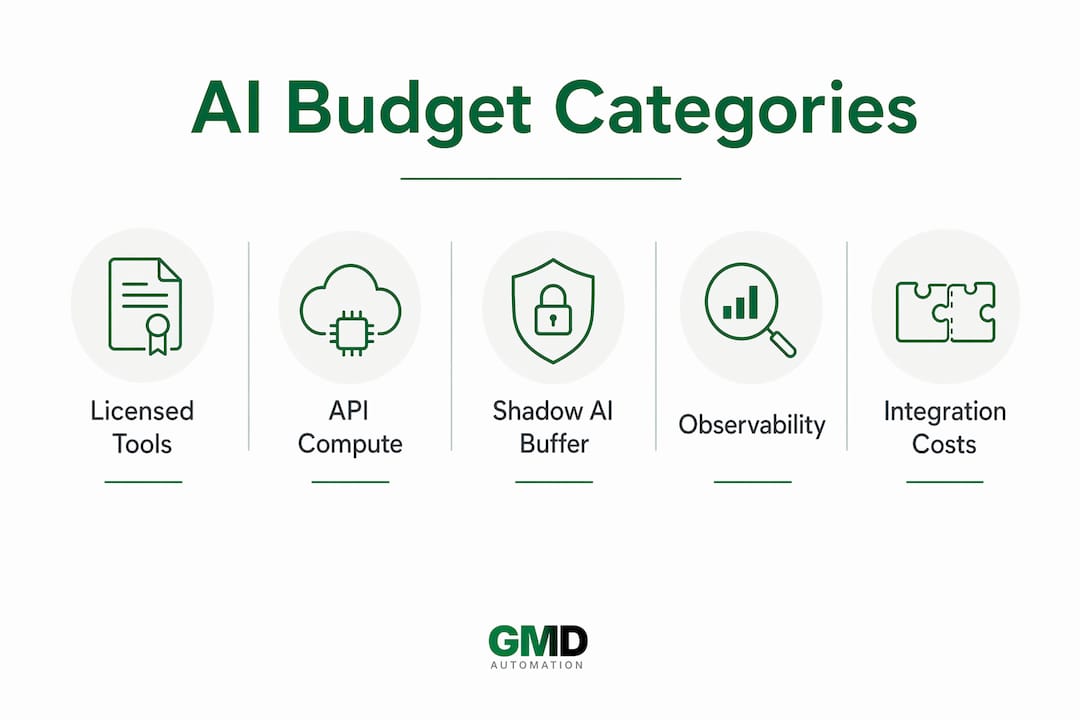
AI budgets divide into four finance-friendly categories: licensed tools, API compute, shadow AI buffer, and observability. Each category behaves differently and requires a distinct sizing rule.
Licensed per-seat tools cover products like Microsoft Copilot at £25 per user per month and ChatGPT Enterprise, which is priced by negotiated contract. These costs are predictable and map directly to headcount, making them the easiest line item to defend in a board review. The risk is treating them as the whole budget rather than the visible tip of a larger spend.

API compute covers model inference and embedding workflows called programmatically. Unlike seat licences, API costs scale with usage volume, not user count. A customer service automation that handles 10,000 queries per day will generate meaningfully different API bills in January versus December peak periods.
Shadow AI refers to unapproved AI tool usage across the organisation. Employees independently subscribing to tools like Perplexity, Midjourney, or niche vertical AI products create duplicated spend that never appears on the IT procurement register. Budgeting 15 to 25% of licensed tool spend as a shadow AI buffer is the accepted industry practice for maintaining financial transparency.
Observability and monitoring covers the dashboards, logging infrastructure, and alerting systems that track AI performance and cost in production. This category typically runs 15 to 20% of API spend and is almost always underfunded in first-year budgets.
| Category | Sizing rule | Budgeting approach |
|---|---|---|
| Licensed tools | Per seat, per month | Fixed line item tied to headcount plan |
| API compute | Per token or per call | Variable, modelled from usage forecasts |
| Shadow AI buffer | 15–25% of licensed spend | Contingency reserve reviewed quarterly |
| Observability | 15–20% of API spend | Operational overhead, not optional |
Pro Tip: Build your shadow AI buffer as a named line item in the budget from the outset. Finance teams that treat it as a contingency rather than a planned expense consistently underreport true AI costs.
How does token-based budgeting change AI cost management?
AI spend is better forecasted by token consumption than by licence count or user numbers. A token is the basic unit of text that a language model processes, roughly equivalent to three quarters of a word in English. Every prompt sent to a model and every response generated consumes tokens, and the bill accumulates at the token level, not the session level.
The forecasting challenge is that token consumption varies enormously by use case. A simple classification task might consume 200 tokens per query. A retrieval-augmented generation workflow that pulls context from a document store before answering can consume 4,000 tokens for the same apparent user action. This variability means that naïve per-user estimates produce budgets that are structurally wrong before the first invoice arrives.
Token budget models must include multipliers for tool-call chains, retry overhead, and retrieval-augmented turns. In agentic AI systems, a single user request can trigger a chain of model calls: one to interpret intent, one to query a database, one to format a response, and potentially one or two retries if the model output fails a validation check. The real cost of that interaction is five to seven times the cost of a single model call.
- Map each AI workflow to its token consumption profile before budgeting, not after deployment
- Model best-case, expected, and peak-load scenarios for each workflow separately
- Apply a tool-call multiplier of three to five for agentic or multi-step workflows
- Add a 20% retry buffer for any workflow that calls external APIs or validates outputs
- Revisit token forecasts monthly for the first quarter of any new deployment
"CFOs must shift towards governance and strategy-grounded spend planning focused on token economics, viewing AI as a variable consumption cost, not fixed overhead." — Deloitte, AI token economics for CFOs
Pro Tip: Ask your AI vendor for a token consumption report from a comparable customer deployment before you model your own forecast. Vendors like OpenAI and Anthropic can often share anonymised benchmarks that are far more accurate than internal estimates.
What hidden costs do businesses often overlook when budgeting for AI?
Hidden AI costs at scale run three to five times higher than visible licence fees. This is the single most consequential fact in AI financial planning, and most organisations discover it only after their first production deployment.
Inference at production scale is the most common shock. Pilot costs are calculated on low-volume test traffic. Production volumes can be ten times higher within weeks of launch, particularly for customer-facing applications. A chatbot that cost £500 per month in testing can cost £5,000 per month serving real users at scale.
Integration and engineering costs cover the work required to connect AI tools to existing data infrastructure, build prompt maintenance workflows, and keep integrations current as vendor APIs change. These costs are labour costs, not software costs, and they are rarely included in initial business cases. For a mid-sized UK business, a single AI workflow integration can require 40 to 80 hours of engineering time to deploy and ongoing maintenance thereafter.
Governance, security, and change management may represent 10 to 20% or more of total AI programme budgets. This category covers data privacy reviews, staff training, process redesign, and the internal communications required to drive adoption. Businesses that skip this investment frequently report low utilisation of AI tools they have already paid for, which is the most expensive outcome of all. For UK businesses, compliance with the ICO's guidance on AI and data protection adds a further governance layer that carries real cost.
| Cost type | Visibility | Typical proportion of total budget |
|---|---|---|
| Licence fees | High | 25–35% |
| API compute | Medium | 20–30% |
| Integration and engineering | Low | 15–25% |
| Governance and change management | Very low | 10–20% |
| Shadow AI and observability | Very low | 10–15% |
Understanding AI automation business benefits requires accounting for these hidden costs alongside the productivity gains, otherwise the ROI calculation is built on incomplete data.
How can continuous monitoring and forecast-vs-budget reviews optimise AI spending?
Daily monitoring and forecast-vs-budget review loops allow teams to detect overruns early and act before invoices arrive. This is the operational discipline that separates organisations that control AI costs from those that discover problems at month end.
A production-grade monitoring setup tracks spend across four dashboard categories: inference costs by model and provider, compute and storage for any self-hosted components, networking costs for data transfer, and licence utilisation rates. Each category should have a weekly budget threshold that triggers a review when breached, not a monthly one.
The practical steps for implementing effective monitoring are:
- Set daily spend alerts at 80% and 100% of the pro-rated daily budget for each AI service
- Review forecast-vs-actual weekly with both the engineering lead and the finance owner
- Identify the top three cost-driving workflows each week and assess whether their output justifies the spend
- Maintain a pre-approved list of corrective actions: pausing non-critical features, capping workflow volumes, or switching to a lower-cost model tier
- Run a formal monthly review that feeds findings back into the next quarter's budget forecast
The corrective action list is the detail most organisations miss. When a spend alert fires at 11pm on a Tuesday, the team needs a pre-authorised playbook, not an emergency meeting. Switching from GPT-4o to GPT-4o mini for lower-stakes classification tasks, for example, can reduce inference costs by 60 to 80% with minimal quality impact.
Pro Tip: Use virtual tagging on every API call to capture user, feature, and routing metadata. Accurate cost allocation by feature and team makes it possible to charge back costs to the business unit generating them, which changes spending behaviour faster than any policy document.
What practical steps should businesses take to build an AI budgeting strategy?
Effective financial planning for AI tools starts with collecting 90 days of historical spend data across all AI-related services, including any personal subscriptions employees are expensing. Without a baseline, every forecast is a guess.
Once you have a baseline, the practical steps are:
- Segment costs into the four categories described above: licences, API compute, shadow AI buffer, and observability. Assign an owner to each category.
- Model usage forecasts at the workflow level, not the tool level. Each workflow has a distinct token profile and growth trajectory.
- Set per-employee budgets for knowledge workers using licensed tools. Many firms budget £80 to £240 per knowledge worker per month, which provides a useful sanity check against bottom-up workflow estimates.
- Align AI spend with strategic goals. Each AI investment should map to a measurable productivity outcome. If a workflow cannot be tied to a time saving, error reduction, or revenue contribution, it should not be in the budget.
- Reserve explicitly for shadow AI and observability as named line items, not contingencies. This is the difference between a budget that survives contact with reality and one that does not.
- Include adoption and change management costs from the outset. Unused AI tools are the most expensive category of all.
For UK businesses exploring affordable AI strategies, the per-employee budgeting model is particularly useful because it scales proportionally with headcount and is easy to defend to a board that is sceptical of open-ended technology spend.
Pro Tip: Run a quarterly shadow AI audit by surveying department heads on which AI tools their teams are using independently. The results consistently reveal three to five unbudgeted tools per department in organisations with more than 50 employees.
Key takeaways
Businesses that budget for AI tools accurately treat it as a variable consumption cost segmented into four categories, not a fixed licence overhead, and they build monitoring loops that catch overruns before invoices arrive.
| Point | Details |
|---|---|
| Four-category framework | Split AI spend into licences, API compute, shadow AI buffer, and observability from day one. |
| Token-based forecasting | Model token consumption per workflow, including tool-call multipliers, not per user or per seat. |
| Hidden costs dominate | Total AI programme costs run two to four times initial licence estimates when integration and governance are included. |
| Daily monitoring matters | Forecast-vs-actual reviews must be weekly, with pre-approved corrective actions ready to deploy. |
| Per-employee benchmarking | Budget £80 to £240 per knowledge worker per month as a cross-check against bottom-up workflow forecasts. |
Why most AI budgets fail before the second quarter
I have reviewed AI budgets across dozens of UK business deployments, and the pattern is almost always the same. The initial budget is built by someone who understands the technology and someone who understands finance, but they are not in the same room at the same time. The result is a licence cost that is accurate and an everything-else that is a rounding error.
The token economics shift is the part that catches most finance teams off guard. They are accustomed to software that costs a fixed amount per user per month. AI platforms that bill per token processed are fundamentally different. A single agentic workflow can cost more in one afternoon of heavy usage than a seat licence costs in a month. Until finance teams internalise that AI is a utility cost, not a software cost, budgets will keep breaking.
The other lesson I keep returning to is that governance and change management are not soft costs. They are the costs that determine whether the technology investment generates any return at all. I have seen organisations spend £200,000 on AI tooling and achieve near-zero adoption because nobody budgeted for the training, the process redesign, or the internal communications required to make the tools part of daily work. The technology worked. The budget did not account for the human side of deployment.
The businesses that get this right build a cross-functional AI finance committee that meets monthly, includes both engineering and finance representation, and has authority to reallocate budget between categories as usage data arrives. That governance structure is worth more than any forecasting model.
— Ravi
How Gmdautomation helps UK businesses control AI costs
Unpredictable AI costs are one of the primary reasons UK businesses delay or abandon AI adoption. Gmdautomation is built specifically to remove that barrier. Their AI automation solutions for UK businesses operate on a predictable monthly subscription that covers implementation, operation, maintenance, and ongoing optimisation. There are no upfront capital costs and no invoice surprises driven by token overruns or unplanned engineering work. For business owners who want the productivity gains of enterprise-grade AI without the budgeting complexity described in this article, Gmdautomation offers a transparent, fixed-cost model that makes financial planning straightforward. Explore their services to see how AI automation can be deployed affordably and at scale for your organisation.
FAQ
What are the four main categories in an AI budget?
The four categories are licensed tools, API compute, shadow AI buffer, and observability. Each requires a distinct sizing rule and a named budget owner to maintain financial clarity.
Why do AI costs often exceed initial estimates?
Total AI programme costs run two to four times initial licence estimates because integration, engineering, governance, and change management costs are rarely included in first-pass budgets.
What is token-based budgeting and why does it matter?
Token-based budgeting models AI costs by the volume of text processed rather than by user count. Token variability requires explicit demand modelling because a single agentic workflow can trigger multiple model calls, making per-seat estimates structurally inaccurate.
How much should a business budget per employee for AI tools?
Many firms budget £80 to £240 per knowledge worker per month for licensed AI tools, though total per-employee costs including compute and governance are typically higher.
What is shadow AI and how should it be budgeted?
Shadow AI is unapproved AI tool usage by employees outside formal procurement. Reserving 15 to 25% of licensed tool spend as a shadow AI buffer is the accepted practice for maintaining budget accuracy and financial transparency.