

DevOps and MLOps are the operational disciplines that turn AI prototypes into secure, auditable, and production-ready services. Without them, a model is just a notebook. With them, it becomes a governed system that can be deployed, monitored, rolled back, and defended in front of an auditor. For UK businesses evaluating managed AI services, the practical question is not whether to use these practices, but whether your provider has actually built them in.
The controls that deliver secure, compliant, and scalable AI deployments are:
- Gated CI/CD pipelines with automated validation before every promotion to production
- A model registry that records lineage: datasets, code commits, metrics, and human approvals
- Write-once audit logs that satisfy ICO accountability expectations
- Continuous monitoring for drift, latency, and business KPI degradation
- A named platform owner with clear governance accountability
For most UK businesses, buying a managed MLOps service is faster and lower-risk than building in-house. The engineering depth required, particularly for UK regulatory compliance, takes years to assemble. A managed subscription with compliance included from day one is the more defensible starting position.
Table of Contents
- What does DevOps actually do in an AI deployment?
- What do UK regulations require from your MLOps pipeline?
- What tests must run before a model goes to production?
- How does platform engineering keep AI services affordable and reliable?
- Who owns the AI platform, and how do you keep it running long-term?
- How do you monitor models once they are in production?
- What security controls must you insist on?
- What timeline and pricing should UK businesses expect?
- How do you choose a managed MLOps provider?
- How Gmdautomation implements MLOps for UK customers
- Key takeaways
- The gap between MLOps on paper and MLOps in practice
- Gmdautomation's managed subscription for compliant AI deployment
- Useful sources and further reading
What does DevOps actually do in an AI deployment?
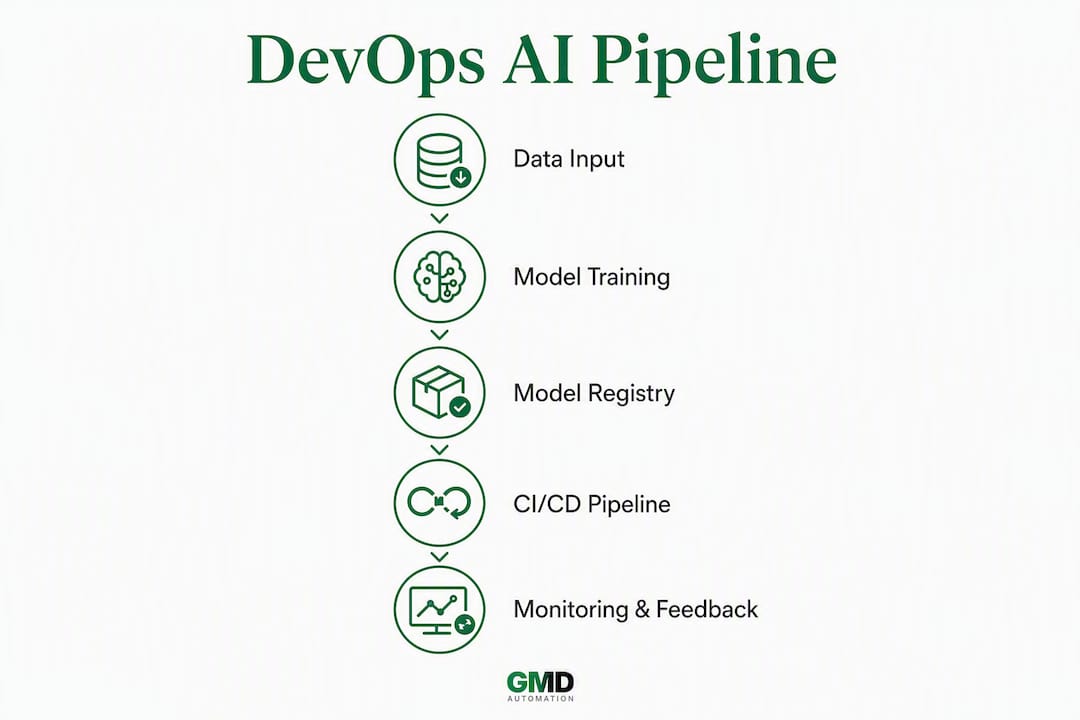
The role of DevOps in AI deployment goes well beyond shipping code. End-to-end MLOps automation covers the full lifecycle: data ingestion, training, validation, packaging, deployment, and ongoing monitoring. Each stage needs its own controls.
The core responsibilities break down as follows:
- CI/CD and continuous training (CT) pipelines: automate the path from a code commit or new training data to a validated, deployed model
- Model registry and versioning: the canonical record linking every model version to its training data, evaluation results, and approver sign-offs
- Data pipeline validation: schema checks, distribution tests, and data quality gates before training begins
- Deployment manifests: reproducible packaging so the same artefact runs identically in staging and production
- Observability: real-time metrics on model health, latency, and output distributions
- Rollback: automated or one-click reversion to the last known-good model version
- Policy engine integration: governance rules expressed as code, evaluated automatically at promotion gates
A useful way to picture the stack: data feeds into training, training outputs to the registry, the registry feeds the CI/CD pipeline, a policy engine evaluates the promotion, the approved artefact reaches the runtime, and observability wraps the whole thing.
Pro Tip: Ask any vendor to show you their model registry. If they cannot produce a record linking a specific model version to its training dataset, evaluation metrics, and the name of the person who approved it, their MLOps is superficial regardless of what their sales deck says.

What do UK regulations require from your MLOps pipeline?
The UK AI Cyber Security Code of Practice recommends automated CI/CD gates that validate bias, fairness, and reproducibility before models reach production. That is not a suggestion for large enterprises only. Any organisation deploying AI that affects individuals needs to demonstrate these controls exist and have been exercised.
The ICO's guidance on AI and data protection is equally direct: DPIAs are not a tick-box exercise. They act as roadmaps and must involve senior management and data protection officers. Separately, 2025 UK legislation on automated decision-making sets out statutory safeguards for solely automated significant decisions, including requirements for meaningful human intervention and contestability.
The artefacts an auditable MLOps pipeline must produce:
- DPIA record with senior sign-off and DPO involvement
- Model lineage report from the registry (dataset, code commit, metrics, approver)
- Bias and fairness evaluation results per release
- Human oversight sign-off log for high-risk decisions
- Incident and rollback history
- Evidence bundle from the policy engine at each promotion gate
| Regulatory requirement | MLOps control that satisfies it |
|---|---|
| UK GDPR accountability and governance | Audit logs, DPIA records, named data steward |
| AI Cyber Security Code of Practice | Automated CI/CD gates, bias/fairness checks |
| Automated decision-making safeguards | Human sign-off gate, contestability log |
| Individual rights (access, rectification) | Model registry with lineage, data pipeline traceability |
What tests must run before a model goes to production?
Every promotion gate should run a defined set of automated tests. Failing any one of them blocks the release until the issue is resolved.
| Test | Purpose | Fail action |
|---|---|---|
| Feature transform unit tests | Verify preprocessing logic produces expected outputs | Block promotion, alert engineer |
| Data schema validation | Confirm input data matches expected types and ranges | Block training run |
| Performance threshold check | Model accuracy, F1, or AUC must meet minimum bar | Block promotion |
| Fairness and bias evaluation | Check performance parity across protected groups | Block promotion, flag for human review |
| Reproducibility check | Re-running training on same data yields consistent results | Block promotion |
| Dependency integrity scan | Verify no tampered or vulnerable packages in the build | Block promotion |
| Security vulnerability scan | Static analysis of model serving code and dependencies | Block promotion |
Pro Tip: Phase your gates. Start with data schema validation and performance thresholds, which are fast and catch the most common failures. Add fairness checks and reproducibility tests once the pipeline is stable. Automating everything on day one is slower than building incrementally.
How does platform engineering keep AI services affordable and reliable?
Containerisation and orchestration are the foundation. Models packaged as containers run consistently across environments, and an orchestrator handles scaling without manual intervention. For UK deployments, data residency constraints mean infrastructure must be pinned to UK or EEA regions, which rules out certain default cloud configurations.
Infrastructure as code (IaC) makes environments reproducible and auditable. Cost telemetry, attached to each inference workload, surfaces the actual per-request cost so pricing decisions are grounded in real numbers rather than estimates. Serverless inference works well for bursty or low-volume workloads; dedicated GPU capacity suits high-throughput or latency-sensitive ones.
Pro Tip: Run a capacity test against your peak inference scenario before go-live. A model that performs well on a laptop can saturate a small cluster under real load. Test at 2x your expected peak, not your average.
For scalable AI automation architecture, the managed subscription model has a concrete advantage over raw cloud spend: the monthly fee is fixed regardless of infrastructure fluctuations, so finance teams can plan without surprise bills.
Who owns the AI platform, and how do you keep it running long-term?
Practitioner evidence is consistent: when pilot teams disband without a defined platform owner, deployments lose momentum and governance degrades. Successful organisations treat AI as a continuous managed service.
| Role | Core responsibility |
|---|---|
| Platform owner | Accountable for release velocity, tooling, and platform health |
| Data steward | Data quality, lineage, and GDPR compliance |
| SRE / ML engineer | Incident response, monitoring, and retraining pipelines |
| Compliance owner | Audit evidence, regulatory reporting, policy gate sign-off |
| Business owner | KPI definition, prioritisation, and sign-off on high-risk decisions |
The operating rhythm that keeps this functional: structured onboarding, a defined release cadence, quarterly governance reviews, a scheduled retraining calendar, and post-incident reviews after every production failure.
Pro Tip: Assign a single named platform owner before you deploy anything. That person's name should appear in the governance documentation, the incident runbook, and the vendor contract. Shared ownership is no ownership.
How do you monitor models once they are in production?
Silent performance degradation is the most common way AI systems fail. The model keeps running, but its outputs drift from what the business needs. Catching this requires monitoring at multiple levels simultaneously.
Metrics to track:
- Latency (p50, p95, p99) and error rate per endpoint
- Input feature distributions versus training baseline
- Output distribution shifts over time
- Performance on key demographic or business slices
- Business KPIs tied directly to model outputs (conversion rate, escalation rate, etc.)
When a regression is detected, the incident flow is: triage to confirm the failure mode, rollback to the last approved model version, root cause analysis on data or code changes, retrain and re-validate before re-promotion.
Pro Tip: Tie model observability to a business metric from day one. A drop in model accuracy is easy to dismiss; a 12% fall in appointment booking rate is not. Business metrics create urgency and reduce the time between detection and action.
What security controls must you insist on?
Security in AI pipelines requires controls at every layer. The ICO's guidance on individual rights and the AI Cyber Security Code of Practice both expect demonstrable technical controls, not policy documents alone.
Non-negotiable controls:
- Role-based access control with least-privilege enforcement
- Secrets management (no credentials in code or environment variables)
- Network segmentation between training, staging, and production environments
- Tamper-evident audit logs using write-once, read-many (WORM) storage
- Vulnerability scanning on all model serving dependencies
- Runtime protection against adversarial inputs and prompt injection
A minimal audit log schema for each event: timestamp, actor identity, action taken, artefact hash, policy engine outcome, and target environment. Every promotion, rollback, and configuration change should produce a record in this format.
Pro Tip: For high-risk models, store audit logs in a separate WORM bucket with no delete permissions granted to the application service account. This is a practical step toward tamper-evident traceability that aligns with enterprise AI security architecture best practice.
What timeline and pricing should UK businesses expect?
| Phase | Typical duration | Key milestone |
|---|---|---|
| Discovery and scoping | 2–3 weeks | Requirements, data audit, compliance mapping |
| Pilot deployment | 4–6 weeks | First model in staging with CI/CD gates active |
| Production go-live | 2–4 weeks | Governance sign-off, monitoring live, audit logs active |
| Optimisation | Ongoing | Retraining cadence, cost tuning, feature expansion |
Pricing shapes vary. Fixed monthly subscriptions give finance teams predictability. Consumption-tiered models suit organisations with variable workloads. Outcome-linked fees align vendor incentives with business results. The zero-upfront subscription model, where implementation costs are absorbed into the monthly fee, removes the capital expenditure barrier that stalls many UK enterprise AI projects.
The benefits of managed AI service models include faster time to value and lower initial risk compared with building an internal MLOps platform from scratch, which typically requires 12–18 months of engineering investment before the first production deployment.
How do you choose a managed MLOps provider?
The AdvAI regulatory-aligned deployment framework identifies the absence of an operational lifecycle as a primary barrier to enterprise AI adoption. Your procurement questions should expose whether a vendor has actually solved this.
Questions to ask every vendor:
- Can you show us a model registry entry with full lineage for a live deployment?
- What automated tests run at each CI/CD gate, and what is the fail action for each?
- How do you handle rollback, and what is the typical time to revert a production model?
- What is your incident response SLA, and who is the named escalation contact?
- Where is data processed and stored, and can you confirm UK or EEA residency?
- What security accreditations do you hold (ISO 27001, Cyber Essentials Plus)?
- How do business owners participate in governance sign-offs?
Red flags that should stop a procurement:
- No model lineage or registry, only ad hoc version folders
- Manual promotion gates with no automated validation
- Opaque or consumption-only pricing with no cost ceiling
- No named platform owner or SRE in the contract
- Compliance described as a future roadmap item rather than a current capability
Pro Tip: Ask for a sample evidence bundle from a recent deployment. A credible vendor produces this in hours. If the answer is "we can prepare something for you," the governance is not automated.
How Gmdautomation implements MLOps for UK customers
Gmdautomation's managed subscription covers the full deployment lifecycle, from discovery through to ongoing optimisation, with compliance built into the pipeline rather than bolted on afterwards.
The typical engagement flow:
- Discovery (weeks 1–2): requirements capture, data audit, DPIA initiation, and compliance mapping against UK GDPR and the AI Cyber Security Code of Practice
- Pipeline build (weeks 3–6): CI/CD gates configured with automated validation for performance, fairness, and reproducibility; model registry established with lineage tracking
- Policy engine integration (week 6–7): governance rules expressed as code; evidence bundles generated automatically at each promotion
- Production go-live (week 8): monitoring active, WORM audit logs live, human sign-off gate in place for high-risk decisions
- Ongoing managed service: retraining cadence, drift alerts, quarterly governance reviews, and compliance reporting included in the monthly subscription
| Included in subscription | Detail |
|---|---|
| CI/CD pipeline with validation gates | Automated bias, fairness, and performance checks |
| Model registry and lineage | Full audit trail from dataset to production |
| Monitoring and drift detection | Real-time alerts on model and business metrics |
| Compliance support | DPIA assistance, audit evidence bundles, UK GDPR alignment |
| Incident response | Named SRE contact, defined rollback SLA |
Zero upfront costs. No capital expenditure. The subscription covers implementation, operation, and optimisation from month one.
Pro Tip: Request a technical walkthrough of Gmdautomation's CI/CD evidence bundle before signing. Seeing the actual artefacts from a live deployment is the fastest way to verify that governance is real, not described.
Key takeaways
DevOps and MLOps operationalise AI by embedding compliance, security, and observability directly into the deployment pipeline, making production AI auditable and recoverable by design.
| Point | Details |
|---|---|
| CI/CD gates are non-negotiable | Automated validation for bias, fairness, and reproducibility must block promotion, not just flag issues. |
| Model registry anchors governance | Every model version must link to its dataset, code commit, metrics, and named approver. |
| UK regulation demands artefacts | DPIA records, lineage reports, and human sign-off logs are what auditors will ask for. |
| Platform ownership prevents stall | A named platform owner in the contract keeps release velocity and governance intact long-term. |
| Gmdautomation delivers managed MLOps | Zero-upfront subscription covers CI/CD, compliance, monitoring, and incident response from day one. |
The gap between MLOps on paper and MLOps in practice
Most organisations that claim to practise MLOps have a model registry and a CI/CD pipeline. Fewer have a policy engine that emits an evidence bundle at every promotion gate. Almost none have tested their rollback procedure under real incident conditions before they needed it.
The compliance conversation in UK AI deployments tends to focus on the DPIA, which is the right starting point but not the finish line. The ICO's accountability framework expects you to demonstrate ongoing governance, not just a document signed at project kick-off. That means the artefacts need to exist continuously, not be assembled retrospectively when an auditor asks.
The practical implication: governance embedded in the pipeline is categorically different from governance described in a policy. The former produces evidence automatically. The latter produces a paper trail that someone has to maintain manually, and manual processes degrade under pressure. When a model regression happens at 2 AM, the team that has automated rollback and WORM audit logs recovers in minutes. The team relying on runbooks and shared drives does not.
For UK businesses evaluating managed AI services, the single most useful procurement test is to ask for an evidence bundle from a live deployment. What you receive in response tells you more than any reference call.
Gmdautomation's managed subscription for compliant AI deployment
Gmdautomation gives UK businesses a production-ready AI deployment with compliance included from day one, not as an add-on. The monthly subscription covers implementation, CI/CD pipeline configuration, model registry setup, monitoring, incident response, and ongoing optimisation. There is no capital expenditure, no internal MLOps team to hire, and no gap between what the contract promises and what the pipeline actually produces.
For IT decision-makers who need a defensible audit trail and a named SRE contact in the contract, this is the concrete alternative to an 18-month internal build. Request a technical walkthrough to see the CI/CD evidence bundle and governance artefacts from a live deployment before you commit to anything.
Useful sources and further reading
The sources below are the primary references for UK AI governance and MLOps practice. Procurement teams and compliance officers should read the first three before any vendor evaluation.
- Implementation guide for the UK AI Cyber Security Code of Practice — DSIT, UK Government
- ICO guidance: accountability and governance implications of AI — Information Commissioner's Office
- ICO guidance: individual rights in AI systems — Information Commissioner's Office
- UK legislation: automated decision-making provisions (2025) — legislation.gov.uk
- AdvAI regulatory-aligned AI deployment framework — UK Government
- Gmdautomation: managed AI automation for UK businesses