

AI supports lean business operations by redesigning workflows from the ground up, not by automating what already exists. Bain research confirms that companies redesigning workflows alongside AI capture significantly higher value, including shorter cycle times and lower costs. McKinsey echoes this: operational redesign around hybrid teams outperforms AI adoption alone. For executives applying Lean Six Sigma or any lean methodology, this distinction is the difference between compounding efficiency and locking in digital waste. The question is not whether to adopt AI, but how to deploy it so it eliminates inefficiency rather than preserves it.
How AI supports lean business operations by eliminating the 8 wastes
Lean methodology identifies eight categories of waste, known collectively by the acronym DOWNTIME: Defects, Overproduction, Waiting, Non-utilised talent, Transportation, Inventory excess, Motion, and Extra processing. AI targets each of these directly, but the mechanism differs by waste type.
Defects fall when AI applies real-time quality checks to production or data entry workflows. A manufacturer using computer vision to inspect components catches errors at the point of creation rather than at final inspection. Waiting shrinks when AI routes approvals automatically, removing the queues that pile up in manual handoff processes. Extra processing disappears when AI identifies reports that nobody reads and flags them for removal before they consume further resource.
Non-utilised talent is the waste most executives underestimate. When skilled staff spend their days on data entry, report formatting, or chasing approvals, their analytical capability sits idle. AI automation of those repetitive tasks frees human attention for creative problem-solving and process improvement work. That shift is not incidental. It is the core productivity gain.
- Defects: AI vision systems and automated validation catch errors at source, reducing rework loops.
- Waiting: Intelligent routing and automated approvals cut queue times in administrative and operational workflows.
- Non-utilised talent: Automating repetitive tasks returns skilled workers to value-adding activities.
- Extra processing: AI audits workflows to identify redundant steps, reports, and approvals that consume time without output.
- Overproduction: Demand forecasting models prevent over-scheduling, over-ordering, and excess output.
Pro Tip: Before deploying any AI tool, map the process end to end and mark every step as value-adding or wasteful. Automate only the value-adding steps. Automating a wasteful step makes it faster and harder to remove later.
How does AI complement Lean Six Sigma to accelerate improvement cycles?
Lean Six Sigma uses the DMAIC framework: Define, Measure, Analyse, Improve, Control. AI accelerates the Measure and Analyse phases most dramatically. Traditional process mapping and data collection take weeks. AI compresses that to hours by pulling continuous data streams from operational systems and surfacing bottlenecks automatically.
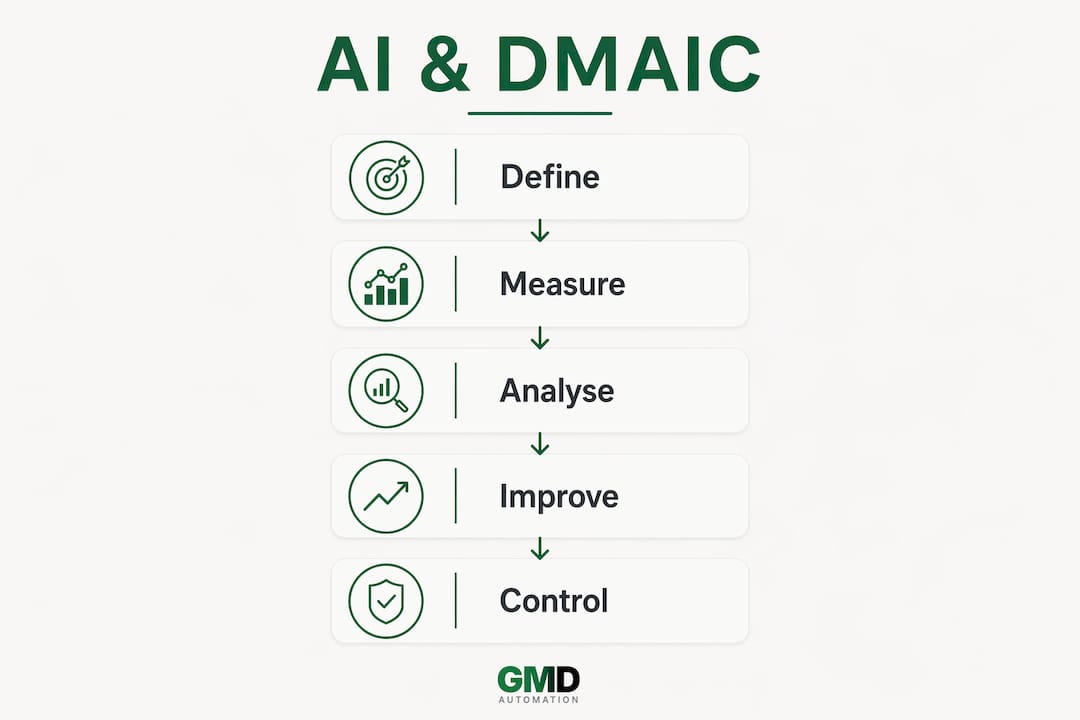
Companies integrating AI with Lean Six Sigma report an 18% reduction in defect rates alongside significantly reduced process-mapping times. That defect reduction compounds over improvement cycles, meaning each DMAIC pass starts from a higher baseline. The speed gain in Measure and Analyse phases means teams complete more improvement cycles per year, not just faster individual cycles.
| DMAIC Phase | Traditional approach | AI-assisted approach |
|---|---|---|
| Measure | Manual data collection over days or weeks | Continuous automated data streams, near real-time |
| Analyse | Spreadsheet analysis, periodic review | Predictive analytics, automated bottleneck detection |
| Improve | Pilot testing with limited data | Simulation modelling with full process data |
| Control | Periodic audits and manual checks | Automated monitoring with exception alerts |
AI provides data velocity. It does not provide human judgement. Root cause analysis still requires experienced practitioners who understand the operational context behind the numbers. An AI system can flag that defect rates spike on Tuesday mornings. It cannot tell you that the Tuesday morning shift uses a different supplier batch without a human connecting those facts.
Pro Tip: Embed explicit human review checkpoints at the Analyse and Improve phases of every AI-assisted DMAIC cycle. Governed workflows with review points maintain accountability and prevent AI outputs from driving decisions without validation.
What are the best practices for integrating AI into lean workflows?
The most common and costly mistake in AI integration is automating broken processes. Excess approvals, redundant data transfers, and reports that nobody reads do not disappear when you automate them. They become faster, more embedded, and more expensive to remove. This is workflow debt, and most organisations carry more of it than they realise.

Bain research identifies accumulated workflow debt as the primary barrier to scalable AI automation. Reducing it is a prerequisite, not an afterthought. The practical sequence is: map the process, delete the waste, improve what remains, then automate. Reversing that order produces digital inefficiency at speed.
Clean, standardised data is the second prerequisite. AI performs best on tasks that are bounded, repetitive, data-stable, and traceable within workflows. Feeding inconsistent or incomplete data into an AI system produces inconsistent outputs, which erodes trust and triggers manual overrides that negate the efficiency gain.
Explainable AI frameworks address the transparency problem. Methods such as SHAP and LIME allow staff to validate AI outputs and understand why a recommendation was made. This matters in lean environments where root-cause discipline is a cultural norm. If staff cannot interrogate an AI decision, they will not trust it, and adoption stalls.
| Integration approach | Outcome |
|---|---|
| Automate existing process without review | Waste locked into digital infrastructure, higher repair costs |
| Map and clean process, then automate | Efficiency gains compound, waste eliminated at source |
| Deploy AI without data standardisation | Inconsistent outputs, manual overrides, low adoption |
| Use XAI frameworks for transparency | Staff trust AI outputs, root-cause discipline maintained |
Pro Tip: Run an automation opportunity audit before any AI deployment. Score each candidate process on data quality, step clarity, and waste level. Only proceed with processes that score well on all three.
How can AI protect human focus in a hybrid workforce?
AI automation creates mental space. When workers are no longer processing invoices, chasing approvals, or reformatting data, they direct their attention to the work that requires judgement, creativity, and relationship. This is not a soft benefit. It is the mechanism through which lean cultures sustain continuous improvement over time.
The emerging model is the hybrid workforce, which blends human workers with AI agents and, in some environments, autonomous systems. Bain describes this as a spectrum that includes standard AI users, augmented specialists, autonomous agents, and robotic systems. Reskilling and trust-building are required at every level of that spectrum. Executives who treat AI deployment as a technology project rather than a people change programme consistently underperform those who invest in both.
Fear of job replacement is the most significant adoption barrier in lean environments. Addressing it directly, with transparency about which tasks AI will handle and which roles will expand, determines whether the workforce engages or resists. The human-centric approach treats AI as a tool that protects human focus, not one that replaces human contribution.
Practical steps for building a hybrid workforce in lean operations:
- Audit task portfolios: Identify which tasks each role performs that are repetitive, rule-based, and low-judgement. These are the primary candidates for AI automation.
- Communicate the intent: Tell teams explicitly that AI will take the low-value tasks so they can focus on higher-value work. Transparency reduces resistance.
- Invest in reskilling: Equip staff with the skills to work alongside AI, interpret its outputs, and escalate exceptions. AI training for operations teams is not optional.
- Build feedback loops: Create structured channels for staff to report AI errors or unexpected outputs. This sustains trust and improves the system over time.
- Measure human outcomes: Track not just efficiency metrics but also employee engagement and the proportion of time spent on value-adding work. Both matter in a lean culture.
Organisations that synchronise workflow redesign with workforce modernisation unlock productivity gains that AI tools alone cannot deliver. The technology is the enabler. The people and process redesign is the source of the gain. For a broader view of how AI automation is reshaping operations across sectors, AI workflows transforming managed services offers useful parallel examples from technology-intensive environments.
Key takeaways
AI delivers measurable gains in lean operations only when businesses redesign processes and workforce roles before and alongside deployment, not after.
| Point | Details |
|---|---|
| Redesign before automating | Map and eliminate waste from every process before deploying AI to avoid locking inefficiency into digital systems. |
| AI accelerates DMAIC cycles | Continuous data streams compress Measure and Analyse phases, enabling more improvement cycles per year. |
| Human judgement remains essential | AI provides data velocity; root cause analysis and decision validation still require experienced practitioners. |
| Explainable AI builds trust | SHAP and LIME frameworks allow staff to interrogate AI outputs, sustaining lean's root-cause discipline. |
| Workforce redesign multiplies gains | Reskilling and transparent communication about AI roles unlock productivity that technology alone cannot achieve. |
Why executives get this wrong more often than they should
The most persistent misconception I encounter is that AI is an incremental productivity add-on. Executives buy a tool, point it at an existing process, and expect the efficiency to follow. It rarely does. What they have done is automate their current behaviour, including the meetings nobody needs, the approvals that add no value, and the reports that nobody reads.
The organisations I have seen extract genuine value from AI in lean operations share one characteristic: they treated the deployment as a process redesign project with an AI component, not an AI project with a process component. That inversion changes everything. It means the first question is always "what should this process look like?" rather than "what can AI do here?"
Leadership culture is the other variable that most articles ignore. Lean environments run on psychological safety, the willingness of workers to surface problems without fear. AI adoption that feels imposed, opaque, or threatening to job security destroys that safety. Executives who communicate clearly about what AI will and will not do, and who invest in reskilling rather than headcount reduction, find adoption faster and results stronger.
The technology is genuinely capable. The constraint is almost always organisational, not technical. Treat AI as a catalyst for rethinking how work gets done, and the lean gains follow. Treat it as a shortcut, and you will spend the next two years unpicking the digital waste you created.
— Ravi
How Gmdautomation helps UK businesses apply AI to lean operations
Gmdautomation builds AI automation systems specifically for UK businesses that want to reduce manual workload and improve operational speed without large upfront investment. Every system is deployed with implementation, maintenance, and ongoing refinement included in a predictable monthly subscription, removing the capital risk that typically delays AI adoption.
For executives ready to move from lean principles to lean practice, Gmdautomation provides the infrastructure to automate the right processes from day one. The platform is built for compliance, performance, and rapid deployment, so your teams spend less time on repetitive tasks and more time on the work that drives results. Explore AI automation for UK businesses to see how the deployment model works and what it delivers for operations teams at your scale.
FAQ
What is the difference between lean operations and AI-driven automation?
Lean operations is a management methodology focused on eliminating waste and maximising value. AI-driven automation is a technology layer that accelerates lean by handling repetitive, data-intensive tasks at speed and scale.
Can AI be applied to lean operations without Lean Six Sigma training?
Yes, but Lean Six Sigma provides the structured problem-solving framework that prevents AI from automating waste. Without it, businesses risk embedding inefficiency into digital systems rather than eliminating it.
How does AI reduce defects in lean manufacturing?
AI applies real-time quality checks, such as computer vision inspection, at the point of production. Companies using AI within Lean Six Sigma frameworks report defect rate reductions of around 18% compared to traditional methods.
What is Explainable AI and why does it matter for lean teams?
Explainable AI refers to frameworks such as SHAP and LIME that make AI decisions interpretable to human reviewers. In lean environments, this transparency sustains root-cause discipline and ensures staff can validate AI outputs rather than accept them blindly.
How long does it take to see results from AI in lean operations?
Results depend on process readiness and data quality. Businesses that map and clean processes before deployment typically see measurable cycle time and cost improvements within the first few months of operation.