

What AI-powered reporting systems actually deliver
The case for adopting AI-driven reporting is clearest when you look at what these systems do that traditional tools simply cannot. Here are the primary benefits:
- Real-time anomaly detection: AI continuously monitors data streams and flags irregularities the moment they appear, rather than waiting for a weekly or monthly review cycle to surface a problem.
- Improved data accuracy: Automated data cleaning and validation removes the human error that creeps into manual reporting, producing figures you can trust.
- Greater operational transparency: Continuous monitoring shifts reporting from a periodic snapshot into a live view of business health, supporting faster risk identification.
- Faster, better decisions: Predictive and prescriptive analytics give decision-makers forward-looking intelligence rather than a rear-view mirror. KPMG research found improved decision-making among the top five benefits cited by enterprises adopting AI reporting.
- Cost efficiency: Automating routine reporting tasks frees analyst time for higher-value work and reduces the overhead of manual data preparation.
- Scalability and customisation: AI reporting platforms scale with the business, handling growing data volumes without a proportional increase in headcount or infrastructure cost.
Understanding AI reporting automation is the logical first step before evaluating any specific platform.
Table of Contents
- How AI transforms business operations through automation and insight
- What AI reporting tools actually do to your workforce
- Key considerations before implementing AI reporting in your organisation
- Gmdautomation: AI reporting built for UK businesses
- Key takeaways
How AI transforms business operations through automation and insight
Traditional reports are static. They tell you what happened last quarter. AI-powered reporting systems tell you what is happening now, and what is likely to happen next.

The operational shift starts with data preparation. AI automates the cleaning, validation, and consolidation of data from multiple sources, cutting the time analysts spend wrangling spreadsheets before they can even begin interpreting results. Research confirms that this automation introduces real-time alerts, anomaly detection, and natural language summaries that make complex outputs accessible to non-technical stakeholders.
Natural language generation is one of the less-discussed advantages of AI reporting. Rather than presenting a table of figures, the system produces a plain-English summary: "Revenue in the North West region fell 12% week-on-week, driven by a drop in repeat orders." That kind of contextualised output changes who can act on data, not just who can read it.
Self-service analytics extend this further. Business users can query data independently without waiting for an analyst to build a custom report. The bottleneck between data and decision shrinks considerably.
Stat to note: A large majority of enterprises surveyed cited real-time risk insights as a top benefit of AI reporting, along with lower costs, trend prediction, increased data accuracy, and improved decision-making among the foremost advantages.
Predictive analytics takes the reporting function a step further still. Instead of describing past performance, the system models likely future outcomes and, in its prescriptive form, recommends specific actions. For a finance team managing cash flow or a supply chain analyst tracking inventory, that shift from reactive to proactive is where the real value sits. Businesses adopting advanced digital technologies like AI report approximately 19% higher turnover per worker, a productivity differential that compounds over time.
AI also supports quality assurance functions. For QA teams in technology businesses, AI tools in test reporting follow the same logic: automated monitoring catches defects faster and with greater consistency than manual review cycles.
What AI reporting tools actually do to your workforce
The fear that AI will hollow out analyst teams is not well-supported by evidence. ONS data covering 2023 to 2026 shows that most UK businesses implementing AI have seen no change in overall workforce headcount. The impact concentrates on administrative and data-gathering roles, with staff shifting towards interpretive and strategic work rather than being displaced.
What changes is the nature of the job. Analysts who previously spent the majority of their time pulling data, formatting reports, and chasing down discrepancies can redirect that effort towards interpreting results, advising stakeholders, and contributing to strategy. That is a better use of skilled people.
- Upskilling becomes critical: Over 60% of businesses that reported AI expertise barriers invested in training existing staff to bridge the gap.
- Larger firms lead adoption: The UK Business Data Survey 2026 found 82% of large businesses using AI for at least one purpose, compared with lower rates among smaller organisations.
- Efficiency is the primary driver: Nearly 60% of UK businesses use AI primarily to improve the efficiency of existing operations rather than to create new products or enter new markets.
The collaboration between human judgement and machine intelligence is where the productivity gains actually materialise. AI surfaces the signal; people decide what to do with it. Neither works as well without the other.
Pro Tip: Before deploying AI reporting tools, map which tasks in your current reporting cycle are purely mechanical. Those are the highest-value automation targets, and freeing them up is where you will see the fastest return.
Key considerations before implementing AI reporting in your organisation
Getting the benefits of AI-powered reporting systems requires more than selecting a platform. Several practical factors determine whether the investment pays off.
Data security and regulatory compliance sit at the top of the list for UK businesses. Any AI reporting system handling personal or commercially sensitive data must align with UK GDPR and, where applicable, FCA or sector-specific requirements. Governance maturity assessments, as KPMG recommends, help organisations understand where their data practices need strengthening before AI is layered on top.
Integration with existing systems is frequently underestimated. The UK Business Data Survey 2026 found that only 21% of AI-using businesses had their tools integrated into existing business systems such as CRM or finance platforms. Those that did reported significantly higher rates of data analysis (62%) compared with those that did not (30%). Integration is not a nice-to-have; it is what separates a useful tool from a transformative one.
Data quality and governance determine the reliability of AI outputs. Garbage in, garbage out applies with particular force to machine learning models. Establishing documented data transformation processes and validated quality measures before deployment prevents the system from producing confident-sounding but unreliable insights.
Cost-benefit analysis and ROI should be grounded in realistic timelines. The productivity gains are real, but they accumulate over months, not days. Factor in training costs, integration work, and the time required for staff to build confidence with new tools.
User adoption and change management are where many implementations stall. Technical deployment is the easier half. Getting analysts and business users to trust and act on AI-generated insights requires clear communication, hands-on training, and visible leadership support.
The industries benefiting most from AI automation tend to be those where data volumes are high, reporting cycles are frequent, and the cost of a missed signal is significant: financial services, logistics, retail, and professional services among them.
Gmdautomation: AI reporting built for UK businesses
Most organisations know what they want from AI reporting. The gap is between that ambition and a working system that fits their existing infrastructure, meets UK compliance requirements, and does not require a six-month implementation project before anyone sees a result.
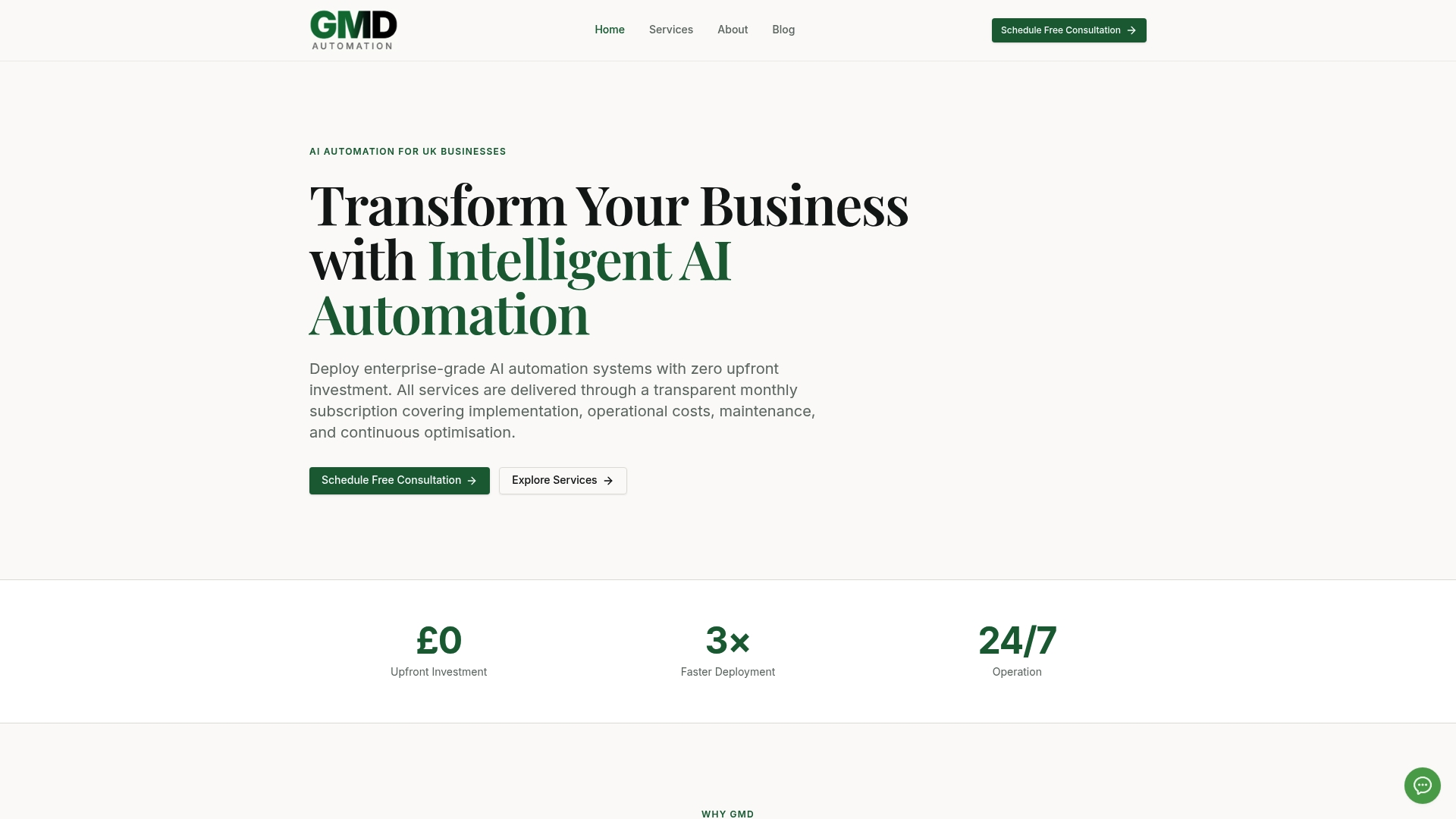
Gmdautomation addresses that gap directly. The platform deploys enterprise-grade AI automation with no upfront capital cost, operating on a transparent monthly subscription that covers implementation, ongoing operation, maintenance, and optimisation. For UK businesses that want the advantages of AI automation without committing to a large capital project, that model removes the most common barrier to adoption.
The systems are built for security and compliance from the outset, scalable as the business grows, and supported by continuous optimisation rather than a one-time setup. Onboarding is designed to be fast, and the subscription model means costs remain predictable as usage scales.
To see what an AI reporting deployment looks like in practice for your organisation, visit Gmdautomation and explore the options available.
Key takeaways
AI-powered reporting systems deliver their greatest value when real-time monitoring, automated data processing, and predictive analytics are combined with strong data governance and deliberate change management.
| Point | Details |
|---|---|
| Real-time risk detection | 70% of enterprises cite real-time risk insights as a top benefit of AI reporting systems. |
| Productivity uplift | Businesses adopting AI report approximately 19% higher turnover per worker than non-adopters. |
| Workforce impact | Most UK businesses implementing AI see no change in overall headcount; roles shift towards higher-value tasks. |
| Integration matters | Only 21% of AI-using UK businesses have tools integrated into existing systems, yet those firms report far higher data analysis rates. |
| Gmdautomation | Offers rapid, no-upfront-cost deployment of compliant, scalable AI reporting systems built for UK businesses. |