

Intelligent process automation (IPA) is defined as the combination of robotic process automation (RPA) and artificial intelligence technologies to automate complex, end-to-end business processes with cognitive decision-making capabilities. Unlike basic rule-based automation, IPA incorporates machine learning, natural language processing (NLP), optical character recognition (OCR), and advanced analytics to handle unstructured data and adapt to changing conditions. Platforms such as UiPath and Blue Prism have built entire product lines around this principle. Organisations that move beyond IPA pilot phases achieve an average 32% cost reduction, according to a Deloitte survey cited by Salesforce. That figure alone explains why IPA has become a central pillar of digital transformation programmes across finance, retail, and supply chain sectors.
What is intelligent process automation and how does it work?
IPA represents an evolution from rule-based automation to incorporating cognitive AI capabilities such as decision-making and learning. The simplest way to understand it: traditional RPA acts as the "hands," executing predefined steps on structured data. IPA adds the "brains," allowing systems to interpret context, learn from outcomes, and handle exceptions without human intervention.
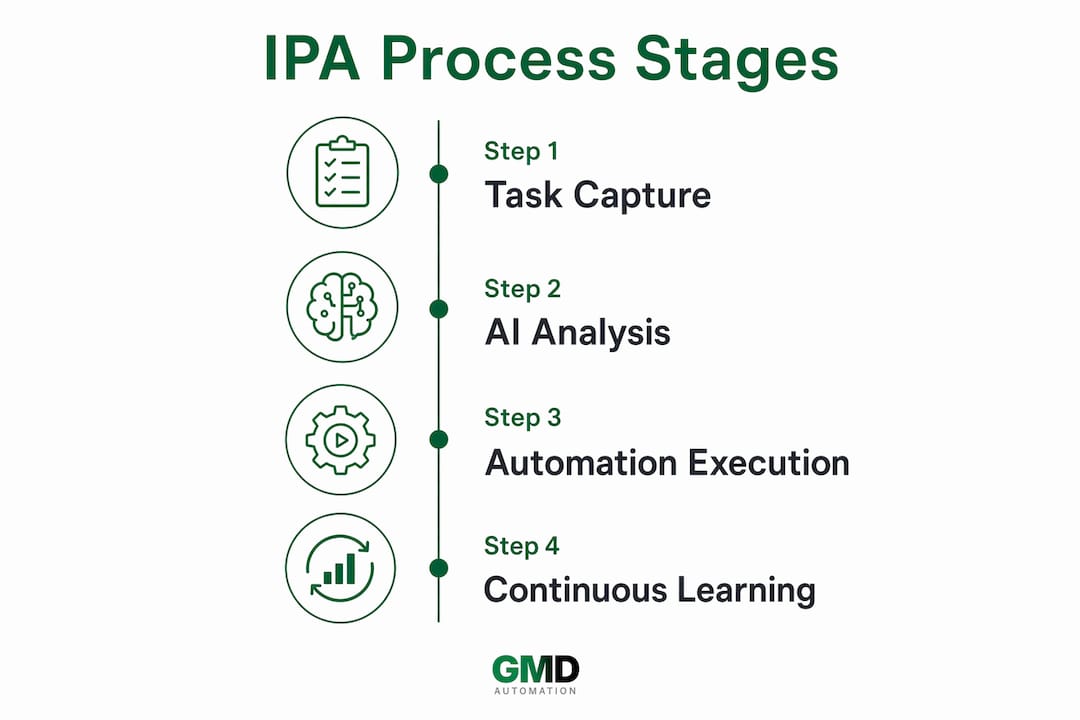
The process works in three broad stages. First, RPA bots handle the repetitive, structured tasks: data entry, form submission, file transfers. Second, AI components process unstructured inputs such as emails, invoices, and scanned documents. Third, analytics and machine learning layers review outcomes, identify patterns, and refine future decisions automatically.

Modern IPA systems classify complex tasks in under 10 seconds using large language model (LLM) integration. That speed matters in high-volume environments such as financial services, where thousands of transactions require triage every hour.
What technologies and components make up IPA?
IPA integrates OCR, NLP, machine learning, and analytics with RPA to analyse unstructured data and improve business insights over time. Each component plays a distinct role.
RPA handles structured, repetitive tasks: copying data between systems, generating reports, processing standard forms. Machine learning enables the system to improve accuracy with each cycle, recognising patterns in historical data. NLP allows IPA to read and interpret written language, from customer emails to regulatory documents. OCR converts scanned images and PDFs into machine-readable text. Analytics surfaces performance data so teams can measure outcomes and adjust workflows.
The table below contrasts basic automation with IPA across the dimensions that matter most to IT decision-makers.
| Capability | Basic Automation (RPA) | Intelligent Process Automation |
|---|---|---|
| Data types handled | Structured only | Structured and unstructured |
| Decision-making | Rule-based, explicit | AI-driven, adaptive |
| Learning over time | No | Yes, via machine learning |
| Exception handling | Requires human input | Managed autonomously |
| Typical use cases | Data entry, report generation | Invoice processing, email triage, compliance checks |
Pro Tip: Before selecting AI components, map the specific data types your target process handles. If the majority of inputs are unstructured, prioritise NLP and OCR capabilities first. If the process is largely structured but high-volume, a lighter RPA-plus-analytics stack may deliver faster results at lower cost.
What are the benefits of intelligent automation for businesses?
The benefits of intelligent automation are measurable, not theoretical. The 32% operational cost reduction cited above is the headline figure, but the downstream effects are equally significant for business leaders planning multi-year transformation programmes.
Key benefits include:
- Cost reduction: Fewer manual processing hours translate directly into lower operational expenditure.
- Faster decisions: IPA tools automate complex mission-critical processes with minimal human input, enabling faster, smarter decisions across the organisation.
- Reduced error rates: AI-driven validation catches anomalies that human reviewers miss under volume pressure.
- Scalability: IPA systems handle demand spikes without additional headcount, a critical advantage in seasonal industries.
- Employee reallocation: Staff freed from repetitive tasks shift to higher-value work such as client management, analysis, and product development.
- Improved customer experience: Faster processing times and fewer errors produce better service outcomes at every touchpoint.
The sub-10-second classification capability mentioned earlier is not a laboratory result. Financial services workflows built with tools such as Make (formerly Integromat) and Claude AI demonstrate this in production environments, processing email triage and trade data synchronisation at scale. That kind of throughput was simply not achievable with first-generation RPA.
The indirect benefits deserve equal attention. When employees stop spending hours on manual data entry, organisations report measurable improvements in staff satisfaction and retention. For UK businesses facing persistent skills shortages, that is a material competitive advantage.
How does IPA compare to RPA and hyperautomation?
IPA focuses on optimising specific processes, while hyperautomation targets broad, enterprise-wide automation. Confusing the two leads to misaligned investment decisions.
Basic RPA is the starting point. It automates repetitive, rule-based tasks on structured data. It cannot learn, cannot handle exceptions intelligently, and breaks when inputs deviate from expected formats. IPA solves those limitations by layering AI on top of RPA.
Hyperautomation is a broader organisational strategy. Defined by Gartner, it encompasses IPA, RPA, AI, OCR, NLP, process mining, and low-code platforms working together across an entire enterprise. Think of it this way: IPA is a technology stack. Hyperautomation is a transformation strategy that uses IPA as one of its tools.
| Dimension | RPA | Intelligent Process Automation | Hyperautomation |
|---|---|---|---|
| Scope | Individual task | End-to-end process | Enterprise-wide |
| Core technologies | Bots, scripts | RPA + AI, NLP, OCR, ML | All of the above plus process mining, low-code |
| Learning capability | None | Yes | Yes, at scale |
| Primary outcome | Task efficiency | Process optimisation | Organisational transformation |
Pro Tip: If your objective is to fix a specific high-volume process such as invoice approval or compliance reporting, IPA is the right starting point. If you are planning a multi-year digital transformation across multiple departments, build toward a hyperautomation strategy with IPA as the foundation.
What are practical applications of IPA in modern enterprises?
Financial service IPA workflows automate email triage, trade data synchronisation, and operations reporting, reducing manual work significantly in production environments. These are not edge cases. They represent the most common entry points for IPA adoption across UK enterprises.
Common sectors and applications include:
- Financial services: Invoice processing, fraud detection, regulatory compliance checks, trade reconciliation.
- Retail and e-commerce: Order management, returns processing, supplier communication, demand forecasting.
- Supply chain and logistics: Shipment tracking, inventory updates, supplier onboarding, exception management.
- Healthcare: Patient record processing, appointment scheduling, billing reconciliation, regulatory reporting.
- Human resources: CV screening, onboarding document processing, payroll validation.
Tools such as Make and Zapier handle workflow orchestration at the no-code and low-code end. Claude AI and similar large language models provide the natural language understanding layer. Platforms like UiPath and Blue Prism deliver enterprise-grade bot management and governance. Combining these tools allows teams to prototype and deploy IPA workflows rapidly, even in complex financial services environments.
For IT decision-makers, the practical starting point is process selection. Not every process is a good candidate. The best candidates share three characteristics: high volume, rule-governed logic, and significant manual effort. Invoice processing typically scores high on all three.
Pro Tip: Map and improve existing workflows before automating them. Automating a flawed process does not fix it. It scales the flaw. Spend time with process owners to eliminate unnecessary steps, reduce handoffs, and standardise inputs before a single bot is deployed.
For a broader view of how IPA fits within enterprise AI automation strategies, the scope of opportunity becomes clear quickly.
Key takeaways
Intelligent process automation delivers measurable operational value only when the right AI components are matched to well-designed processes and governed with clear performance metrics.
| Point | Details |
|---|---|
| IPA definition | IPA combines RPA with AI technologies including NLP, OCR, and machine learning to automate complex processes. |
| Proven cost impact | Organisations beyond pilot phases achieve an average 32% operational cost reduction, per Deloitte research. |
| IPA vs hyperautomation | IPA optimises specific processes; hyperautomation is a broader enterprise-wide transformation strategy. |
| Process-first principle | Automating a flawed process scales inefficiency. Map and improve workflows before deploying any automation. |
| Practical entry points | Invoice processing, email triage, compliance checks, and operations reporting are the most common first deployments. |
Why most IPA programmes stall before they deliver
The technology is rarely the problem. In my experience working with business and IT leaders on automation programmes, the most common reason IPA initiatives stall is organisational, not technical.
Teams select a process, deploy a tool, and declare success after the pilot. Then the programme sits. No one owns the governance. No one tracks whether the model is drifting. No one asks whether the process it was built on is still the right one six months later. AI-driven bots adapt from data, but only if someone is watching the outputs and feeding corrections back into the system.
The second pitfall is change management. IPA changes how people work. Staff who previously handled a process manually need to understand their new role. Without that conversation, you get resistance, workarounds, and shadow processes that undermine the automation entirely.
My honest advice: treat IPA as an ongoing capability, not a one-time project. Build a small centre of excellence, even if it is just two or three people, to own process standards, monitor performance, and prioritise the next automation. The organisations I have seen extract the most value from IPA are not the ones with the most sophisticated tools. They are the ones with the clearest governance and the most disciplined approach to process improvement before automation.
The real-world examples of AI process automation that produce lasting results all share that discipline.
— Ravi
How Gmdautomation helps UK businesses deploy IPA
Gmdautomation builds and deploys AI automation systems specifically for UK enterprises, with no upfront capital expenditure required. Every solution covers implementation, operation, maintenance, and ongoing optimisation under a single monthly subscription, so your finance team knows exactly what it costs before you sign anything.
If you are a business or IT leader ready to move beyond manual processes, Gmdautomation's AI automation solutions are designed to get you from scoping to live deployment without the risk or complexity of traditional enterprise software projects. The platform is built for security, compliance, and performance at scale, making it a practical fit for regulated UK industries including financial services, retail, and healthcare.
FAQ
What is intelligent process automation in simple terms?
Intelligent process automation is the combination of robotic process automation and artificial intelligence to handle complex business processes that involve unstructured data and decision-making. It goes beyond basic automation by learning from data and adapting to exceptions without human reprogramming.
How does intelligent process automation differ from standard RPA?
Standard RPA follows fixed rules on structured data and cannot handle exceptions or learn over time. IPA adds AI layers including machine learning and NLP, enabling it to process unstructured inputs and improve accuracy with each cycle.
What are the most common examples of process automation using IPA?
The most common applications include invoice processing, email triage, compliance checks, trade data reconciliation, and operations reporting. Financial services and retail sectors are the most active adopters in UK enterprise environments.
What are the main benefits of intelligent automation for business leaders?
The primary benefits are operational cost reduction, faster decision-making, lower error rates, and the ability to scale without additional headcount. Organisations that move past the pilot phase report an average 32% reduction in operational costs.
What intelligent process automation tools are used in practice?
Widely used tools include UiPath and Blue Prism for enterprise bot management, Make and Zapier for workflow orchestration, and large language models such as Claude AI for natural language understanding. These are often combined to build end-to-end IPA workflows across departments.