

Polling-based API calls that hammer endpoints every few seconds are a bottleneck most AI-driven operations teams hit hard before they realise what is wrong. Webhook automation ai systems solve this by flipping the communication model. Instead of your system asking "anything new?" on repeat, the source notifies you the moment something happens. Polling creates latency and overhead that compounds across multi-step AI workflows, degrading responsiveness exactly when speed matters most. This guide walks through the foundations, implementation, and ongoing management of automated webhook integrations built for production-grade AI environments.
Table of Contents
- Key takeaways
- What webhook automation AI systems require before you build
- How to implement webhook automation step by step
- Troubleshooting common webhook automation problems
- Measuring success and maintaining reliability
- My honest take on webhook infrastructure for AI
- How Gmdautomation supports your webhook strategy
- FAQ
Key takeaways
| Point | Details |
|---|---|
| Webhooks replace polling | Event-driven delivery achieves sub-1.5-second latency, dramatically improving AI workflow responsiveness. |
| Security requires layering | Signature verification alone is insufficient; freshness windows and replay prevention storage are both necessary. |
| Idempotency is non-negotiable | At-least-once delivery is the production standard, so receivers must handle duplicate events safely. |
| Managed platforms reduce risk | Webhook management systems with built-in retries and observability cut engineering overhead significantly. |
| Monitoring beats dashboards | Tracking retries, schema drift, and silent failures prevents production breakdowns before users notice. |
What webhook automation AI systems require before you build
Getting the foundations right matters more than the speed of deployment. Skipping this stage is where most AI automation workflows develop fragile, hard-to-debug problems six months down the line.
Understanding the core mechanics
A webhook is an HTTP callback. When a defined event occurs in a source system, that system sends an HTTP POST request carrying a payload to a URL you control. Outgoing webhooks push data out from your system; incoming webhooks receive data from external services. The payload typically contains structured JSON describing the event, the affected resource, and relevant metadata. Event triggers might include a new AI model job completing, a customer action, or a data pipeline state change.

The distinction between webhook types matters when you are connecting multiple AI agents in a chain. AI-specific webhook considerations include agent-to-agent calls, call-chain tracking, and fan-out delivery to multiple consumers, all of which go well beyond what a standard SaaS integration requires.
Security requirements you cannot shortcut
Every incoming webhook endpoint needs signature verification. The sender includes a hash of the request body using a shared secret, and your receiver recomputes that hash to confirm the payload has not been tampered with. However, signature verification alone is insufficient. Without a freshness window (typically a five-minute tolerance on the request timestamp) and a replay prevention cache storing recently processed event IDs, an attacker who intercepts a valid signed request can replay it indefinitely.
Signature verification also requires a raw body parser. Any middleware that parses and re-serialises the body before your verification step will alter the byte sequence, breaking the hash comparison.
Infrastructure options at a glance
| Option | Best for | Trade-offs |
|---|---|---|
| DIY endpoint on cloud compute | Small-scale, low-event-volume projects | Full engineering ownership of retries, security, and observability |
| Managed gateway platform | Production AI systems with reliability requirements | Monthly cost from around £30; removes operational complexity |
| AI platform SDK helpers | Platforms like Claude Managed Agent | Thin payloads with separate hydration calls; opinionated but safe |
Managed webhook gateways provide enterprise-grade reliability with lifecycle management, signature verification, queueing, and retries starting around $39 per month. For most operations teams, that is a straightforward trade: predictable cost in exchange for not building and maintaining critical infrastructure yourself.
Pro Tip: Before writing a single line of endpoint code, document every event type the system will receive and the expected payload schema for each. Schema drift, where the sender changes field names or data types without warning, is one of the most common sources of silent integration failure.
How to implement webhook automation step by step
Knowing the theory is one thing. Executing it reliably in a production AI environment requires a specific sequence.
-
Design your endpoint for idempotency first. Every endpoint should check whether an incoming event ID has already been processed before acting on it. At-least-once delivery is the production standard because exactly-once delivery is practically impossible. Store processed event IDs in a fast cache or database, keyed against the event's unique identifier.
-
Validate the signature before processing anything. Parse the raw request body, extract the signature from the header, recompute it using your shared secret, and compare using constant-time string comparison to prevent timing attacks. Reject anything that fails.
-
Apply timestamp freshness validation. Check the event timestamp and reject requests outside your defined freshness window. This is the second line of defence against replay attacks, complementing your event ID cache.
-
Return a 200 response immediately. Your endpoint should acknowledge receipt within milliseconds and hand off actual processing to an asynchronous queue or worker. Long-running synchronous processing causes sender-side timeouts and triggers unnecessary retries.
-
Configure retry logic with exponential back-off. If your downstream AI processing fails, retries should space out progressively to avoid overwhelming your system. A standard pattern is three to five retries over a period of minutes to hours.
-
Set up dead-letter queues with alerts. Events that exhaust all retries should move to a dead-letter queue (DLQ). DLQ events require urgent investigation; they typically represent either a systemic downstream failure or a payload that your code cannot handle.
-
Test with live traffic before go-live. Synthetic tests rarely surface the edge cases that real event traffic exposes, particularly around malformed payloads and unexpected field types.
Comparing implementation approaches
| Approach | Reliability | Observability | Engineering effort |
|---|---|---|---|
| Custom endpoint only | Low without extra work | Minimal | High |
| Custom endpoint plus queue | Medium | Moderate | Medium to high |
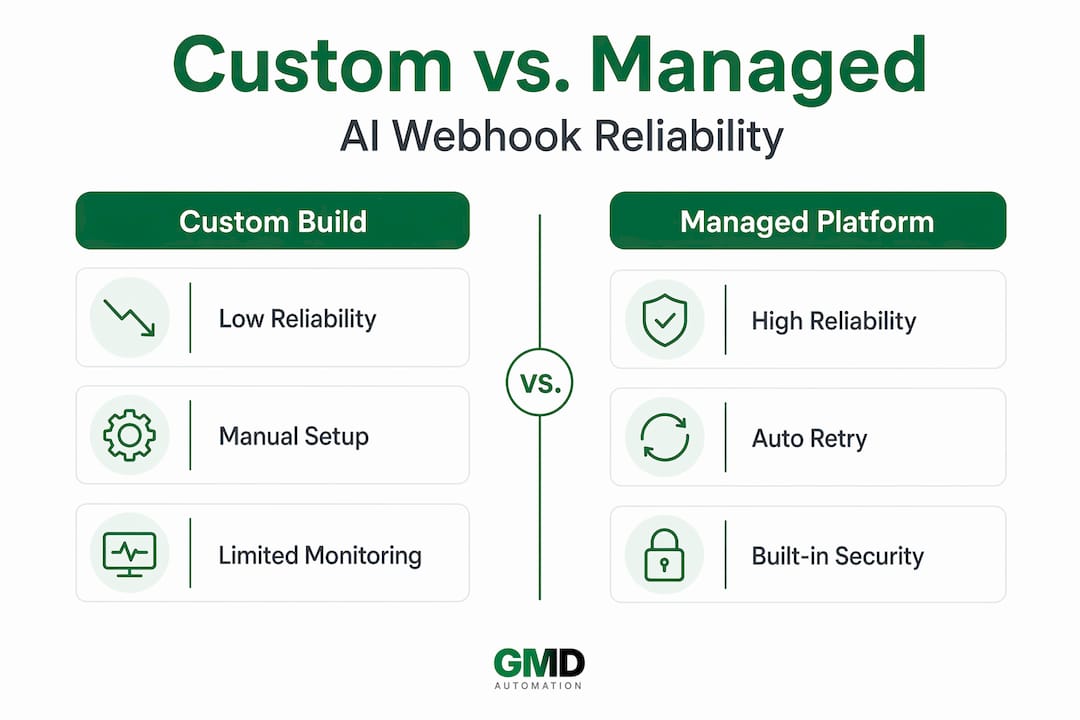
| Managed platform (e.g. Hookdeck, Svix) | High out of the box | Built-in dashboards and alerts | Low to medium |
Pro Tip: If you are using webhooks for AI, consider reading the types of AI middleware available for your stack before committing to a custom implementation. The right middleware layer can absorb much of this complexity.
Managed platforms like Hookdeck provide automatic idempotency headers and deduplication, replacing traditional DLQ setups with an integrated issues system that supports bulk retries and alerting. For AI automation workflows under any meaningful load, that kind of operational coverage is worth paying for.
Troubleshooting common webhook automation problems
Even well-built systems break. The difference between a resilient system and a fragile one is how quickly you detect problems and how contained the damage is.
Event duplication. Duplicate events are not bugs in most webhook systems. They are expected behaviour given at-least-once delivery semantics. If your receiver is not idempotent, duplicates cause double-processing, which in an AI workflow might mean duplicate database writes, double-charged transactions, or AI agents running the same task twice. The fix is always at the receiver, not the sender.
Retry storms. A retry storm occurs when a large backlog of failed events all retry simultaneously, flooding your endpoint or downstream AI system. Exponential back-off with jitter reduces this risk significantly. Some managed webhook management systems handle this automatically, but if you are running your own retry logic, you need to build it deliberately.
Schema drift. Monitoring schema drift in webhook payloads is often overlooked because payload changes do not always generate HTTP errors. A renamed field passes signature verification and returns a 200 response, but your downstream processor silently receives null where it expected data. The only way to catch this reliably is to validate payload structure on every event against a defined schema.
Auto-disabled endpoints. Many webhook providers automatically disable an endpoint after a sustained period of delivery failures. This is a protective mechanism, but it creates a silent failure: the provider stops sending, your system shows no errors, and you have no idea events are being dropped. Monitoring the provider's delivery success rate independently of your own application logs is the only reliable protection.
The most dangerous webhook failure is the one you do not know about. A retry that eventually succeeds looks fine in your logs. An endpoint that gets auto-disabled generates no error at all. Building observability into webhook infrastructure is not optional for production AI systems.
Replay attack edge cases. Timestamp freshness windows handle the obvious case, but consider an attacker who intercepts a request and replays it within the five-minute window. Your event ID cache is the defence here. Multi-layered defence combining time-limited signatures and event ID caching is the minimum viable security posture for any webhook automation AI system handling sensitive data.
Measuring success and maintaining reliability
Deploying a working webhook integration is not the finish line. Production reliability requires ongoing measurement and deliberate maintenance practices.
Tracking the right metrics separates teams that catch problems early from those that learn about failures from unhappy users:
- Delivery success rate by event type, not as a single aggregate figure
- Retry rate, where 1 to 3 percent is normal and anything higher warrants investigation
- DLQ volume, which should sit at zero under normal conditions
- End-to-end processing latency, from event emission to AI action completion
- Schema validation failure rate, to catch drift before it causes silent failures
- Endpoint availability, checked independently of provider-side dashboards
Webhook monitoring tools that track real traffic, schema drift, and failures, then send alerts to common channels like Slack or PagerDuty, improve production reliability significantly over relying on provider dashboards alone.
Periodic reconciliation is also worth building into your maintenance calendar. At least monthly, compare your AI platform's event log against the events your system has processed to identify any dropped events that did not generate retries. This is particularly important for AI automation workflows where a missed event might represent a customer action or a financial transaction.
On the architecture side, hybrid approaches that use webhooks for reliable back-end event delivery alongside WebSockets for real-time UI updates represent a mature pattern for AI platforms serving end users. The two protocols are complementary, not competing.
Finally, rotate your webhook signing secrets on a schedule. Treat them like any other credential: revoke and replace on a regular cycle, and immediately on any suspected exposure.
My honest take on webhook infrastructure for AI
I have seen enough AI automation projects stall or fail in production to have a fairly firm view on where organisations go wrong. The pattern is almost always the same: the team underestimates webhook infrastructure as a discipline and treats it as a configuration task rather than an engineering concern.
What typically happens is this. A developer sets up an endpoint in an afternoon, verifies that events arrive, and calls it done. Three months later, the AI system is dropping events intermittently, nobody knows why, and debugging is brutal because observability was never built in. The operational burden of webhook management consistently surprises organisations who have only handled straightforward API integrations before.
My view is that for any AI system where reliability actually matters, and that is most of them once they are in production, the cost of a managed platform is trivially small compared to the engineering hours you will spend rebuilding its features from scratch. The scalable AI automation architecture that holds up under load is almost never the one built entirely in-house.
The one thing I would add that most guides omit: treat your webhook infrastructure with the same seriousness as your database infrastructure. You would not run a production database without backups, monitoring, and a recovery plan. Extend that same discipline to how events flow through your AI systems, and you will avoid most of the cascading failures that make AI automation a liability rather than an asset.
— Ravi
How Gmdautomation supports your webhook strategy
Gmdautomation has built its AI automation platform specifically for UK businesses that need enterprise-grade reliability without the overhead of managing complex infrastructure in-house. If the implementation steps in this guide feel like a significant undertaking for your team, that is exactly the problem Gmdautomation solves.
The platform handles the full lifecycle of AI automation for UK businesses, including webhook management, security, monitoring, retries, and ongoing optimisation, all under a predictable monthly subscription. There are no upfront capital costs, no hidden complexity passed back to your team, and no compromise on performance or compliance. Operations managers and IT decision-makers get a fully managed AI workflow system that is production-ready from day one, with ongoing support built into the model. If you want to see what webhook-powered AI automation looks like in practice, the Gmdautomation demo agent is a good starting point.
FAQ
What is webhook automation in AI systems?
Webhook automation in AI systems uses event-driven HTTP callbacks to trigger AI workflows the moment a defined event occurs, replacing polling with real-time notification. This approach significantly reduces latency and removes unnecessary API load.
How do managed webhook platforms differ from custom builds?
Managed webhook management systems provide built-in signature verification, retry logic, deduplication, and observability from the start, whereas custom builds require your team to engineer all of these features themselves. The operational difference is substantial for teams without dedicated infrastructure engineers.
Why is idempotency required for webhook automation AI systems?
Because at-least-once delivery is the standard for webhook systems, the same event may arrive more than once. Idempotent receivers process each unique event only once regardless of how many times it is delivered, preventing duplicate actions in your AI workflows.
What are the biggest security risks in automated webhook integrations?
The main risks are tampered payloads, replay attacks, and auto-disabled endpoints from sustained failures. Layering signature verification, timestamp freshness windows, and event ID caching addresses the first two; independent monitoring handles the third.
How do you know if your webhook automation is actually working?
Track delivery success rate by event type, retry rate, DLQ volume, and end-to-end processing latency. Silent failures, where schema drift causes dropped data without HTTP errors, are only caught through payload validation and periodic reconciliation against source event logs.