

AI access control is the integration of artificial intelligence into access management systems to provide adaptive, context-sensitive, and automated control over organisational resources and identities. Unlike traditional models that grant access based on fixed rules, AI-driven systems evaluate permissions continuously, factoring in user behaviour, location, device posture, and real-time threat signals. 70% of organisations have integrated AI into their security programmes by Q1 2026. That figure signals a fundamental shift in how enterprises think about identity and access management, moving away from static gatekeeping towards dynamic, intelligent enforcement.
What is AI access control and how does it differ from traditional systems?
Traditional access control relies on static models such as Role-Based Access Control (RBAC) and Multi-Factor Authentication (MFA). These systems grant permissions at login and rarely revisit them until a session ends. The problem is that threats do not wait for a session to expire.
AI access control replaces that static model with continuous evaluation. The system checks identity, risk signals, location changes, and device posture throughout a session, not just at the point of entry. Access tokens must be verified in real time against multiple contextual factors to ensure ongoing validity. That means a user who logs in from London and then attempts to access a sensitive database from an unrecognised device mid-session will trigger an immediate policy response.

The table below contrasts the two approaches across the dimensions that matter most to IT and security teams.
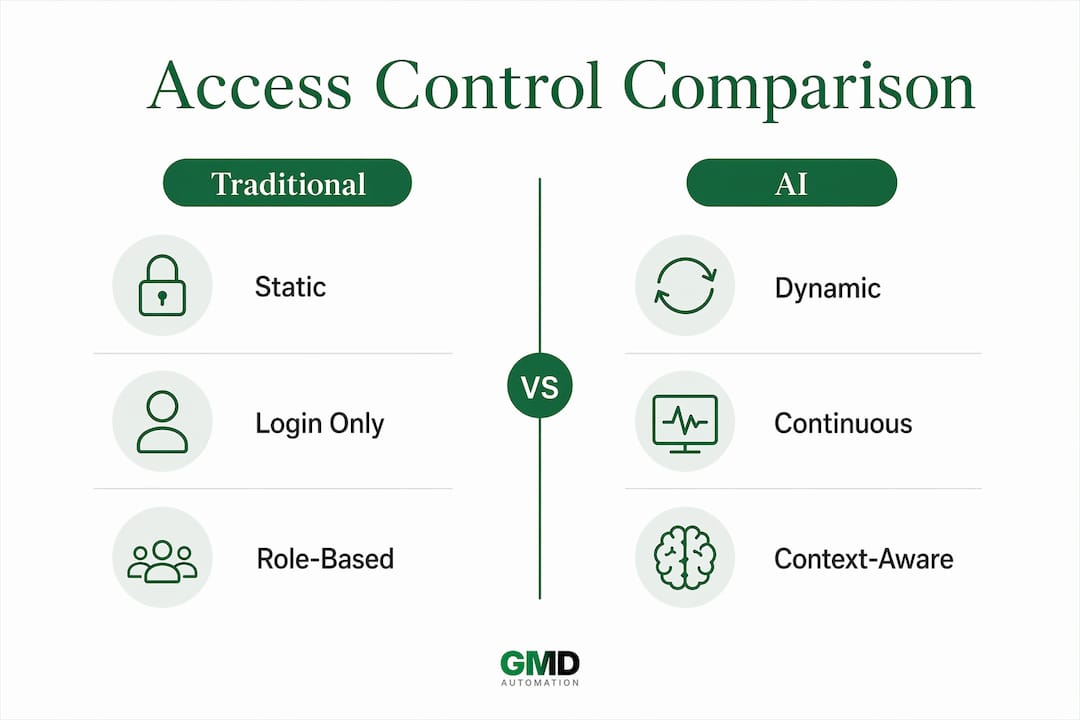
| Feature | Traditional access control | AI access control |
|---|---|---|
| Permission evaluation | At login only | Continuously at runtime |
| Policy basis | Fixed roles and rules | Context, behaviour, and risk signals |
| Threat response | Manual or scheduled | Automated and real time |
| Agent identity support | Human users only | Distinct identities for AI agents |
| Privilege model | Long-lived credentials | Ephemeral, task-scoped tokens |
The shift is not cosmetic. AI agents require a continuous control plane because static login-time authentication models are insufficient for autonomous agent security. Organisations that retain legacy IAM architectures alongside AI workloads are running two incompatible security philosophies simultaneously.
Pro Tip: Audit your existing RBAC policies before deploying AI access control. Overly broad roles are the most common source of privilege creep, and AI systems will inherit those problems if you do not clean them up first.
What are the main types of AI access control mechanisms?
AI access control is not a single technology. It is a collection of mechanisms that work together to enforce the right permissions at the right moment. Understanding each one helps IT leaders make informed decisions about where to invest.
-
Attribute-Based Access Control (ABAC) with AI policy engines. ABAC evaluates access based on attributes of the user, resource, and environment rather than a fixed role. AI policy engines extend this by learning from historical patterns and adjusting attribute weights dynamically. A finance director accessing payroll data at 2am from an overseas IP address will receive a different access decision than the same person accessing the same data from the office at 9am.
-
Ephemeral tokens and zero standing privilege. Zero standing privilege with ephemeral, task-specific access tokens greatly reduces risk compared to static, long-lived credentials. A token issued for a specific task expires the moment that task completes. If an attacker intercepts it, the window of exploitation is measured in seconds, not months.
-
Real-time context analysis. Dynamic scoping allows policies to evaluate permissions at runtime based on current context, including task type, time, location, and detected anomalies. This is the mechanism that makes AI access control genuinely adaptive rather than simply automated.
-
Semantic guardrails and AI firewalls. Modern AI firewalls inspect natural language in real time, blocking prompt injection and jailbreak attacks that traditional firewalls cannot detect. This is particularly relevant for organisations deploying large language model (LLM) based tools internally, where a malicious prompt could be used to extract sensitive data.
-
Agent identity separation. AI agents must be treated as untrusted, autonomous principals with distinct identities and logged, scoped service accounts for each action. Mixing agent credentials with human user accounts creates accountability gaps that are almost impossible to audit retrospectively.
What challenges come with implementing AI access control?
Adopting AI access control introduces governance and operational challenges that go beyond standard IT project risks. Executives and IT leaders need to understand these before committing to an implementation roadmap.
The most immediate challenge is managing AI agent identities. Every autonomous agent operating in your environment needs a unique, verifiable identity. Without that, you cannot attribute actions to specific agents, and your audit trail becomes worthless. AI security cannot rely solely on model improvements but requires system-level controls like isolation, least privilege, and auditability. That reframes the problem: you are not just configuring software, you are designing an operating environment.
A second challenge is keeping dynamic policies current. AI access control systems depend on accurate, up-to-date threat intelligence and behavioural baselines. A policy engine trained on six-month-old data will make poor decisions. Continuous monitoring and regular policy reviews are not optional extras; they are core operational requirements.
The third challenge is governance balance. Full automation is tempting, but critical decisions benefit from human oversight. Agentic AI defence in cyber-physical systems benefits from human-in-the-loop workflows that combine AI diagnosis with automated remediation. Removing humans entirely from high-stakes access decisions creates accountability gaps and regulatory exposure, particularly under frameworks such as the UK GDPR and the NCSC's Cyber Essentials scheme.
Pro Tip: Define a clear escalation matrix before go-live. Specify which access decisions the AI handles autonomously, which require human approval, and which trigger an immediate security alert. This prevents both under-reaction and over-automation.
- Over-privileging AI agents is the most common technical mistake. Start with the narrowest possible permissions and expand only when a documented business need justifies it.
- Data residency and privacy obligations affect which contextual signals you can legally collect and process. Engage your Data Protection Officer early.
- Vendor lock-in is a real risk. Favour policy engines that use open standards so you can migrate without rebuilding your entire access architecture.
How can organisations integrate AI access control in practice?
Implementation works best as a phased process rather than a single large deployment. The following sequence reflects what works in practice for UK enterprises moving from legacy IAM to AI-driven access management.
-
Define and catalogue all identities. Map every human user, service account, and AI agent that touches your systems. You cannot enforce access policies on identities you have not documented. Include third-party integrations and API connections in this inventory.
-
Adopt a centralised policy engine. Tools such as Open Policy Agent (OPA) or Cedar provide a single point of policy definition and enforcement. Centralisation prevents the policy fragmentation that occurs when individual teams manage their own access rules in isolation. For a broader view of how these fit into your architecture, the guide on enterprise AI security covers integration patterns in detail.
-
Implement continuous evaluation. Move beyond point-in-time authentication. Configure your policy engine to re-evaluate access decisions based on live signals including device posture, geolocation, and behavioural anomalies. 46% of companies plan to increase their security budgets, with 42% moving to AI-powered security technology for threat detection. That investment is being directed precisely at this continuous evaluation capability.
-
Issue ephemeral credentials for AI agents. Replace long-lived service account tokens with short-lived credentials scoped to specific tasks. Automate the issuance and revocation process so that credential management does not become a manual bottleneck.
-
Establish executive reporting metrics. Define the indicators that matter at board level: number of anomalous access events detected, mean time to revoke compromised credentials, and policy coverage across all identities. Understanding AI governance frameworks helps translate these technical metrics into language that resonates with non-technical stakeholders.
-
Run a red team exercise before full deployment. Test your policy engine against simulated attacks including prompt injection, credential replay, and privilege escalation attempts. Findings from this exercise will reveal gaps that internal reviews miss.
Key takeaways
AI access control outperforms traditional IAM because it evaluates permissions continuously, assigns distinct identities to AI agents, and enforces least privilege through ephemeral credentials rather than static roles.
| Point | Details |
|---|---|
| Continuous evaluation is non-negotiable | AI systems must verify identity and risk signals throughout a session, not only at login. |
| Ephemeral tokens reduce blast radius | Short-lived, task-scoped credentials limit damage if a credential is compromised. |
| Agent identity must be separate | AI agents need distinct, logged identities to maintain a credible audit trail. |
| Human oversight remains critical | Automated decisions on high-stakes access events need a defined human escalation path. |
| Policy centralisation prevents fragmentation | A single policy engine such as OPA or Cedar keeps access rules consistent across all systems. |
The uncomfortable truth about AI access control adoption
I have watched organisations invest heavily in AI security tools and still suffer breaches. The reason is almost always the same: they treated AI access control as a product purchase rather than an architectural commitment.
The technology is not the hard part. Defining what your AI agents are allowed to do, and enforcing those boundaries consistently, requires organisational discipline that most enterprises have not yet developed. The shift from human-centric IAM to a continuous control plane for AI agents is as much a cultural change as a technical one.
The organisations getting this right share one characteristic: they treat AI agents with the same scepticism they would apply to an unknown external contractor. Every action is logged. Every credential is scoped. Every anomaly is investigated. That posture feels excessive until the day it prevents a serious incident.
Zero standing privilege is the principle I would prioritise above all others. The idea that an AI agent should hold permanent access to any system is the same flawed thinking that gave us over-privileged service accounts a decade ago. We know how that ended. The smishing and AI-driven threat landscape is moving faster than legacy IAM can respond. Ephemeral credentials are not a nice-to-have; they are the baseline.
My advice to any executive reading this: do not wait for a regulatory mandate to force your hand. The organisations that build mature AI access control frameworks now will have a measurable security advantage within 18 months. Those that delay will spend that time responding to incidents instead.
— Ravi
AI access control solutions for UK businesses
Gmdautomation builds AI automation systems for UK enterprises that need security, compliance, and performance without large upfront costs. Their subscription model covers implementation, ongoing operation, and continuous optimisation, so your team focuses on governance rather than infrastructure management.
For organisations ready to move from static IAM to intelligent, adaptive access management, Gmdautomation provides the architecture and support to do it at pace. Their systems are designed to integrate with existing enterprise IT environments, reducing the friction that typically slows AI adoption. Explore what AI automation for UK businesses looks like in practice, and see how Gmdautomation can support your access control and security objectives from day one.
FAQ
What is AI access control in simple terms?
AI access control is a security system that uses artificial intelligence to decide who or what can access organisational resources, evaluating permissions continuously based on real-time context rather than fixed rules set at login.
How does AI improve traditional access control systems?
AI adds continuous evaluation, behavioural analysis, and anomaly detection to access management. Traditional systems like RBAC grant access once and rarely revisit it; AI systems re-evaluate permissions throughout every session.
What is zero standing privilege in AI access control?
Zero standing privilege means AI agents hold no permanent access rights. Instead, they receive short-lived, task-specific credentials that expire automatically, limiting the damage if those credentials are ever compromised.
What types of AI access control mechanisms exist?
The main mechanisms include ABAC with AI policy engines, ephemeral token issuance, real-time context analysis, semantic guardrails, AI firewalls for natural language inspection, and separate identity management for AI agents.
How do organisations start implementing AI access control?
The recommended starting point is a full identity catalogue covering all users, service accounts, and AI agents, followed by adopting a centralised policy engine such as Open Policy Agent and replacing long-lived credentials with ephemeral, task-scoped tokens.