

IT governance in AI is defined as the structured set of policies, accountability mechanisms, and oversight controls that ensure AI systems are deployed, operated, and retired in alignment with business objectives, risk tolerance, and regulatory requirements. Without this structure, organisations face uncontrolled AI proliferation, compliance gaps, and accountability failures that no technical solution alone can fix. Frameworks such as the NIST AI Risk Management Framework (NIST AI RMF), ISO 42001, and the EU AI Act now set the baseline for what responsible AI governance looks like. The role of IT governance in AI is not a separate discipline. It is the operational backbone that makes AI safe to scale.
How does IT governance integrate with AI governance frameworks?
IT governance does not need to be rebuilt from scratch to accommodate AI. Existing corporate governance tools, including RACI matrices, balanced scorecards, and stage-gate review processes, map directly onto AI governance requirements. Integrating AI governance into established strategic execution frameworks produces measurably higher maturity and accountability than building isolated AI governance departments.
The NIST AI RMF organises AI governance into four functions: Govern, Map, Measure, and Manage. Each of these maps cleanly onto IT governance processes that most organisations already run. "Govern" aligns with policy and ownership structures. "Map" aligns with risk assessment workflows. "Measure" aligns with performance monitoring. "Manage" aligns with incident response and change control.

The practical implication is significant. A cross-functional AI steering committee does not need to be a new body. It can be a standing agenda item within an existing IT governance board, with AI-specific metrics added to the balanced scorecard. This approach prevents the siloed AI governance that most organisations fall into, where AI oversight exists on paper but never connects to real decision-making authority.
Pro Tip: Add AI system performance metrics directly to your existing balanced scorecard rather than creating a separate AI dashboard. Governance that lives inside your current review cadence gets reviewed. Governance that lives in a separate tool gets ignored.
For IT leaders building this integration, the AI governance for businesses guide from Gmdautomation covers how IT governance structures directly influence AI risk management across the full system lifecycle.
- Map NIST AI RMF functions to existing IT governance processes rather than treating them as new obligations.
- Add AI risk ratings to current risk registers instead of maintaining a separate AI risk log.
- Use existing RACI matrices to assign AI governance roles, filling gaps where AI-specific responsibilities are absent.
- Embed AI review checkpoints into existing project governance gates, not into a parallel AI approval process.
What risks does IT governance address in AI implementation?
Shadow AI is the most underestimated risk in enterprise AI deployment. Initial AI inventories consistently reveal 3 to 10 times more AI systems than leadership estimates. That gap represents unvetted models processing business data outside any compliance or security control.
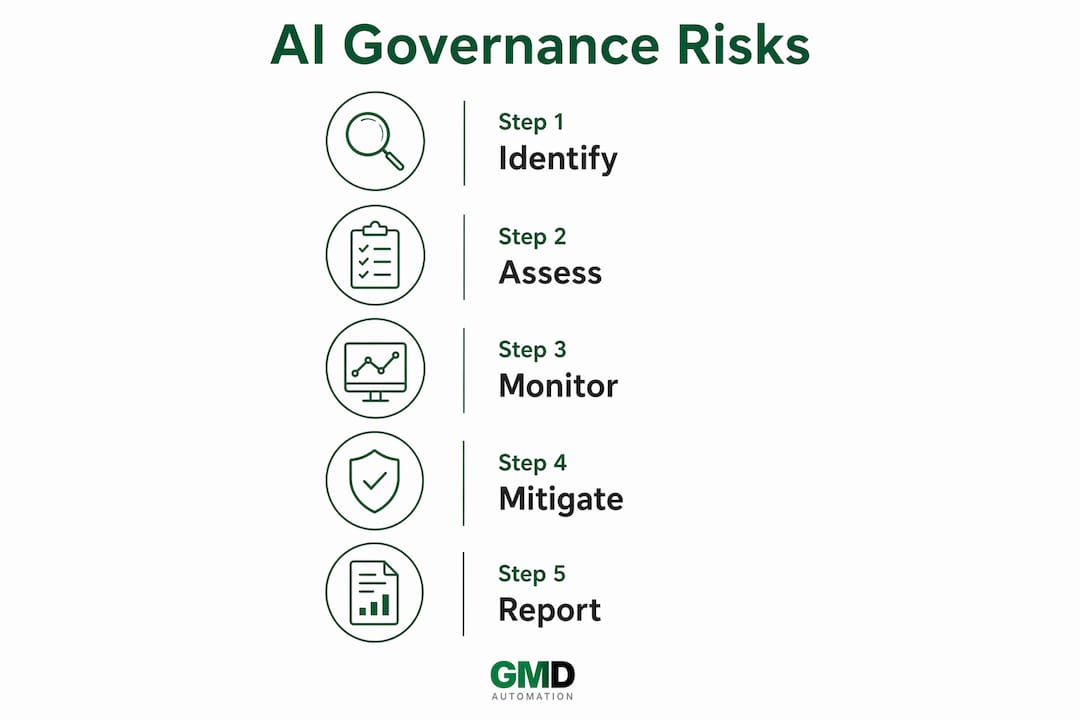
The accountability problem compounds this. Only 16.9% of strategic AI governance measures have explicit ownership, and 91.4% of those owned measures have not been updated in six months. This creates what governance professionals call "phantom ownership," where a named individual exists on paper but exercises no real oversight. IT governance directly addresses this by embedding AI accountability into job descriptions, performance reviews, and escalation paths.
Regulatory exposure is a third category of risk. Under the EU AI Act, the deployer of an AI system retains independent legal responsibility for compliance, even when a third-party vendor built and maintains the model. That means your organisation owns the data governance, incident reporting, and human oversight obligations regardless of who wrote the code. IT governance provides the audit trail and control evidence that regulators require.
- Conduct a full AI system inventory before any other governance activity. Expect to find far more systems than your leadership team believes exist.
- Assign named owners with explicit authority, not just awareness, for every AI system in the inventory.
- Map each AI system against the EU AI Act risk tiers and the relevant NIST AI RMF controls.
- Define and document stop authority: the named individual with both the responsibility and the technical ability to halt an AI system immediately.
- Test your AI incident response plan. Only 20% of organisations have done so, leaving most enterprises unprepared for a live AI failure.
The stop authority point deserves particular attention. Effective AI governance programmes embed clear authority to halt or roll back AI systems into job descriptions, with the technical capacity to act immediately. This is not a theoretical safeguard. It is the difference between a contained incident and a regulatory breach.
What are the core components of effective AI governance?
Effective AI governance converges on five pillars regardless of which framework an organisation follows. NIST, ISO 42001, and the EU AI Act all align on: inventory and classification, risk and impact assessment, controls and human oversight, evidence and audit trail, and continuous improvement. These are not sequential phases. They operate in parallel across the AI lifecycle.
Building and maintaining a live AI inventory
A live AI inventory is the foundation of everything else. It must capture the model name, version, business owner, data inputs, risk classification, and current operational status for every AI system in use. Static spreadsheets fail within weeks. The inventory must connect to your change management process so that every model update, retraining event, or new deployment triggers an automatic review.
Policy codification and regulatory mapping
Acceptable-use policies, data handling rules, and incident response procedures must be written, approved, and tested before any AI system goes live. Policies that exist but remain untested provide no real protection. Cross-framework regulatory mapping, covering NIST AI RMF, ISO 42001, and the EU AI Act simultaneously, prevents the duplication of effort that occurs when teams treat each regulation as a separate compliance project.
Pro Tip: Build a single regulatory mapping table that lists each control once and marks which frameworks it satisfies. One control, three compliance credits. This approach cuts governance overhead significantly and makes audit preparation straightforward.
For organisations building this architecture, the enterprise AI security guide from Gmdautomation covers how to embed IT governance controls into AI security design from the ground up.
Continuous monitoring and evidence management
Governance evidence must be maintained continuously and updated with every model change or tuning event. Automated triggers embedded in MLOps pipelines are the only reliable way to achieve this at scale. Manual evidence collection fails under audit pressure because it is always incomplete. Drift detection, performance monitoring, and bias checks must run on a defined schedule, with results logged automatically to the audit trail.
A practical AI governance framework treats these five pillars as living capabilities, not one-time deliverables. The organisations that pass regulatory audits are those that built continuous evidence collection into their operations from day one.
How do you implement IT governance for AI in an enterprise?
Implementation follows a defined sequence, and the timeline is longer than most leadership teams expect. Building foundational AI governance takes 4 to 6 months. Reaching full operational maturity typically requires 12 to 24 months. Organisations that treat governance as a sprint rather than a sustained programme consistently fail their first external audit.
- Assign named executive ownership first. A Chief AI Officer, Chief Risk Officer, or equivalent must hold accountability for the AI governance programme. Shared ownership means no ownership.
- Form a cross-functional steering committee. Include IT, legal, compliance, HR, and the business units that operate AI systems. Governance decisions made without business unit input produce policies that operations teams ignore.
- Implement stage-gate checkpoints. Every AI project must pass defined governance reviews at concept, development, pre-deployment, and post-deployment stages. Each gate requires documented evidence, not verbal sign-off.
- Integrate cybersecurity awareness training. Shadow AI usage is detected in 69% of organisations. Training staff on approved tools and the risks of unapproved ones reduces the shadow AI surface area faster than technical controls alone.
- Plan for iteration, not perfection. The first version of your AI governance framework will have gaps. Build a quarterly review cycle into the programme from the start, and treat each iteration as a maturity milestone rather than a failure.
The most common pitfall is policy without enforcement. Organisations publish acceptable-use policies, assign nominal owners, and then conduct no follow-up monitoring. Six months later, the phantom ownership problem described earlier takes hold, and the governance programme exists only as documentation. Enforcement requires technical controls, regular audits, and consequences for non-compliance that are proportionate and consistently applied.
For IT leaders who want to understand how governance connects to AI transformation at the organisational level, the role of IT in AI transformation guide from Gmdautomation provides a practical framework for aligning IT governance with broader AI adoption goals.
Key takeaways
IT governance is the operational structure that makes AI safe, accountable, and compliant at scale. Without it, organisations face shadow AI proliferation, phantom ownership, and regulatory exposure that technical solutions cannot resolve.
| Point | Details |
|---|---|
| Integrate, do not duplicate | Map AI governance functions onto existing IT governance tools such as RACI matrices and balanced scorecards. |
| Inventory first, govern second | Expect to find 3 to 10 times more AI systems than leadership estimates before any controls can be applied. |
| Name every owner explicitly | Only 16.9% of AI governance measures have explicit ownership; phantom ownership is the leading cause of governance failure. |
| Define stop authority clearly | Assign named individuals with both the responsibility and the technical ability to halt AI systems immediately. |
| Build for maturity, not speed | Full AI governance maturity takes 12 to 24 months; treat it as a sustained programme with quarterly review cycles. |
Why most AI governance programmes fail before they start
The uncomfortable truth I have observed across multiple enterprise AI programmes is this: most organisations treat AI governance as a compliance exercise rather than a management discipline. They produce policies, assign nominal owners, and file the documentation. Then nothing changes operationally.
The governance programmes that actually work share one characteristic. They are built inside the organisation's existing accountability structures, not alongside them. When AI metrics appear on the same scorecard that the board reviews every quarter, they get the same attention as revenue and risk. When AI owners face the same performance consequences as any other operational owner, they stay engaged. Governance that lives in a separate AI ethics committee, disconnected from real business cadences, becomes invisible within six months.
The second failure pattern I see consistently is the gap between policy and technical control. An acceptable-use policy that prohibits unapproved AI tools means nothing if there is no technical mechanism to detect or block them. Governance requires both the written rule and the operational enforcement. Neither works without the other.
My recommendation is to start with the inventory, assign real owners with real authority, and embed AI governance into the review processes that already have teeth in your organisation. The frameworks, NIST AI RMF, ISO 42001, and the EU AI Act, provide the structure. Your existing governance culture provides the accountability. The combination is what makes it work.
— Ravi
How Gmdautomation supports AI governance for UK businesses
Gmdautomation works with UK businesses to deploy AI automation systems that are built with governance, compliance, and security controls from the outset. Every system Gmdautomation delivers includes implementation, operation, maintenance, and ongoing optimisation under a predictable monthly subscription, with no upfront capital expenditure required. For IT leaders who need AI systems that align with the EU AI Act, NIST AI RMF, and ISO 42001 from day one, Gmdautomation provides the technical architecture and governance documentation to support that alignment. Explore AI automation for UK businesses to see how Gmdautomation structures its deployments for compliance and operational accountability.
FAQ
What is the role of IT governance in AI?
IT governance in AI provides the policies, accountability structures, and oversight controls that ensure AI systems are deployed and managed safely, ethically, and in line with business objectives. It integrates AI risk management into existing corporate governance frameworks rather than treating AI oversight as a separate function.
Which frameworks define AI governance requirements?
The NIST AI Risk Management Framework, ISO 42001, and the EU AI Act are the three primary frameworks shaping AI governance requirements for enterprises in 2026. They converge on five pillars: inventory and classification, risk assessment, controls and human oversight, evidence management, and continuous improvement.
How long does it take to implement AI governance?
Building foundational AI governance takes 4 to 6 months. Reaching full operational maturity typically requires 12 to 24 months, depending on the size of the AI system estate and the maturity of existing IT governance structures.
What is shadow AI and why does it matter for governance?
Shadow AI refers to AI tools and models used within an organisation without formal approval or oversight. Initial AI inventories reveal 3 to 10 times more AI systems than leadership estimates, making shadow AI detection a critical first step in any governance programme.
Who is legally responsible for AI compliance under the EU AI Act?
The deployer of an AI system retains independent legal responsibility for compliance under the EU AI Act, even when a third-party vendor built the model. This means the deploying organisation owns the data governance, incident reporting, and human oversight obligations regardless of vendor involvement.