

AI voicemail transcription converts spoken voicemail messages into text and structured data, ready for email, CRM records, or task queues, usually within seconds of a call ending. The main payoff is time: teams stop replaying audio to triage messages and start scanning text instead. Before rolling it out, check two things: accuracy on your actual call audio, and whether the vendor supports redaction and data retention rules that match your compliance obligations.
TL;DR:
- Transcription accuracy drops significantly with background noise, accents, or jargon, making pilot testing on real call data essential before full deployment.
- Redaction policies should default to redacting sensitive information in transcripts, with access to original audio restricted to a select few to reduce compliance risk.
- Cost considerations include storage, human review for low-confidence transcripts, and integration efforts, which often outweigh the headline per-minute rate.
- Managed services offer full handling of setup, redaction, and ongoing tuning starting around £250 to £300 per month, ideal for organizations seeking a hands-off solution.
- High accuracy levels around 93 to 95 percent are typical on clean audio, but pilot testing helps identify real-world challenges like noise and speaker variability.
Table of Contents
- What is AI voicemail transcription and what does it produce?
- How does AI voicemail transcription actually work?
- What benefits and limits should you expect from voicemail transcription?
- How do you handle privacy, redaction, and compliance obligations?
- Setting up a pilot: integration, testing and ongoing monitoring
- How do leading AI voicemail transcription providers compare?
- What does AI voicemail transcription cost in practice?
- Where does AI voicemail transcription actually change how a business runs?
- Why is my transcription accuracy inconsistent, and how do I fix it?
- GMD Automation's perspective: pilot before you commit
- Start with a pilot, not a full rollout
- Sources
- FAQ
What is AI voicemail transcription and what does it produce?
A basic transcript is just words on a page. Most modern AI voicemail transcription tools go further, producing an enriched record that a sales or support team can act on without listening to a single second of audio.
Typical outputs include:
- A plain-text transcript with punctuation and speaker labels where more than one voice is present
- A short summary flagging the caller's likely intent (callback request, complaint, booking enquiry)
- Sentiment or urgency tags, useful for prioritising a queue
- Delivery to email, a desktop or mobile app, or a CRM record via webhook or direct sync
Yeastar's voicemail-to-text feature, for example, pushes transcripts straight to email and connected apps, so a message becomes a searchable line item rather than an audio file sitting in an inbox. Other vendors go a step further: Open's AI voicemail tooling can detect intent and spin a message directly into a follow-up task. Voicemail transcription sits early in that chain: capture, transcribe, classify, then route into whatever system runs your day, whether that is a CRM, a ticketing tool, or a shared inbox.
How does AI voicemail transcription actually work?
The process runs through a fairly fixed pipeline, whether you are using a cloud API or an on-premises system.
- Capture. The PBX or VoIP platform records the voicemail as an audio file (commonly WAV or MP3) or streams it live.
- Encoding and pre-processing. Audio is normalised and split into chunks a speech-to-text (STT) model can handle.
- Transcription. An STT model converts speech to text. Better systems add diarization (separating speakers), automatic punctuation, and named-entity recognition to catch names, dates, and numbers correctly.
- Post-processing. The raw transcript is summarised, tagged for intent or sentiment, and filtered for sensitive data before delivery.
Two modes matter here. Real-time streaming transcription suits live call monitoring or agent-assist tools, but voicemail is almost always post-call: the message finishes, then gets processed, so a few seconds of latency rarely matters.
Engine choice shapes cost and control. Managed cloud APIs are fastest to deploy but mean your audio leaves your network. Open-source models offer more control over data residency but need infrastructure and tuning. WhisperAI's platform illustrates the middle ground: broad language support and vocabulary tuning through an API, without the heavier lift of running your own model stack.
What benefits and limits should you expect from voicemail transcription?
The productivity case is straightforward. Staff scan text instead of replaying audio, transcripts are searchable across weeks of messages, and enriched outputs can auto-populate a CRM field or trigger a follow-up task without anyone typing a summary.
Statistic callout: STT.ai reports its best models reaching 93 to 95% accuracy on clean audio for voicemail-style recordings. That figure drops noticeably with background noise, strong accents, or a caller mumbling a phone number down a bad line.
The common failure points are predictable:
- Proper names and industry jargon that don't appear in the model's training vocabulary
- Regional accents and non-native speech patterns
- Overlapping speech or heavy background noise on mobile calls
- Numbers spoken quickly (phone numbers, account references, dates)
Cost runs on a per-minute or per-API-call basis in most pricing models, and storage or retention adds a second line item once volumes grow. For anything customer-facing or compliance-sensitive, budget for a human review step on flagged or low-confidence transcripts rather than trusting the raw output outright. A hybrid workflow, automated transcript plus a light QA pass on anything flagged, tends to balance speed against correctness better than either extreme.
How do you handle privacy, redaction, and compliance obligations?
Voicemail transcripts routinely capture card numbers, addresses, and other personal data spoken by callers who never agreed to have it stored as searchable text. That is the part most teams underestimate until a compliance review forces the question.
Redaction can run in two modes. Real-time redaction strips sensitive data as the call happens; post-interaction redaction processes the completed recording and transcript afterwards. Amazon Connect's documentation notes that redacted audio can store silence where sensitive data was removed, and that whether the original, unredacted file is kept at all is a configuration choice, not a default.
Policy-based redaction varies by platform too. Five9's redaction settings always strip PCI data by default, with optional rules to redact names, addresses, or all spoken numbers depending on the policy you set.
Key decisions to make before go-live:
- Whether you retain original audio for dispute resolution, or only the redacted version
- Who can access unredacted transcripts, and for how long
- Whether callers are told their message may be transcribed by AI (a disclosure line on the greeting is common practice)
- Consulting ICO guidance on lawful basis and retention periods before storing voice data at scale
Pro Tip: Keep redacted transcripts as the default record everyone works from, and restrict access to original audio to a named few. It cuts your exposure without losing the ability to investigate a genuine dispute.
Setting up a pilot: integration, testing and ongoing monitoring
A rushed rollout is how teams end up with a transcription tool nobody trusts. A structured pilot fixes that before it becomes a habit.
- Verify integration points first. Confirm your PBX can export or stream recordings in a format the vendor accepts (WAV, MP3, or PCM), and that webhook or CRM connector endpoints are ready to receive transcripts.
- Design the pilot sample deliberately. Include a real mix of accents, call types, and background conditions, not just clean office recordings, so accuracy numbers mean something.
- Set acceptance thresholds up front. Decide the latency you need and the accuracy rate you'll accept before comparing vendors, not after.
- Get user opt-in and run QA reviews on a sample of outputs weekly during the pilot.
- Plan for ongoing operations. Build a process for updating vocabulary lists, handling incidents, and enforcing retention and deletion schedules once live.
A conversational AI IVR implementation guide covers the contact-centre integration side in more depth if your PBX setup is complex. Partner reference material like California Telecom's VoIP features list is also a useful vendor-agnostic checklist for what a modern phone system should support before you bolt AI transcription on top.
How do leading AI voicemail transcription providers compare?
Providers split roughly into three tiers, and picking the wrong one usually means picking the wrong tier, not the wrong brand.
Consumer and lightweight tools cover basic conversion needs cheaply or for free. Tools like TicNote's free voicemail-to-text converter handle short pilot workloads and casual use across several languages, but they generally lack enterprise data residency guarantees, redaction controls, or CRM integrations. Fine for testing the concept; not built for regulated data.
Specialist transcription vendors sit in the middle. STT.ai's use-case page for voicemail claims 93 to 95% accuracy on clean audio, diarization, and a broad range of export formats, with a free minutes tier that makes it genuinely useful for piloting before committing spend.
PBX-integrated and managed platforms sit at the top. Yeastar bundles voicemail-to-text directly into its phone system feature set, syncing transcripts to email and client apps without separate integration work. Contact-centre platforms like Five9 add configurable, policy-driven redaction on top of transcription, which matters once you're handling payment or personal data at volume.
The right tier depends on volume and risk, not brand preference. A small team testing the water can start with a specialist API and free minutes. A regulated business handling customer payment details at scale needs policy-based redaction and a vendor that will sign a proper data processing agreement, which points towards a managed platform or a fully managed service rather than a self-serve tool.
What does AI voicemail transcription cost in practice?
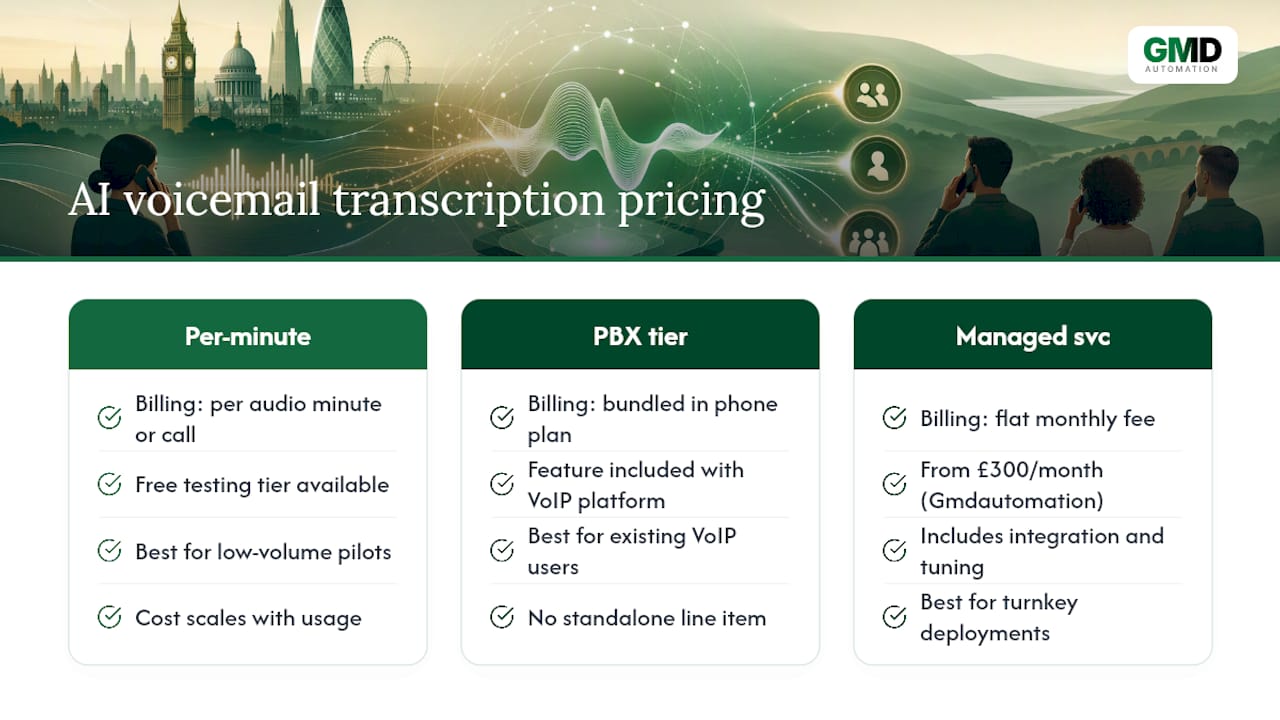
Pricing for AI voicemail transcription tools typically follows one of three models, and each suits a different stage of adoption.
Per-minute or per-call APIs charge for the audio processed, often with a free tier for testing. This suits low-volume users or anyone piloting before a full rollout, since costs scale directly with use rather than sitting as a fixed monthly overhead.
Subscription tiers bundled into a phone system roll transcription into an existing PBX or unified communications plan. This tends to suit businesses already paying for a VoIP platform where transcription is one feature among many, rather than a standalone line item.
Managed service subscriptions cover the transcription engine plus integration, redaction configuration, monitoring, and ongoing tuning for a flat monthly fee. Gmdautomation's AI answering and qualification service runs on this model, starting at £300 a month, with implementation, operation, and optimisation included rather than billed separately.
Beyond the headline rate, three costs catch teams out. Storage and retention add up once transcripts and audio accumulate over months, particularly if you're keeping originals for dispute resolution. Human review time for flagged or low-confidence transcripts is real labour, even if it's a few minutes per case. And integration effort, connecting the transcription output to a CRM or ticketing system, often costs more in engineering hours than the transcription service itself. Budgeting for all three before comparing headline per-minute rates avoids an unpleasant surprise three months into a rollout.
Where does AI voicemail transcription actually change how a business runs?
The clearest wins show up wherever someone was previously listening to audio just to decide what to do next.
A sales team missing calls after hours gets transcripts landing in a shared inbox by morning, tagged by likely intent, so the first person in doesn't have to triage twenty voicemails before the coffee's made. A lettings or property management business fields a steady stream of maintenance requests and payment queries by voicemail; transcribing and routing those automatically means urgent issues (a burst pipe, a locked-out tenant) get flagged ahead of routine ones instead of sitting in a queue in call order.
Support teams use searchable transcripts to spot recurring complaints across hundreds of messages, something no one has time to do by ear. Recruiters and client-facing consultants use transcripts to log candidate or client updates into a CRM without manual note-taking after every call. Credit control functions, chasing overdue payments by phone, benefit from transcripts that automatically log a promise-to-pay date or a dispute reason straight into the account record, which is close to what a managed credit-control automation setup does in practice.
The common thread across all of these: someone stops listening and starts reading, and whatever used to require a human decision about priority now happens automatically, based on tagged intent rather than the order calls came in.
Why is my transcription accuracy inconsistent, and how do I fix it?
Inconsistent accuracy almost always traces back to one of four causes, and each has a fairly direct fix.
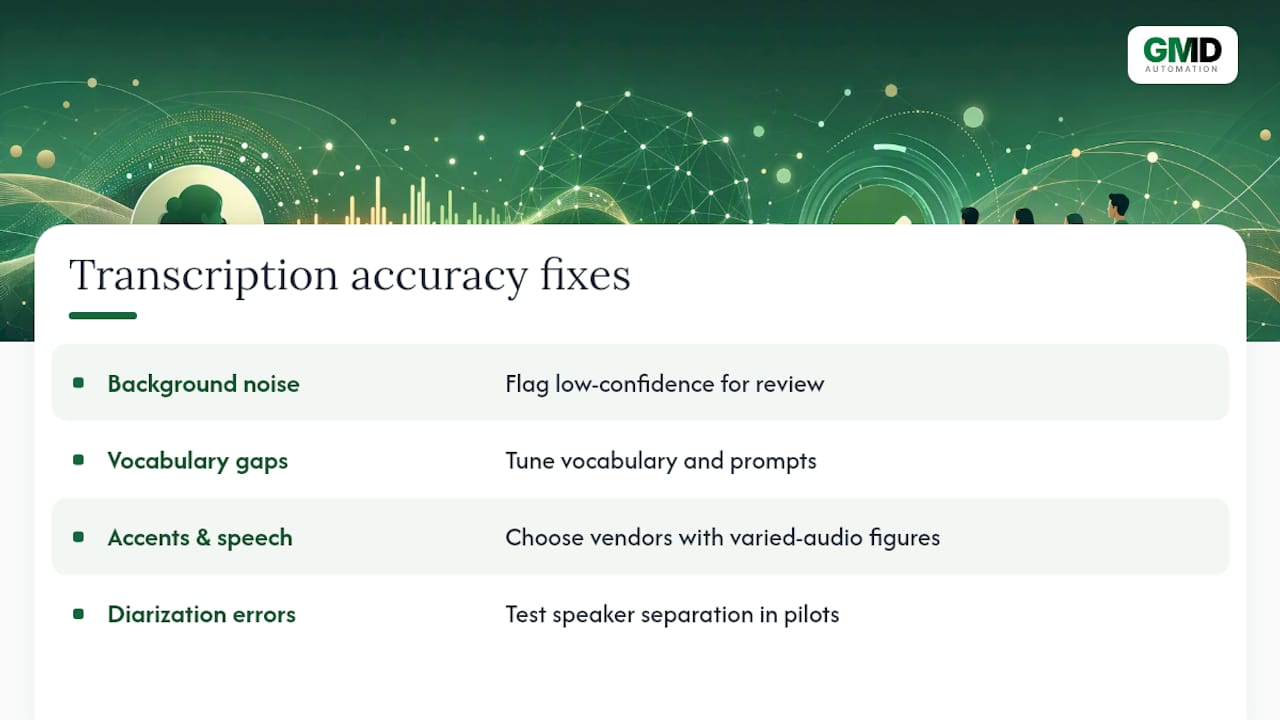
Background noise and poor call quality. Mobile calls in transit, retail environments, or building sites will degrade any STT model's output. There's no full fix, but flagging low-confidence transcripts for human review catches the worst cases before they cause a problem.
Vocabulary gaps. Product names, local place names, and industry jargon trip up general-purpose models constantly. Most serious platforms, including WhisperAI, let you tune vocabulary or prompts to teach the model your specific terms, which measurably improves recognition on repeat offenders.
Accents and speech patterns. Regional and non-native accents remain one of the harder problems in speech recognition generally. Choosing a vendor that publishes accuracy figures across varied audio, rather than just clean studio recordings, gives a more honest read on how it'll perform on your real call traffic.
Diarization errors on multi-speaker messages. When a voicemail includes background conversation or a caller talking over someone else, speaker separation can misattribute lines. Testing this specifically during a pilot, rather than assuming it works because single-speaker tests passed, avoids a nasty surprise later.
The fastest fix for most teams is simpler than it sounds: run a proper pilot on your own messy, real-world audio before signing anything long-term.
GMD Automation's perspective: pilot before you commit
Most vendor claims about accuracy come from clean, quiet test audio, not the mobile calls and noisy lines that make up a real voicemail queue. That gap is why Gmdautomation runs a 2 to 4 week pilot before any full deployment, testing integration, accuracy on the client's own audio, and redaction controls against actual ICO risk, not theoretical risk.
Latency budgeting matters more than most buyers assume. An 800 millisecond conversational budget is a reasonable engineering target for anything approaching real-time voice interaction, and it's worth asking any vendor how their pipeline performs against it rather than accepting a vague "fast" as an answer.
The pattern worth noticing: teams that skip the pilot tend to discover accuracy and compliance gaps only after the system is already handling live customer data.
— Ravi
Start with a pilot, not a full rollout
There's a real gap between what a transcription API demo shows you and what your actual call traffic will do to it. Self-serve tools like STT.ai or PBX-bundled features from providers like Yeastar work well for teams happy to manage integration, redaction policy, and ongoing tuning themselves. A managed subscription service is built for organisations that would rather not carry that operational load.
The AI answers, qualifies and books service starts at £300 a month and covers implementation, operation, and ongoing optimisation under one subscription, no separate integration project, no upfront capital spend. For lettings and property businesses fielding a steady stream of tenant calls, the AI credit controller for lettings runs on the same model from £250 a month, logging payment promises and disputes straight into your records instead of a voicemail queue nobody checks until Monday.
Either service suits a business that wants voicemail handled properly without hiring engineering time to build and maintain the pipeline. Start with a pilot: it validates integration with your existing phone system, checks accuracy against your real call audio, and confirms redaction controls meet your compliance obligations before you commit to anything beyond the trial period.
Sources
- Amazon Connect — Sensitive data redaction
- Voicemail to Text (Voicemail Transcription) — Yeastar
- Stt
- AI Transcription Redaction — Five9 documentation
- Whisper AI — Official site
FAQ
Can AI transcribe phone calls, not just voicemails?
Yes. The same speech-to-text pipeline used for voicemail, capture, transcription, diarization, and summarisation, applies to full live calls, either in real time or after the call ends. Contact-centre platforms often run both voicemail and full-call transcription through the same engine.
Is there a free AI voicemail assistant available?
Several free or low-cost tools exist, such as TicNote's voicemail-to-text converter, which suit casual or pilot use. They generally lack the redaction policies, data residency guarantees, and CRM integrations that regulated or high-volume businesses need.
How do I get an AI voice for voicemail greetings?
That's a separate feature from transcription: voice cloning or text-to-speech tools generate a synthetic greeting, while transcription converts incoming messages to text. Some managed voice automation providers, including Gmdautomation, offer both as part of a wider AI voice agent setup.
Is there a reliable way to transcribe an old voicemail recording?
Yes, provided you can extract the audio as a standard file (WAV or MP3). Most STT platforms and apps accept file uploads for one-off transcription jobs, separate from any live integration with a phone system.
What accuracy can I expect from voicemail transcription software?
On clean audio, leading models report 93 to 95% accuracy. Background noise, accents, and jargon lower that figure, which is why a short pilot on your own call audio gives a far more useful number than any vendor's marketing claim.