

An AI voicemail drop delivers a voice message straight into a recipient's voicemail box without ringing their phone, using server-to-server delivery and either a cloned voice or recorded audio. The fastest safe way to test one is a short, compliance-first pilot with a managed provider that has already solved consent, routing and delivery reliability. Some managed providers run this kind of pilot for sales teams weighing up whether voicemail drops belong in their outreach mix.
TL;DR:
- Pilot campaigns should target 500 to 2,000 contacts split over several days to accurately measure delivery and callback rates before scaling.
- Successful delivery depends on confirming carrier relationships, correct CRM integration, and pairing drops with follow-up messages within 48 hours.
- Legally, campaigns must provide easy access to human agents, record consent, and maintain transparency to comply with UK regulators.
- Script length should stay under 30 seconds, focus on value, and include a single clear call to action with minimal personalization for natural tone.
- In-house building is viable only with significant voice engineering resources; most teams benefit from managed providers that handle compliance and infrastructure.
Table of Contents
- What is an AI voicemail drop and how does it work?
- What can an AI voicemail drop actually deliver, and where does it fall short?
- Is an AI voicemail drop legal to use in the UK?
- How do you pilot an AI voicemail drop system?
- How should you write an AI voicemail drop script?
- What metrics prove an AI voicemail drop campaign is working?
- When does a managed pilot beat building it yourself?
- Start a compliance-first AI voicemail drop pilot
- Where to check the rules and dig deeper
- Sources
What is an AI voicemail drop and how does it work?
Ringless voicemail delivery bypasses the phone's ringer entirely. Instead of dialling a number and waiting for someone to pick up, the system connects directly to the voicemail server behind that number and drops a pre-recorded or AI-generated message straight into the inbox. No ring, no missed-call notification, just a voicemail waiting when the recipient next checks their phone.
This is different from a conventional outbound call in one important way: nobody has to answer, and nobody hears a ringtone they might screen. That's the entire pitch. Whether the message itself is worth listening to is a separate question, covered below.
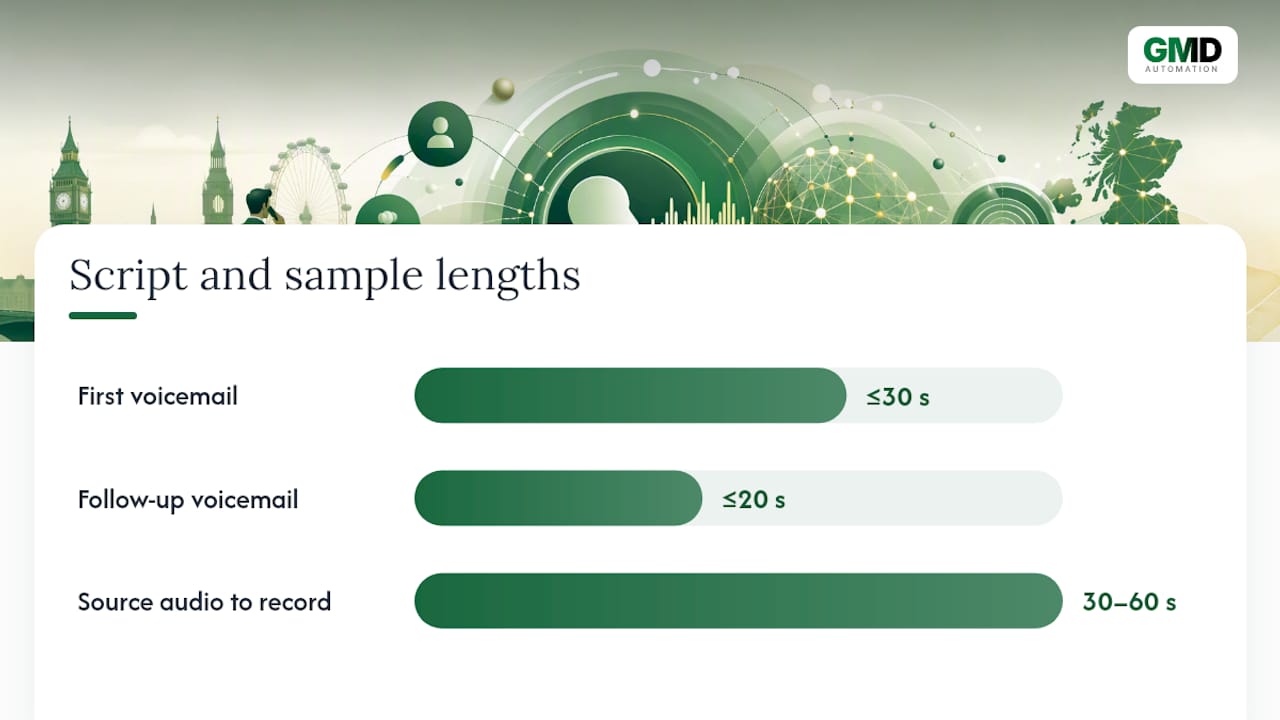
AI voice cloning has made the "record once, send thousands" model realistic. Most platforms need roughly 30 to 60 seconds of clean, high-quality source audio to build a natural-sounding clone. Skimp on the sample and the output tends to sound flat or robotic, which recipients notice immediately.
Personalisation usually works through merge fields, most commonly a first name and one or two account details pulled from the CRM. The mechanics are simple; the failure mode is not. Odd pauses around inserted names, mismatched pronunciation, or a fact that's slightly wrong (a renewal date that's off by a month) are the most common reasons a personalised drop sounds worse than a generic one.
Delivery also depends heavily on the receiving network:
- Mobile voicemail on major UK carriers generally accepts direct-to-voicemail delivery reliably.
- VoIP numbers can behave inconsistently depending on the provider's own voicemail architecture.
- Landlines are largely incompatible with ringless delivery, since many don't route to a server-side voicemail box the same way.
- Retry logic matters: platforms typically attempt delivery across a short window rather than firing once, which materially affects landing rates.
What can an AI voicemail drop actually deliver, and where does it fall short?
Used well, voicemail drops buy sales teams two things: scale and visibility. A single rep can "leave" hundreds of personalised messages in the time it would take to dial even a fraction of that list manually, freeing up hours for actual conversations. And because voicemail sits in a different attention channel to email, a well-placed drop often gets noticed when a cold email would be ignored outright. Practitioners in the space report that short messages with an obvious value proposition tend to generate higher callback rates than longer, vaguer ones.
The catch is that voicemail drops rarely work alone. They perform best as one beat in a cadence, not the whole song. Marlie is blunt about this: pairing a drop with a follow-up SMS or email within a day or two consistently outperforms voicemail sent in isolation, because the recipient gets a second, easier way to respond.
Where drops underperform is predictable. Bad targeting (calling a number that's changed hands), generic scripts, and sending too frequently to the same list all suppress response rates and, worse, generate complaints. Three or four drops to the same contact within a short window is usually the point where annoyance outweighs any benefit.
- Gains: outreach scale, SDR time saved, better cut-through than email alone
- Limits: weak on its own, needs a clean list, and callback quality depends entirely on script and targeting
Pro Tip: Treat your first voicemail drop campaign as a targeting test, not a script test. A brilliant message to the wrong list still fails.
Is an AI voicemail drop legal to use in the UK?
Yes, when it's run properly, but "properly" carries real weight here. Two regulators matter for UK teams: Ofcom, which oversees telecoms conduct, and the Information Commissioner's Office (ICO), which oversees data protection and automated contact. Neither treats voicemail drops as a grey area to ignore.
Ofcom's guidance is clear that automated voice services should preserve an easy route to a human agent — a "press 0 to speak to someone" option isn't a nice extra, it's the kind of safeguard regulators expect as standard. The ICO, separately, expects automated contact and voice processing to meet data protection standards; its own guidance notes that professional quality, brevity and honest messaging cut down complaints and reduce regulatory exposure.
Five practical steps keep a campaign on the right side of both:
- Confirm the legal basis for contacting each person before the list goes anywhere near a campaign tool, and document it.
- Build an opt-out into every message and honour it immediately, not at the next list refresh.
- Keep records of consent, message content and send history in case a complaint needs investigating.
- Design every script around trust: short, honest about what it is, and never disguised as a personal call.
- Vet vendors properly. Ask about data handling, storage location and any SOC or ISO evidence before signing anything, and check how call recording and consent obligations are actually handled in practice.
None of this is exotic. It's the same discipline any responsible outbound programme already applies to cold email and cold calling, extended to voice.
How do you pilot an AI voicemail drop system?
Start small, measure honestly, and don't scale until the numbers earn it. A two to four week pilot is long enough to see real patterns without committing budget you can't justify yet.
Sizing the pilot. Aim for 500 to 2,000 target contacts split into matched cohorts, staggered across several days rather than fired in one batch. Sending everything on day one makes it impossible to tell whether a bad result came from the message, the list, or a delivery glitch on that particular day.
Technical checklist before launch:
- Confirm number provisioning and carrier registration are complete, not "in progress"
- Sync the campaign tool with your CRM so callback data lands where reps actually work
- Verify delivery reporting works before the real send, not after
- Pair every drop with a follow-up SMS or email inside 24 to 48 hours
Engineering notes worth knowing even if you're not the one building it. Audio sample quality drives everything downstream, and teams working on voice AI generally target under 800 milliseconds of generation and delivery latency to keep synthetic voice output sounding natural rather than clipped or artificial.
A managed provider earns its fee here by having already solved the parts that trip up in-house builds: number provisioning, carrier relationships, and compliance documentation. GMD Automation structures its pilots around exactly this, with outbound calling automation proving delivery and callback metrics before any wider rollout. Call routing is built in so a human is always reachable. What most teams measure first isn't volume. It's whether the callback rate on a small, clean cohort justifies scaling at all.
How should you write an AI voicemail drop script?
Keep it under 30 seconds and open with something the recipient actually cares about, not your company name. A message that starts "Hi, it's [name] from [company]" has already burned five seconds on nothing.
Personalisation should stay minimal. A first name and one specific, verified detail is plenty. Piling in five or six variables multiplies the chance one of them sounds wrong, and a single mispronounced or mismatched fact undermines the whole message's credibility. Good voice training matters just as much as the script. Recording at least 30 to 60 seconds of clean source audio before cloning a voice tends to produce noticeably more natural output than a rushed sample.
Every script needs an explicit human-access path and one clear call to action, not two competing ones.
- Lead with value in the first sentence, not your name or company.
- Keep the whole message under 30 seconds when read aloud.
- Offer one clear next step: a callback number, a booking link, or "press 0 now".
- State plainly that it's an automated message if that's the case; don't disguise it.
A follow-up script a few days later might run: "Hi [first name], following up on a message I left about your policy renewal. Still happy to help if you've got two minutes. Call [number] or press 0 to connect now."
Both scripts stay under 20 seconds read aloud, which leaves room for a natural pause and a clear sign-off. For guidance on producing the underlying voice recording itself, resources like AmmarAI's guide to generating natural AI voiceovers or VoiceBros' script templates are useful starting points for teams building scripts in-house.
What metrics prove an AI voicemail drop campaign is working?
Four numbers matter more than the rest combined: delivery rate, listen rate, voicemail-to-callback rate, and meetings booked per 100 drops sent. Everything else is secondary.
Delivery rate tells you whether the technical side is sound before you judge the message at all. A weak delivery rate points to carrier or list problems, not a bad script. Listen rate shows whether the message survives the first few seconds; a sharp drop-off there usually means the opening line needs rewriting. Voicemail-to-callback is the number that actually reflects message quality and targeting. Meetings per 100 drops is the figure that justifies the whole exercise commercially.
Secondary signals worth stitching together across channels:
- Reply rate on the paired SMS or email follow-up
- Opt-out rate, which flags fatigue or poor targeting early
- Time-to-callback, which hints at how urgent the message felt
For a test to mean anything, run it against at least a few hundred contacts per cohort and let it run several days before drawing conclusions. A cadence tested on 40 contacts over one afternoon tells you almost nothing reliable. Once a pattern holds across a proper sample, feed it back into the script and targeting, adjust one variable at a time, and re-test rather than overhauling everything at once.
When does a managed pilot beat building it yourself?
Building an AI voicemail drop capability in-house is entirely possible if you've got engineering time, legal resource to work through consent and record-keeping, and patience for a few false starts on carrier registration. Most sales and marketing teams have none of those three in surplus.
The subscription model exists precisely because compliance and delivery infrastructure are the unglamorous parts that take longest to get right and carry the most downside if they go wrong. Centralising that inside a managed platform compresses the time-to-value from months to weeks, and it means one party, not three internal teams, is accountable for the compliance paperwork.
DIY still makes sense for teams with genuine in-house voice engineering experience and enough volume to justify the build cost. For everyone else, the maths favours a pilot that proves the concept before any serious spend follows it.
— Ravi
Start a compliance-first AI voicemail drop pilot
Some providers offer a practical route into AI voicemail drops for teams that want proof before spend: a managed pilot with zero upfront cost, compliance checks built in from day one, and delivery handled on infrastructure that has solved carrier registration and consent tracking.
A pilot typically proves three things within two to four weeks: whether delivery rates hold up on your actual contact list, whether your script generates real callbacks rather than just listens, and whether the economics stack up before you commit to a bigger rollout. From there, the next step is straightforward. Extend the pilot to a wider cohort or move to an ongoing monthly subscription that covers implementation, operation and optimisation without a lock-in contract. Visit GMD Automation to scope a pilot around your own list and outreach goals.
Where to check the rules and dig deeper
For compliance reading, go straight to the regulators rather than a summary of them:
- Ofcom for telecoms conduct rules, including guidance on preserving human-agent access in automated voice services
- Information Commissioner's Office (ICO) for data protection obligations around automated contact and voice processing
- SalesHive's overview of automated voicemail for a practitioner's view on message design and callback performance