

Most small businesses pay somewhere between £60 and £300 a month for self-serve AI call answering platforms at low call volumes, rising to £300–£700 a month for managed services handling a few hundred calls. Per-minute billing suits short, predictable calls; per-resolution or flat subscription pricing works better when call length varies or you care more about outcomes than minutes. Once you know your rough call volume, the calculator further down lets you turn that into a real monthly figure.
TL;DR:
- The true total cost often exceeds the advertised per-minute or per-call rates due to five hidden cost layers, including telephony, compute, and onboarding fees.
- Using a flat subscription fee of approximately £300 per month simplifies budgeting and covers deployment, support, and ongoing tuning without surprises.
- Budgeting for AI call answering requires estimating monthly call volume, average call length, resolution rate, and adding a buffer for extra costs like tuning and overages.
- Overage charges, multi-vendor management, and compliance work typically increase first-year expenses beyond initial quotes, especially with poor onboarding.
- Providers like Gmdautomation offer all-in-one monthly subscriptions starting at £250–£300, combining deployment, telephony, compute, and support into a predictable, single fee.
Table of Contents
- AI call answering cost: pricing models explained
- The five cost layers that make up the real bill
- Sample AI answering pricing scenarios for common call volumes
- How to estimate your own AI answering cost
- Hidden AI call service expenses and total first-year cost
- Publisher perspective: how Gmdautomation approaches transparent pricing
- When AI answering actually pays for itself
- Get a predictable AI answering bill with Gmdautomation
- Sources
- FAQ
AI call answering cost: pricing models explained
Three billing structures dominate the market, and picking the wrong one for your call pattern is the single easiest way to overpay.
Per-minute billing charges for actual talk time, typically $0.07 to $0.40 per minute depending on the platform and voice quality you choose. This works well if your calls are short and consistent, like appointment confirmations or simple triage. It gets expensive fast if callers ramble, get put on hold, or the AI struggles and loops through clarifying questions.
Per-call or per-resolution billing charges a flat fee once a call is handled, usually $0.70 to $1.50 per resolved call. This is generally more predictable for businesses with variable call lengths, because a three-minute call and a twelve-minute call cost the same. Managed services often charge on this basis too, commonly $2 to $4 per call.
Flat subscriptions bundle a set number of minutes or calls into a monthly fee, then charge overage rates beyond that. Most small businesses land on $79 to $300 a month for entry-level subscription plans.
The pricing model rarely tells you the whole story. Many vendors:
- Bundle telephony, speech processing, and AI compute into one line item
- Pass telephony and AI model costs through separately as "usage" charges
- Charge extra for premium voices, call recording, or CRM integrations
- Cap included minutes or calls, then bill overages at a higher per-unit rate
Ask exactly which of these sit inside your quoted price before comparing two vendors side by side.
The five cost layers that make up the real bill
A single quoted "price per minute" almost never reflects your total spend, because five separate cost layers usually sit underneath it, and vendors bundle them differently.
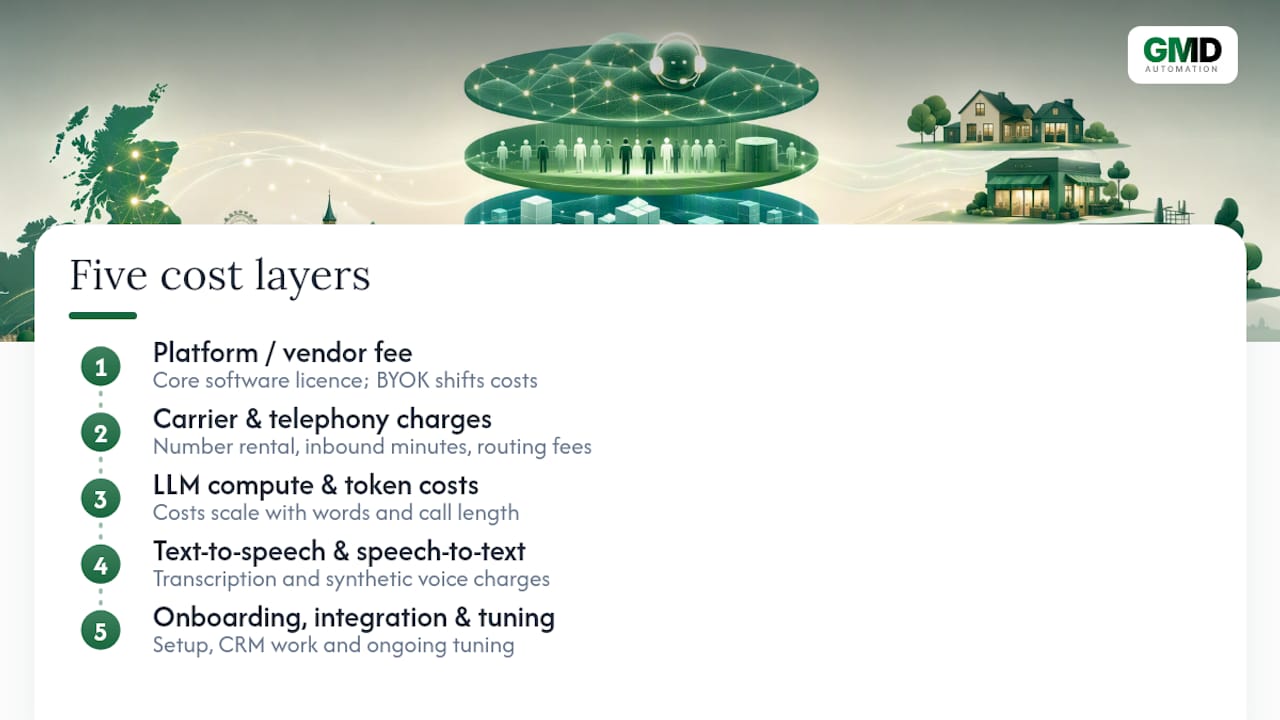
1. Platform or vendor fee. This is the core software licence, whether it's bundled into one all-in rate or billed separately as "bring your own key" (BYOK), where you pay the AI model provider directly and the platform charges only for orchestration. BYOK setups often look cheaper on paper but shift variable costs onto your own invoice.
2. Carrier and telephony charges. Phone number rental, inbound minute charges, and call routing fees come from the underlying telephony carrier. These are usually small individually but add up at volume.
3. LLM compute and token costs. Every word the AI processes and generates costs money, and this is the layer most sensitive to call length. A rambling caller or a poorly scoped script can quietly double your compute bill without changing your per-minute rate.
4. Text-to-speech and speech-to-text costs. Converting speech to text and text back to a synthetic voice carries its own cost, and premium, natural-sounding voices cost noticeably more than robotic default voices.
5. Onboarding, integration, and ongoing tuning. Setup fees, CRM integration work, and the human time needed to keep improving the AI's responses after launch.
Statistic: Benchmarks put all-in AI voice agent costs at $0.07 to $0.25 per minute or $0.28 to $1.00 per call once every layer is combined, roughly double the headline per-minute rate many vendors advertise on their pricing page.
Bundled pricing simplifies budgeting but often costs more overall. BYOK gives you cost control at the price of complexity. Neither is automatically better. It depends on whether you have someone who can manage a multi-vendor bill.
Sample AI answering pricing scenarios for common call volumes
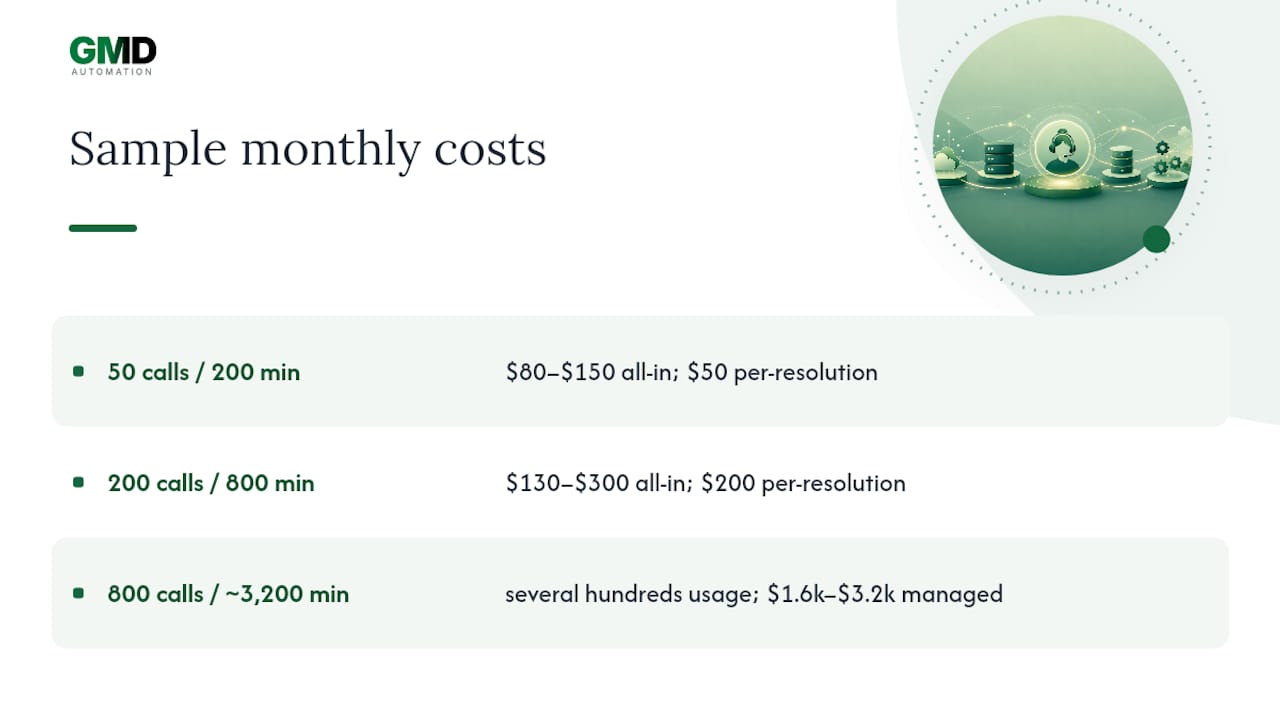
Numbers make this concrete. Here's how the maths works out at three volumes typical of small and medium businesses.
At 50 calls a month, averaging four minutes each (200 total minutes), a per-minute platform at a moderate per-minute rate costs around the tens of dollars mark, plus a base platform fee that usually brings the real total closer to $80 to $150 a month. A per-resolution platform at $1.00 per call costs a flat $50, before any base fee.
At 200 calls a month averaging four minutes (800 minutes), the same per-minute rate produces roughly low hundreds in usage costs. This matches the pattern most service businesses see: around $130 to $300 a month all-in for this volume band. Per-resolution pricing at $1.00 per call comes to $200 flat.
At 800 calls a month, you've moved into mid-tier or managed-service territory. A self-serve platform at this per-minute level across thousands of minutes costs several hundreds in usage alone, before platform fees. A managed service at $2 to $4 per call runs $1,600 to $3,200 a month, but that typically includes tuning, monitoring, and support you'd otherwise pay for separately.
Two variables swing these totals hard: average call length and resolution rate. A platform quoting $0.10 a minute looks cheap until your average call runs nine minutes instead of four, doubling your bill. Low resolution rates create a similar trap on per-resolution pricing, because unresolved calls that get escalated to a human often still incur a charge, and you're now paying twice, once to the AI and once to the person who finishes the job.
How to estimate your own AI answering cost
Building a working estimate takes five inputs and about ten minutes with a spreadsheet.
- Count your monthly call volume. Pull this from your phone system or CRM. If you don't track it, estimate from missed-call notifications over a fortnight and double it.
- Estimate average minutes per call. Time ten recent calls, average them. Most SMB service calls run three to six minutes.
- Set a target resolution rate. What percentage of calls should the AI fully handle without escalation? Be honest here; overestimating resolution rate is the most common budgeting mistake.
- Choose your billing model and plug in the rate. Per-minute: volume × average minutes × rate. Per-resolution: volume × resolution rate × per-resolution price.
- Add a buffer of 15 to 25% for LLM, TTS/STT, and telephony pass-through costs, plus any amortised setup fee spread across twelve months, plus a monthly support or tuning line.
Base cost: 300 × 5 × $0.18 = $270. Add a $1,200 setup fee amortised over 12 months: $100/month. Total estimate: roughly $424/month.
If the second number changes your decision, negotiate a rate cap or ask for per-resolution pricing instead.*
Hidden AI call service expenses and total first-year cost
The quoted monthly price rarely equals what you pay in year one. Budget for these separately.
- One-off integration and compliance work, including CRM connections, call-recording consent setup, and any audit work for regulated sectors, which can run into thousands depending on complexity.
- Ongoing tuning time. Someone needs to review transcripts, correct misunderstood intents, and update scripts, especially in the first three months. Treat this as a small but real ongoing labour cost, not a one-off.
- Overage charges once you exceed included minutes or calls, often billed at a materially higher rate than your base tier.
- Concurrency fees if multiple calls need handling simultaneously during busy periods; some platforms charge per concurrent line.
- Storage and premium voice licensing, particularly if you record calls for compliance or choose a branded, natural-sounding voice rather than a default option.
Poor onboarding tends to increase every one of these costs later, because a badly scoped initial setup means more correction work and more escalations for months afterwards. Reviewing UK-specific call recording and disclosure rules before launch is worth the hour it takes.
Publisher perspective: how Gmdautomation approaches transparent pricing
This AI answering service can be structured as a single monthly subscription that covers deployment, operation, ongoing support, and optimisation, with no upfront build cost. That's a direct answer to the five-layer billing problem described above: instead of five separate line items that can each creep upward, the reader gets one predictable figure.
- Having no upfront cost removes one of the biggest first-year budgeting risks small businesses face.
- Compliance-first onboarding, including call recording and consent handling, can be integrated into deployment rather than billed separately later.
- Pilot-based rollouts, typically running two to eight weeks, reduce the "tuning debt" that comes from launching a poorly scoped script and fixing it after the fact.
- Case studies on compliance-first AI answering deployments show how bundled pricing avoids the overage and BYOK complexity smaller teams struggle to manage in-house.
When AI answering actually pays for itself
The payback question is simpler than most vendors make it sound. If you're missing more than a handful of calls a week, and each missed enquiry has any realistic conversion value, an AI answering service usually pays for itself within a month or two, not a year. The real decision isn't whether to adopt one. It's whether to build on a self-serve platform or buy a managed service.
Build it yourself if you have someone willing to own ongoing tuning and can tolerate a multi-line bill. Buy managed if you'd rather pay a flat, predictable number and let someone else worry about resolution rates. Either way, insist on a first-year all-in estimate before signing, and ask specifically about concurrency limits and overage rates. That's where quoted prices and real bills diverge most often.
— Ravi
Get a predictable AI answering bill with Gmdautomation
Some providers replace the five-layer billing puzzle with one number: a monthly subscription that covers deployment, telephony, compute, and ongoing tuning together, with no upfront cost. Where self-serve platforms leave you juggling per-minute usage, TTS licensing, and integration invoices separately, Your AI answers, qualifies and books starts from £300 per month, all-inclusive.
For lettings businesses managing rent collection calls and reminders, Your AI credit controller for lettings starts from £250 per month on the same all-in basis. Compliance handling, script tuning, and support can be included in a single monthly figure rather than arriving as surprise line items later. If you want a working estimate against your own call volumes, request a free cost estimate or a pilot deployment through the Gmdautomation services page and see the real numbers before you commit to anything.
Sources
- AI Voice Agent Pricing 2026: Real Per Minute and Monthly Costs | Tested
- AI Answering Service Cost in 2026: Real Prices & Examples | Layer3 Labs
- Open
- AI call centre pricing benchmarks and cost guide | Haven AI
FAQ
How much does AI phone answering cost?
Most small businesses pay $79 to $300 a month on subscription platforms, or $0.07 to $0.40 per minute on pay-as-you-go plans. Managed services with full support typically run $300 to $700 a month at modest call volumes, with Gmdautomation's managed option starting from £300 per month.
Can I get AI to answer my phone calls?
Yes. AI answering platforms and managed services can pick up inbound calls, qualify enquiries, book appointments, and escalate complex cases to a human. Setup ranges from a same-day self-serve configuration to a fully managed pilot lasting a few weeks.
Is there an AI call answering service available in the UK?
Yes, several platforms and managed providers operate in the UK, including Gmdautomation's subscription-based AI answering service, which bundles deployment, compliance, and ongoing support into one monthly fee. UK buyers should check call recording and consent rules before launch.
Is there a free AI phone answering service available?
Some platforms offer free trials or very low entry tiers, often around £10 a month plus per-call charges, but these rarely include the compliance, tuning, or support layers a business actually needs. Treat any advertised free tier as a trial period rather than a workable long-term cost.