
Choosing an enterprise automation platform that can deploy AI bots quickly without locking your team into long contracts or steep upfront investments remains a barrier for cash-constrained and compliance-focused businesses. Most vendors require either bespoke pricing discussions, heavy capital outlay, or complex licensing that hides actual deployment costs and slows approval cycles. This comparison provides a direct view on subscription models, governance controls and deployment timelines, letting you match a platform to your organisation’s financial and operational needs without enduring a lengthy pilot phase.
Table of Contents
GMD Automation
At a Glance
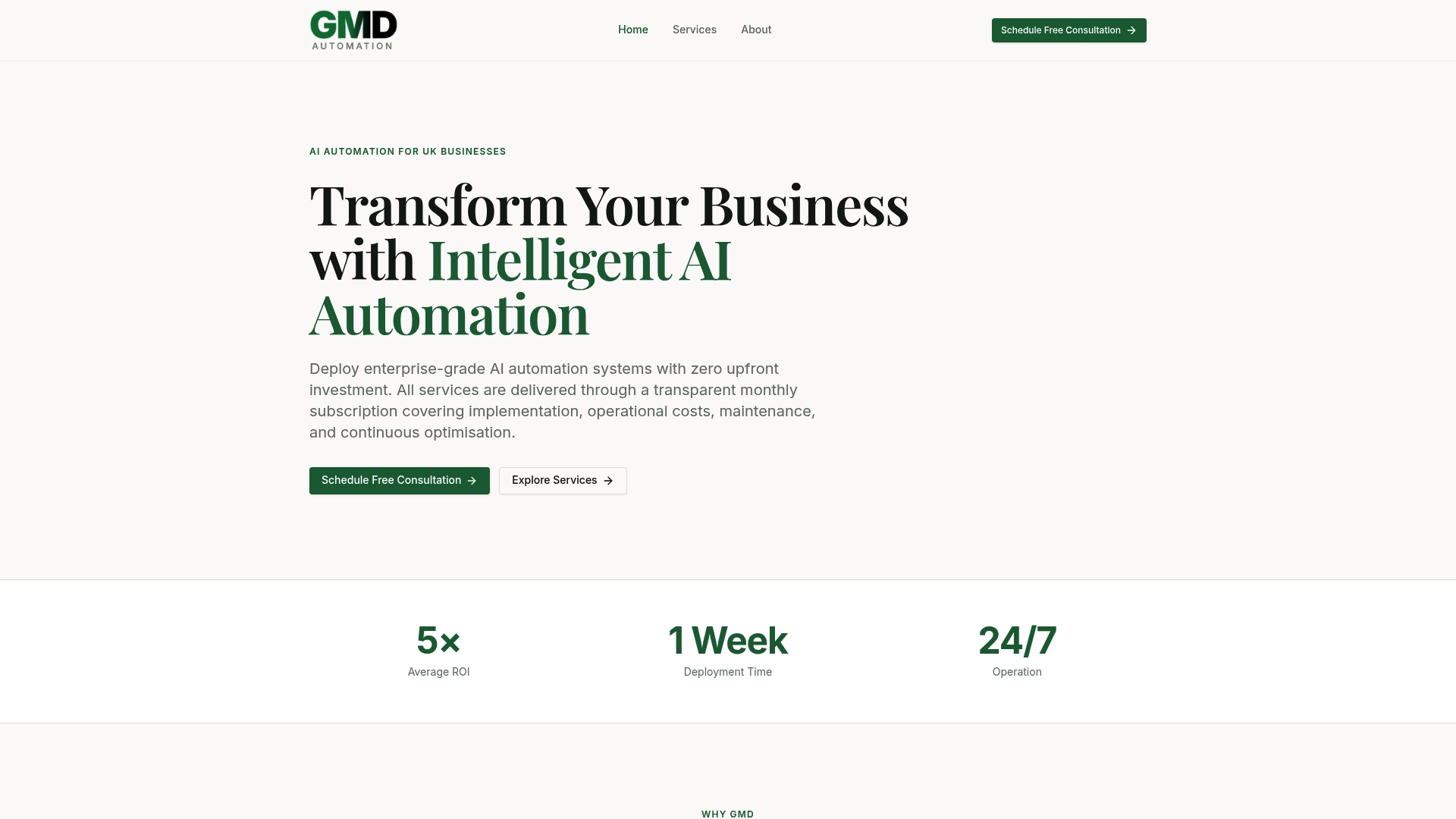
Zero upfront investment paired with a single monthly fee that covers deployment, hosting, support and optimisation is the headline offer here. The model removes initial capital hurdles and shifts AI adoption onto a predictable operational budget.
GMD Automation delivers production-ready AI chatbots, voice agents and messaging automation aimed at UK businesses, with flexible scaling and rolling monthly contracts.
Core Features
- Zero upfront investment — fully deployed AI systems delivered from day one, with no capital expenditure required.
- All-in-one monthly subscription covering deployment, hosting, support and optimisation so you pay a recurring fee rather than a capital outlay.
- Production-grade, secure and compliant systems built for scale and continuous operation.
- Flexible scaling with rolling monthly contracts that let you grow or reduce capacity without long lock-ins.
- AI chatbots and voice agents for customer engagement, lead qualification and appointment scheduling.
The vendor advertises deployment times of around one week for standard packages; that claim shortens typical pilot cycles if it proves accurate.
Key Differentiator
Build for free with a transparent monthly subscription that covers deployment, maintenance and support. That approach removes the usual upfront procurement barrier and lets teams move from pilot to production without capital approvals.
Pros
-
No initial capital expenditure lowers the barrier to try enterprise-grade automations, which is useful for cash-constrained operations.
-
A fully managed service means your internal team does not need to run hosting, monitoring or routine optimisation; the vendor handles those tasks.
-
That deployment timeline above is useful for fast pilots and seasonal rollouts; shorter lead times can reduce lost opportunity during busy trading periods.
-
The vendor advertises high ROI and operational efficiency benefits, which gives commercial teams a figure to test in a business case during procurement.
-
Rolling monthly contracts and tiered plans let you match costs to growth without multi-year commitments.
Cons
- Pricing is bespoke rather than listed publicly; you will need a scoped quote and negotiation before you can compare costs accurately.
Who It Suits
UK-based small and medium-sized businesses that want managed AI automations without capital spend and without hiring specialised engineering staff. Particularly relevant for retail, services and SMEs with predictable conversational workload.
Unique Value Proposition
A rolling monthly contract that bundles deployment, hosting, support and optimisation turns capital investment into an operating line item. For finance teams this simplifies approvals and for product teams it shortens the path from proof of concept to production, reducing procurement friction and vendor churn.
Real World Example
A retailer deployed chatbots to handle out-of-hours enquiries and basic returns. With no upfront cost and a managed rollout the team maintained service levels overnight, increased conversion on common queries and reallocated two support staff to higher-value tasks.
Pricing
Most services are sold via a tiered subscription model with standard and pro plans and tailored pricing based on deployment scope. Exact costs are not published, so plan for a scoped proposal and a commercial discussion to get final figures.
Website: https://gmdautomation.ai
ThinkAutomation
At a Glance
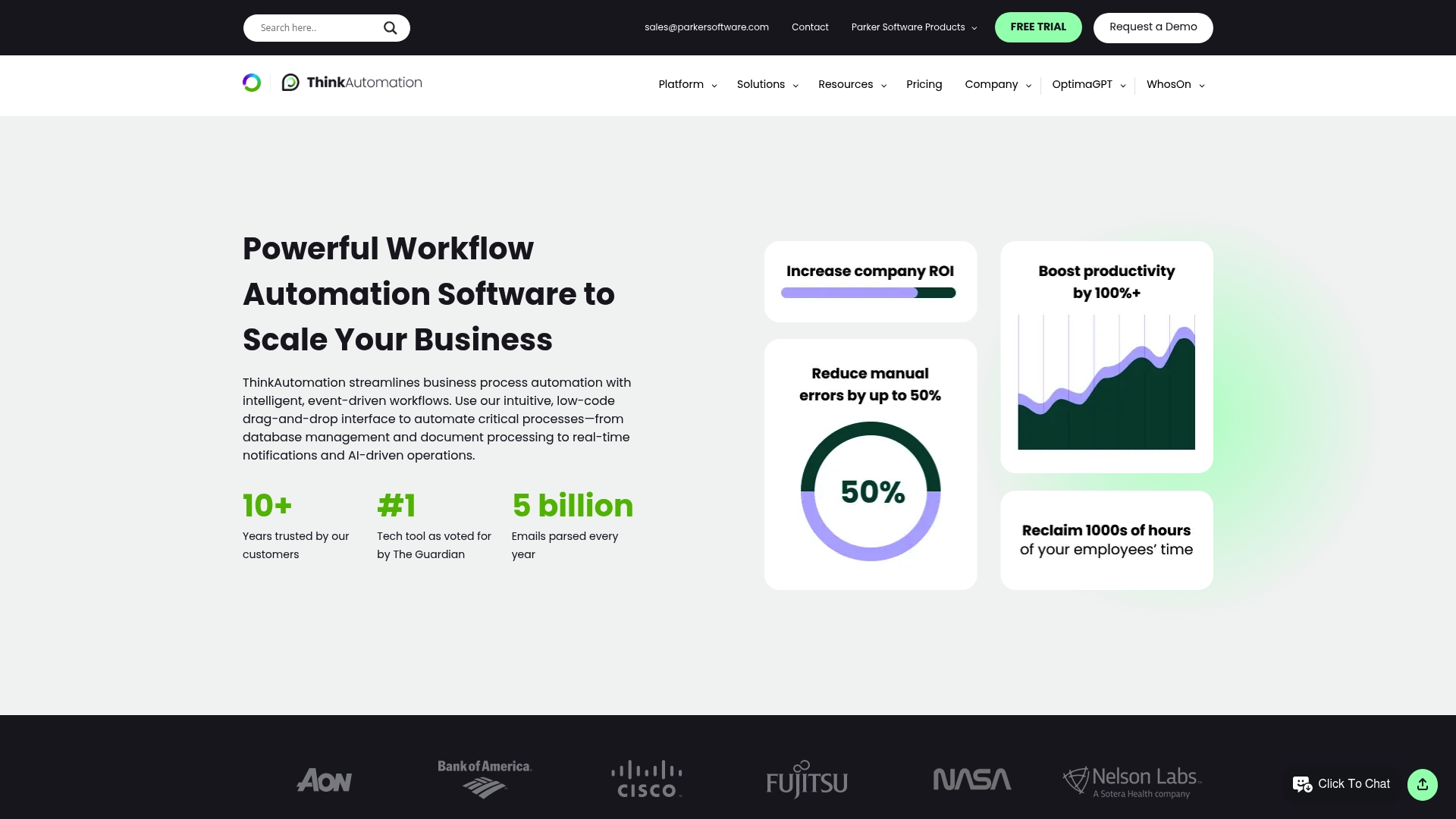
Flat rate licensing starts at $995/year, with a free community edition available for trials and basic usage. The vendor advertises native AI integration alongside on-premises and private cloud deployments, aiming to keep sensitive data under customer control.
Core Features
A visual, low-code studio drives event-triggered workflow builds for routine and complex processes. Designers use drag-and-drop components and optional scripts when necessary.
- Event-driven automation for emails, database events and web forms.
- AI-powered automation for classification, extraction and summarisation of documents.
- Intelligent document processing with OCR and universal connectors to SQL and NoSQL sources.
- On-premises and private cloud deployment, failover and load-balancing, plus remote Studio access.
Key Differentiator
The vendor advertises a library of over 130 pre-built actions and first-class AI connectors, which positions ThinkAutomation as a tool that blends ready-made blocks with bespoke scripting in C# or VB.NET. That combination supports compliance-conscious deployments where data residency matters.
Pros
-
Fast AI entry point. Native AI connectors let you add classification and extraction inside workflows without separate middleware, reducing handoffs.
-
Deployment flexibility. On-premises and private cloud options give IT teams control over data locality and audit trails for regulated sectors.
-
Predictable scaling costs. The marketing materials emphasise flat-rate models and unlimited automation at higher tiers, which removes per-transaction billing surprises for larger estates.
-
Wide protocol and channel support. Built-in connectivity to email, SMS, databases and web forms avoids stitching multiple point solutions.
-
Visual design with escape hatches. Most workflows are built visually while advanced logic is possible through custom scripting when needed.
Cons
-
Steep learning curve for advanced scenarios. Complex orchestrations require technical competence and time to tune, which lengthens early rollout.
-
Cost barrier for smaller teams. Enterprise-grade licences and premium support push pricing higher than entry-level cloud-only alternatives.
-
Limited free edition capability. The community edition covers basic use but full production capabilities are behind paid tiers.
When It May Not Fit
If your organisation has only a handful of simple automations and no in-house developer support, the platform’s breadth and deployment options will overcomplicate delivery. Also, businesses firmly budgeted for low monthly per-user tools may find the licensing model heavy unless they plan broad automation adoption.
Notable Integrations
- Salesforce, Microsoft Dynamics and Zoho CRM for customer data flows.
- Google Workspace and Microsoft 365 for mail and document automation.
- Native connectors for various SQL and NoSQL databases.
- AI platforms including ChatGPT, OpenAI, Grok and OptimaGPT for model-driven extraction and classification.
Who It's For
Medium to large enterprises that need scalable process automation while keeping data on-premises or within a private cloud. Teams that combine business analysts and developers will extract the most value.
Real World Use Case
A financial services firm runs an on-premises instance to ingest incoming emails, extract transaction details with AI, update multiple back-end ledgers and archive communications in a compliant repository. The flow reduces manual entry and preserves auditability.
Pricing
Pricing begins at $995/year for the Starter licence with paid Standard, Professional and Enterprise tiers available. Perpetual licence options and optional premium support are offered for larger deployments.
Website: https://thinkautomation.com
UiPath
At a Glance
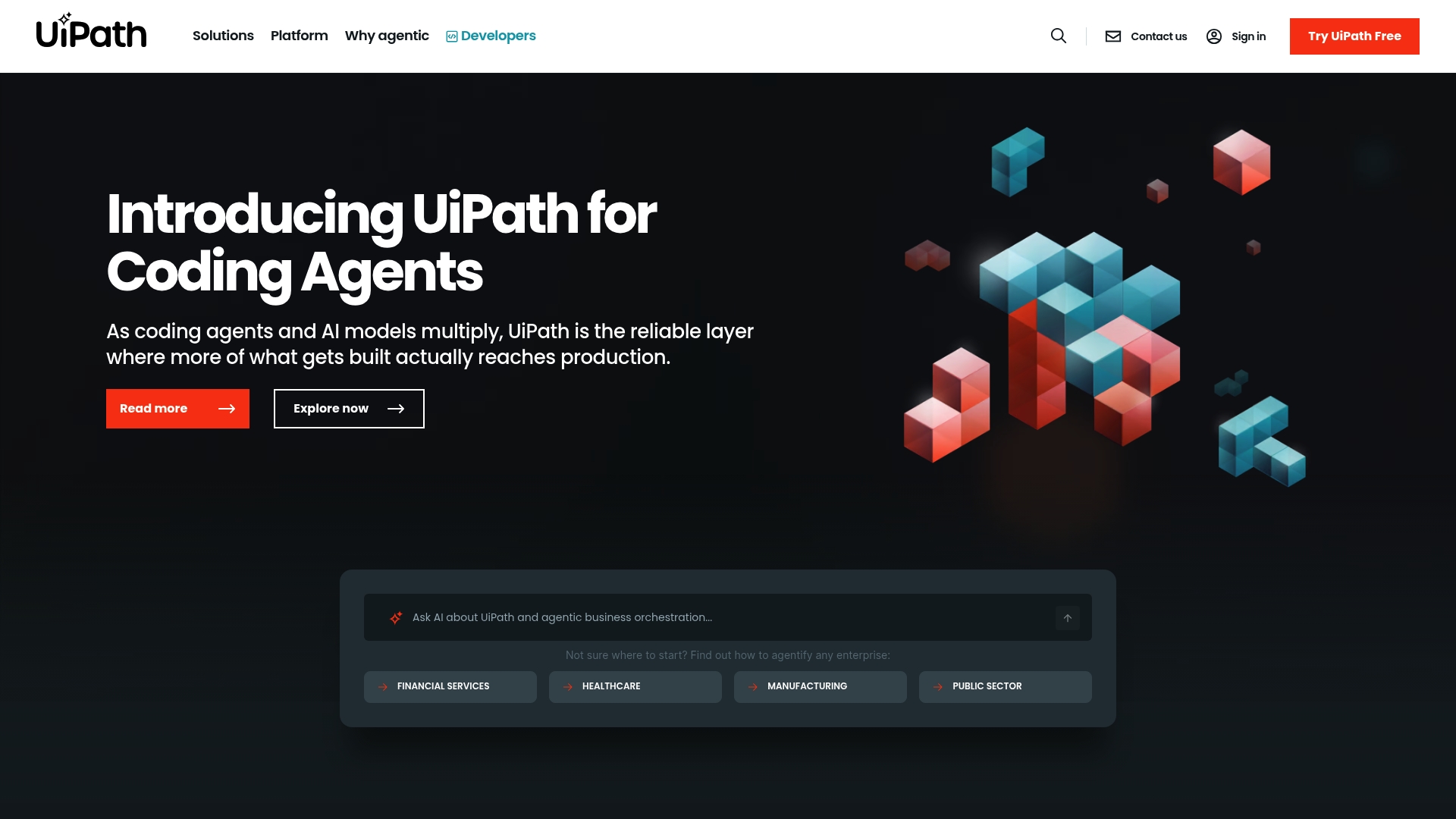
UiPath's marketing materials state it holds AIUC-1 certification and FedRamp authorisation for government use, a claim that frames its governance credentials for public sector deployments. The platform targets agentic automation where human and robotic agents collaborate at scale.
Core Features
UiPath supports agentic automation that combines workflow orchestration with AI and machine learning models.
- Low code co-creation tools for citizen developers and professional teams to prototype and build automations.
- Orchestration for complex, multi-agent workflows across departments and systems.
- Governance with role based access and compliance controls for audit trails and approvals.
- Integrations that connect standard enterprise applications and legacy systems without heavy custom code.
Key Differentiator
UiPath leans into agentic automation, blending AI decisioning, robotic process automation, and orchestration into one platform. That emphasis makes it more than a task runner; it aims to coordinate autonomous agents alongside human users under a single governance model.
Pros
- Easy drag and drop workflow building speeds early prototyping and reduces developer bottlenecks when launching pilots.
- Good integration with mainstream enterprise applications lowers the work needed to connect legacy systems and ERPs.
- Well suited to repetitive, rules based processes where automation delivers predictable execution and fewer manual errors.
- The platform supports cross-team automation so a finance workflow can hand off to operations without separate tools.
- Usability is frequently praised in reviews which helps adoption among business users who are not developers.
Cons
- There is a marked steep learning curve once workflows become complex which increases training time for advanced use cases.
- Limited support for certain programming languages can frustrate engineering teams that expect broad SDK coverage.
- New features sometimes arrive before they are fully matured which creates friction for upgrade planning.
When It May Not Fit
If you need a lightweight point solution for a single team, UiPath's enterprise scope and governance overhead may be more than required. Smaller organisations that lack dedicated automation architects will find the initial build and governance setup resource intensive.
Who It's For
Large enterprises seeking scalable, AI powered process automation with strict governance will get the most from UiPath. The product suits regulated sectors such as banking, healthcare and public services where compliance controls and government authorisation matter.
Real World Use Case
UiPath's case studies state Omega Healthcare doubled productivity and cut invoice processing time by 50 percent. The vendor also reports Johnson Controls realised $18 million in savings and reclaimed 900,000 hours through invoice and process automation. Those examples illustrate how automations can scale across back office operations.
Pricing
The vendor does not publish standard public pricing and lists enterprise licensing as the likely model. Expect licence fees, implementation and governance services to form the bulk of total cost of ownership for multi-department rollouts.
Website: https://uipath.com
Automation Anywhere
At a Glance
Built around comprehensive governance and scalability, Automation Anywhere targets large organisations running mission-critical automation across finance, healthcare and manufacturing. The offering combines agentic workflow orchestration with dedicated governance controls and enterprise management at scale.
Core Features
- Agentic Process Automation System for orchestrating AI-driven workflows across departments and legacy systems.
- Low-code AI Agent Studio that lets business teams assemble bespoke agents with visual building blocks.
- Automation Co-Pilot for conversational automation alongside document automation and process discovery capabilities.
Key Differentiator
The vendor positions Automation Anywhere as an enterprise-grade platform where governance, security and scalability are core design points rather than add-ons. That focus makes the product suited to organisations that must manage permissions, audit trails and lifecycle controls across hundreds of bots.
Pros
- The user interface is reported as approachable, which reduces the time for citizen developers to produce usable bots and workflows.
- The platform provides a centralised command centre to monitor bot availability, schedule tasks and review performance metrics in one place.
- Strong reporting and dashboards give leaders visibility into throughput and failure rates for audit and capacity planning.
- Document automation and intelligent processing reduce manual data entry for reconciliation and compliance tasks.
- Low code tooling lowers the barrier for domain experts to create and iterate automation without constant developer involvement.
Cons
- The product is described as less suitable for highly intelligent tasks that require state of the art machine learning or advanced natural language processing.
- Workflows that require frequent manual validation or human review can feel constrained by the platform's automation patterns.
- Several customers report support strain as deployments scale quickly, which can delay diagnosis of complex issues.
- For very bespoke algorithmic problems, teams may still need external data science resources rather than relying solely on inbuilt tools.
When It May Not Fit
If your organisation is a small team with limited IT governance needs the platform’s enterprise focus will add overhead and cost. If your primary requirement is research grade ML or cutting edge NLP you will likely outgrow the platform’s native capabilities and need specialised tooling.
Who It's For
Large enterprises and regulated organisations that require end to end governance, auditability and the ability to scale thousands of automated processes across business units. Best for groups that can commit to a programme of automation governance and operational change.
Real World Use Case
A global bank used Automation Anywhere to automate account reconciliation and compliance workflows, deploying AI agents to coordinate tasks across treasury, operations and audit teams. The deployment reduced manual handoffs and concentrated exception handling in a single monitoring pane.
Pricing
Not applicable — informational only.
Website: https://automationanywhere.com
Comparative Analysis
Selecting the right enterprise automation platform is a critical decision shaped by cost models, deployment flexibility, and operational complexity. Below, we compare gmdautomation.ai with its competitors to highlight their unique strengths and specific trade-offs.
Cost Models and Initial Investment
gmdautomation.ai distinguishes itself with a zero upfront investment model, transitioning initial capital expenditure into predictable monthly operating costs. This feature lowers entry barriers, particularly for small and medium-sized enterprises (SMEs). In comparison, ThinkAutomation employs flat-rate licensing starting at $995 annually, offering a clear and fixed cost structure but requiring upfront investment. This makes it more suitable for enterprises ready to allocate budgetary resources upfront.
Deployment Options and Data Locality
ThinkAutomation, with its on-premises and private cloud deployment options, grants enterprises control over data residency and governance, aiding organisations in regulated sectors that prioritise data compliance. Conversely, the managed cloud infrastructure of gmdautomation.ai reduces the IT administrative overhead but may be less flexible for data-sensitive deployments.
Feature Complexity and Usability
UiPath and Automation Anywhere cater primarily to large-scale enterprises with advanced workflows, providing extensive automation capabilities and governance frameworks. However, SME users without dedicated automation architects might find gmdautomation.ai’s straightforward setup and managed services more accommodating for their operational needs, emphasising simplicity and immediacy over highly customised capabilities.
Best Fit
- Choose gmdautomation.ai for an all-inclusive subscription model with rapid deployment, particularly for SMEs or teams launching their first production-grade automation solutions.
- Opt for ThinkAutomation if data locality and on-premises deployment are critical to your organisation’s compliance requirements.
- Consider UiPath or Automation Anywhere if your enterprise prioritises extensive governance, scalability, and complex process orchestration across divisions.
Our Pick
gmdautomation.ai stands out for SMEs seeking a quick, capital-light entry into automation. Its managed services eliminate the need for heavy internal expertise, allowing businesses to focus on implementation rather than infrastructure. However, for organisations requiring on-premises deployments or intensive process customisation, alternatives like ThinkAutomation may align better with their specific needs.
Enterprise Automation Platforms Comparison
Assess which enterprise automation platform best aligns with your business needs by comparing key features, costs, and suitability for various operational scenarios.
| Product | Core Features | Key Differentiator | Best For | Pricing | Notable Limitation |
|---|---|---|---|---|---|
| Gmdautomation | AI chatbots, rolling monthly contracts | Zero upfront costs, fully managed service | UK-based SMEs in retail and services | Not disclosed | Bespoke pricing requires a tailored quote |
| ThinkAutomation | Event-driven workflows, AI integrations | Pre-built actions library with coding options | Data-sensitive and regulated industry automation | $995/year + tiered | Steep learning curve for complex configurations |
| UiPath | Workflow orchestration, governance | Agentic automation for human-agent collaboration | Large enterprises with compliance needs | Not disclosed | Limited SDK language support may hinder developers |
| Automation Anywhere | Scaled AI process orchestration, governance | Enterprise-grade platform emphasizing scalability | Regulated sectors needing operational auditing | Not disclosed | Less suitable for highly intelligent or complex tasks |
Explore a Practical Alternative for AI Automation with Gmdautomation
Choosing the right AI automation partner can feel complex especially when managing upfront costs and deployment timelines. This article highlights a key challenge—finding an enterprise-grade platform that offers zero upfront investment yet delivers scalable, secure AI solutions. If you want to avoid capital hurdles and maintain predictable operational budgets while deploying production-ready chatbots and automation at speed, Gmdautomation provides a clear, transparent choice.
Discover how Gmdautomation’s monthly subscription model covers deployment, hosting, support and optimisation, uniquely designed to get UK businesses from pilot to production faster. Gain control over costs and scale your AI-powered customer engagement without the typical procurement barriers. Visit Gmdautomation now to learn more and request a tailored demo that suits your business needs.
Frequently Asked Questions
What advantages does Gmdautomation offer for businesses seeking a fully managed AI solution?
Gmdautomation provides zero upfront investment, allowing businesses to integrate AI chatbots and voice agents from day one without capital outlay. This is supported by its all-in-one monthly subscription that covers deployment, hosting, support, and optimisation, making it an attractive option for businesses wanting to manage costs predictably. Businesses should consider Gmdautomation for a smoother onboarding experience and to avoid upfront financial hurdles.
How does Gmdautomation compare to ThinkAutomation in terms of pricing and accessibility?
ThinkAutomation offers a flat rate licensing model starting at $995/year, which can be beneficial for teams looking for predictable costs. Gmdautomation, on the other hand, does not publish set pricing, requiring a scoped proposal for accurate figures. Businesses may prefer Gmdautomation for its zero upfront investment model, making it easier to trial enterprise-grade automation without extensive financial commitments.
Which platform is better for rapid deployment and scalability, Gmdautomation or Automation Anywhere?
Gmdautomation advertises deployment times of around one week for standard packages, enabling faster pilot cycles. In contrast, Automation Anywhere focuses on broader enterprise governance and may require more setup time for complex workflows. Businesses looking for quick implementations and the ability to scale flexibly should consider Gmdautomation as a more suitable option.
Can businesses effectively manage AI automation without dedicated engineering staff using Gmdautomation?
Yes, Gmdautomation is designed for small to medium-sized enterprises that do not have specialized engineering resources, as it offers a fully managed service. The platform handles hosting, monitoring, and routine optimisation, allowing teams to focus on operational tasks without needing extensive technical expertise. Companies should look at Gmdautomation for its hands-off approach to AI management.
Why should enterprises consider Gmdautomation over UiPath for governance and automation?
UiPath emphasizes agentic automation and governance, which is crucial for larger organisations with strict compliance requirements. However, Gmdautomation simplifies approvals and shortens the path from proof of concept to production with its transparent monthly subscription model. Enterprises needing swift automation deployment without the extensive governance layers may find Gmdautomation a more accessible choice.