

The UK has no single AI Act in force in 2026. Instead, existing regulators police AI within their own sectors, layered on top of two genuinely new legal developments: the Data (Use and Access) Act 2025's rewrite of automated-decision rules, and a fresh statutory duty forcing the Information Commissioner's Office (ICO) to write a dedicated AI code of practice. If you run a UK business, the four bodies to watch this year are the ICO, Ofcom, the Financial Conduct Authority (FCA), and the Department for Science, Innovation and Technology (DSIT).
TL;DR:
- Most UK AI regulation in 2026 relies on existing sectoral regulators like the ICO, Ofcom, and FCA, rather than a single overarching AI law.
- The Data (Use and Access) Act 2025 and SI 2026/425 impose new obligations on automated decision-making and require a formal AI Code of Practice from the ICO.
- Businesses must document automated decision flows, ensure evidence of human involvement, and include testing and provenance clauses in vendor contracts to meet compliance.
- Overlap among regulators is common, and firms must identify and address governance gaps to avoid missing obligations.
- UK firms serving the EU market need to monitor phased requirements of the EU AI Act, which may influence their domestic compliance strategies.
Table of Contents
- UK AI regulation 2026: overview of what changed and why
- Who regulates AI in the UK: ICO, Ofcom, FCA and beyond
- What's actually law: statutes and codes now in force
- How regulator guidance turns into real compliance obligations
- A practical AI compliance checklist for UK businesses
- Does the EU AI Act apply to UK businesses?
- What to expect in UK AI policy through 2027
- Applying this to your business: lessons from managed AI deployment
- A short viewpoint on where UK AI governance is heading
- Sources
- FAQ
UK AI regulation 2026: overview of what changed and why
Three years of policy drift have settled into a pattern. The 2023 pro-innovation white paper set the tone: no new AI regulator, no catch-all statute, just existing bodies applying existing law to AI use-cases. The AI Opportunities Action Plan then shifted the emphasis toward capability and infrastructure, and that shift is now visible in hard funding numbers rather than white paper language.
UK Research and Innovation (UKRI) has committed over £1.6 billion to AI research tied to the National AI for Science Strategy. The government has also stood up the AI Security Institute (AISI) to test frontier models, and published a UK AI Hardware Plan in June 2026 covering compute, chips and domestic capacity. None of that is regulation in the strict sense, but it explains the government's logic: build assurance and testing capability first, legislate narrowly and late.
That logic produces a two-track system:
- Frontier AI developers face signalled, targeted binding rules focused on the most capable models.
- Everyone else operates under sectoral law that already covered data, consumer protection, financial conduct and safety before AI existed, per the House of Commons Library.
The UK's calculated bet is that regulator-led enforcement moves faster than a general statute, and that betting on flexibility beats betting on a fixed rulebook that ages badly against fast-moving models.
Who regulates AI in the UK: ICO, Ofcom, FCA and beyond
No single AI regulator exists, so responsibility falls to whichever body already governs your sector. Get the mapping wrong and you risk approaching the wrong office entirely, or worse, missing an obligation because nobody claimed it.
- ICO — data protection, automated decision-making, and (from 2026) a dedicated AI code of practice.
- Ofcom — AI use inside telecoms and online platforms falling under the Online Safety Act.
- FCA — AI in lending, trading, advice and other regulated financial services.
- MHRA — AI embedded in medical devices and software-as-a-medical-device.
- CMA — competition and consumer-protection risks from AI-driven pricing or market dominance.
- DSIT — no direct enforcement role, but coordinates cross-government AI policy and funds AISI's testing work.
A healthcare AI tool answers to the MHRA for device safety and the ICO for patient data. A telecoms chatbot answers to Ofcom for platform obligations and the ICO for any personal data it processes. A lending algorithm answers to the FCA for conduct risk and the ICO for automated decisions affecting credit outcomes. Overlap is normal, not an error.
Pro Tip: If you can't immediately name which regulator owns your AI use-case, that ambiguity itself is a governance gap worth fixing before a regulator asks the question for you.
What's actually law: statutes and codes now in force
Two changes moved from proposal to binding obligation in the past eighteen months, and both deserve close attention from legal teams.
- Data (Use and Access) Act 2025. Phased in from 5 February 2026, it replaced the old UK GDPR Article 22 regime with new provisions (Articles 22A to 22D) permitting solely automated decisions, provided firms give meaningful information about the logic involved, offer human review, and allow the individual to contest the outcome.
- SI 2026/425. From 12 May 2026, this statutory instrument obliges the ICO to prepare a full Code of Practice on AI and automated decision-making, with consultation and drafting expected to run through 2026 and 2027.
- Sector-specific instruments. The Online Safety Act governs AI-generated content and recommender systems on regulated platforms. The Telecoms Security Act applies where AI touches network infrastructure. The Medical Devices Regulations apply wherever AI functions as, or within, a medical device.
The practical shift under the DUAA is significant: firms can now rely on automated decisions more confidently than under the old Article 22 regime, but only if they can evidence "meaningful human involvement" to a higher standard than previous ICO guidance demanded. Documentation that used to pass muster informally now needs to survive a formal challenge from someone exercising their right to contest.
How regulator guidance turns into real compliance obligations
Codes of practice and statutes set the floor. What determines whether you clear it is how regulators actually behave day to day, and most of that activity right now takes the form of sandboxes, joint statements and funding rather than new statutory rules.
The FCA's Supercharged Sandbox lets financial firms trial AI models under supervision before full deployment. The ICO has published AI strategy statements clarifying how it expects firms to document decision logic. Ofcom and the FCA have issued joint statements on cross-sector AI risk, and the Regulators' Pioneer Fund backs regulator capability-building rather than firm-level grants, per the AI Opportunities Action Plan's one-year review.
Where firms fall short is rarely dramatic. It's usually one of a handful of recurring gaps:
- Human review exists on paper but isn't documented in enough detail to prove it happened.
- Procurement contracts with AI vendors omit clauses on model provenance or testing evidence.
- Testing records don't show which dataset or version produced a given decision.
The AI Assurance Innovation Fund and the emerging Trusted Third-Party roadmap point toward a future where third-party verification becomes a standard procurement line item, not an optional extra.
A practical AI compliance checklist for UK businesses
Treat this as a working order of operations, not a wish list.
- Appoint a senior owner. Name one accountable individual for AI governance and fold that responsibility into existing risk registers, linking to Senior Managers regime obligations where the firm is FCA-regulated.
- Map every automated decision. Document each flow, the human review step attached to it, and how an individual can exercise their right to contest under the DUAA's updated rules.
- Prove model provenance. Keep audit trails showing what data trained or fine-tuned a model, and require the same evidence from vendors before signing.
- Tighten procurement contracts. Insert clauses obliging AI suppliers to provide testing records and remedies if a model underperforms or misbehaves post-deployment.
- Build incident response for AI specifically. Logging and escalation paths should assume a regulator or a data subject might ask for records months after the event.
Pro Tip: Audit trail gaps rarely surface during quiet periods. They surface the moment someone contests a decision, so build the evidence before you need it, not after.
Firms already running mature operational resilience frameworks often find they're closer to compliant than they think. The task is usually adapting existing controls to produce AI-specific proof, not building a parallel governance system from nothing.
Does the EU AI Act apply to UK businesses?
Sometimes, yes. The EU AI Act reaches beyond EU borders when a UK firm places an AI system on the EU market, when its outputs are used within the EU, or when the system affects people resident in the EU, according to the House of Commons Library's analysis.
- If you sell into the EU or serve EU customers directly, the Act's phased obligations through 2025 and 2026 apply to you regardless of UK domestic rules.
- If your AI activity is purely domestic, the EU Act is background reading, not a compliance requirement.
- Firms straddling both markets generally choose one of two routes: harmonise upward to EU standards across the whole business, or run genuinely separate UK and EU compliance programmes.
Harmonising upward tends to cost less in the long run than maintaining two parallel systems, particularly for firms already tracking UK AI regulation obligations closely.
What to expect in UK AI policy through 2027
The ICO's Code of Practice will move through consultation and drafting before final publication, with the SI 2026/425 timetable pointing toward substantive guidance landing before the end of 2027. Expect draft text and consultation windows well before that, giving legal teams a chance to shape the detail rather than react to it.
Targeted legislation for frontier models remains the most likely near-term legislative move, rather than a general UK AI Act. The House of Commons Library's briefing frames this as regulators and codes arriving first, statute later, if at all, for most use-cases.
The assurance market is the area to watch for procurement teams. As the AI Assurance Innovation Fund and Trusted Third-Party roadmap mature, buyers should expect third-party testing and verification to become a standard line item in vendor contracts within the next two procurement cycles.
Applying this to your business: lessons from managed AI deployment
Managed, subscription-based AI deployment tends to handle regulatory documentation better than ad hoc internal builds, largely because ongoing monitoring and audit trails are built into the service rather than bolted on afterwards. Some managed AI service providers structure their UK client deployments around the principle of implementation, operation and ongoing optimisation delivered under one monthly commitment, with the documentation trail that regulators expect built in from day one.
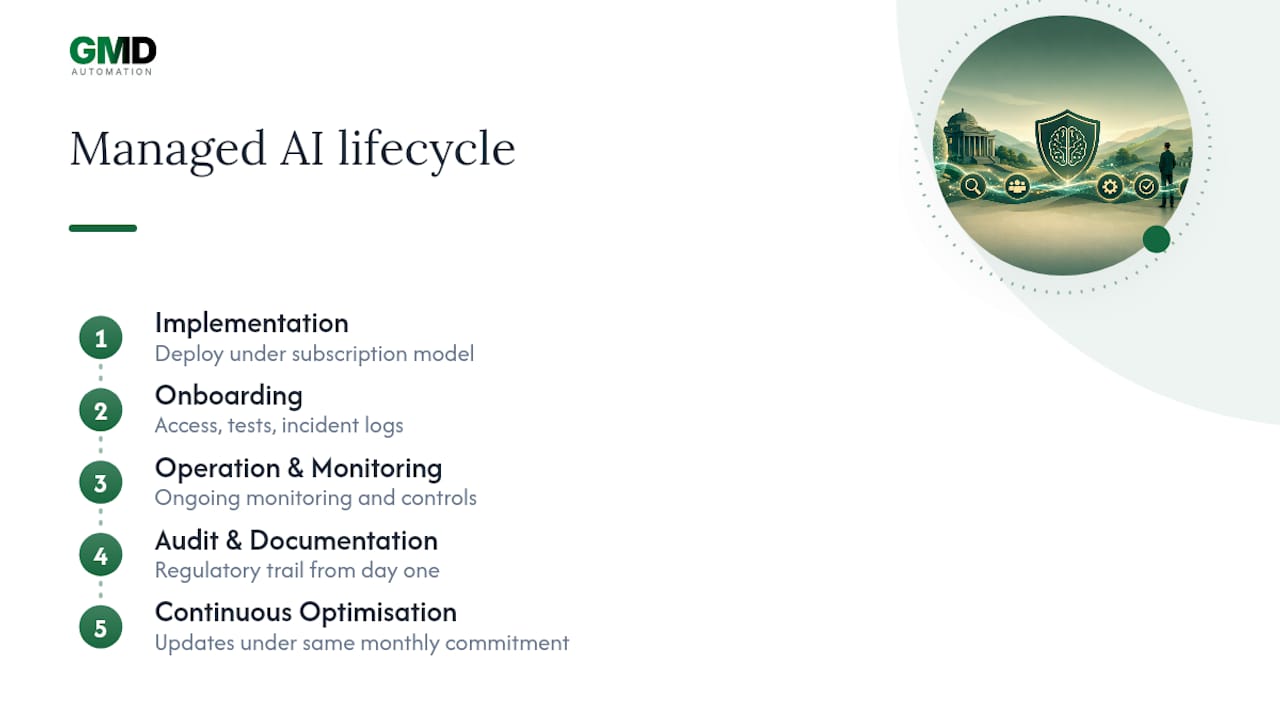
That structure matters most at onboarding, when access controls, testing records and incident logging get set up correctly or not at all. For firms weighing third-party assurance or sandbox participation as the assurance market matures, a managed provider with existing governance discipline is usually easier to plug into that ecosystem than a system built without those habits from the start. Our own guide to AI governance for businesses in 2026 covers the framework in more depth.
A short viewpoint on where UK AI governance is heading
Risk-based governance beats waiting for a general statute that may never arrive. The smartest move available to UK firms right now is early sandbox engagement and third-party assurance, not passive compliance. Regulators and industry both gain from interoperable assurance standards. Watch the ICO and DSIT milestones closely, and prepare before the Code of Practice lands, not after.
— Ravi
Sources
Start with the House of Commons Library briefing, the Data (Use and Access) Act 2025 text, and SI 2026/425 for the legal detail. For AI testing practices that align with regulator expectations, see why AI testing is critical for UK businesses, and for training-context AI use, the Oxford Training Centre's resource on AI in marketing is worth a look. If your AI systems touch network infrastructure, Bootable USBs' analysis of AI and cyber risk is a useful companion read.
If you'd rather have the governance, documentation and audit trail built into your AI deployment from the outset, Gmdautomation's managed AI automation service handles implementation, compliance-ready monitoring and ongoing optimisation for a single monthly fee, with zero upfront cost.
This article is general information, not a substitute for advice from a qualified lawyer. Consult a qualified legal professional about your own circumstances before acting on anything here.
- AI regulation in the UK - The House of Commons Library
- Data (Use and Access) Act 2025 — section on automated decision-making
- The Information Commissioner’s duty to prepare a Code of Practice on AI (SI 2026/425)
- AI Opportunities Action Plan: one year on
- UKRI artificial intelligence research and innovation strategic framework
FAQ
Will AI be regulated in the UK?
Yes, but through existing sectoral regulators and targeted statutes rather than one comprehensive AI Act. The ICO, Ofcom, FCA and MHRA each apply their own rules to AI within their remit, with targeted frontier-model legislation signalled but not yet passed.
What are the key changes in the 2026 AI regulations?
The two biggest changes are the Data (Use and Access) Act 2025's new rules on automated decision-making, phased in from 5 February 2026, and SI 2026/425, which obliges the ICO to produce a dedicated AI Code of Practice from 12 May 2026.
What are the new laws in the UK for 2026?
The Data (Use and Access) Act 2025's amended automated-decision provisions (Articles 22A to 22D) and SI 2026/425's ICO code-of-practice duty are the two substantive legal changes taking effect in 2026, alongside continued application of the Online Safety Act, Telecoms Security Act and Medical Devices Regulations to AI-specific use-cases.
Will the EU AI Act apply to UK firms?
Only if a UK business places an AI system on the EU market, its outputs are used in the EU, or it affects EU residents. Purely domestic UK AI deployments fall outside the EU Act's territorial scope, though UK firms serving EU customers should track its phased 2025 to 2026 obligations closely.