

AI lead qualification scores, enriches, and routes leads in real time, giving reps a ranked list with reason codes instead of a raw contact export. Done properly, it cuts lead-to-meeting time, keeps scoring consistent across thousands of leads a month, and lifts MQL-to-SQL conversion because reps chase the right accounts first. Governance matters as much as the model: GDPR-aware profiling, quarterly recalibration, and a provider like Gmdautomation handling the plumbing separate a working system from an expensive experiment.
TL;DR:
- AI lead qualification automates scoring and routing, reducing lead-to-meeting time and increasing consistency compared to manual efforts.
- It utilizes multiple signals such as firmographic, behavioral, and third-party intent data, with reason codes boosting rep trust.
- Proper deployment requires solid CRM integration, fresh enrichment data, and ongoing model recalibration to prevent bias and drift.
- Managed systems offer faster setup and maintenance, eliminating the engineering burden for most sales teams.
- Success depends on narrow pilot programs, aligned sales and marketing criteria, and measuring KPIs like conversion rates, routing latency, and false positives.
Table of Contents
- What is AI lead qualification and how does it differ from manual scoring?
- Why AI scoring beats static rules: signals, models and reason codes
- How AI fits into the sales workflow: capture, score, route, act
- Operational checklist: integrations, data quality and KPIs
- What risks come with AI lead qualification, and how do you manage them?
- How a managed, production-ready approach solves operational obstacles
- Best practices for training and fine-tuning AI models for lead qualification
- What do successful AI lead qualification deployments look like?
- What challenges come up during deployment, and how do you fix them?
- How do you align sales and marketing around an AI qualification system?
- How do you measure AI qualification accuracy and ROI?
- Practitioner perspective: what actually goes wrong
- Get a working pilot without the build burden
- Sources
- FAQ
What is AI lead qualification and how does it differ from manual scoring?
An AI lead qualification agent enriches a lead with third-party and behavioural data, scores it against a trained model, and routes it to the right rep or queue, usually within seconds of the lead arriving. That is fundamentally different from a human working through a spreadsheet, or a static rule set awarding points for job title and company size.
Manual review and traditional BANT or MQL frameworks rely on a rep or marketer manually checking budget, authority, need, and timeline, then applying fixed point values. It works, but it is slow and inconsistent between reps. Automated qualification compresses that research and routing into seconds, where manual qualification typically eats 15 to 30 minutes per lead once you count research, cross-checking, and CRM data entry. The AI version repeats the same process every time, at the same standard, without fatigue.
Why AI scoring beats static rules: signals, models and reason codes
Static rule sets score what they are told to score. Machine learning models weigh dozens of signals simultaneously and adjust as new outcomes come in, which is why AI lead qualification tends to outperform a fixed points table once volume climbs past a few hundred leads a month.
The signal types that matter most:
- Firmographic data: company size, industry, revenue band, and technology stack.
- Demographic data: job title, seniority, and department, pulled from enrichment sources.
- Behavioural signals: page visits, pricing page views, repeat email opens, and content downloads.
- Third-party intent data: buying signals sourced from external intent providers tracking research activity across the web.
- Conversation data: call transcripts and chat logs, scored for language that indicates urgency or budget.
Real-time behavioural signals decide timing more than any other input, as explained in detail in AI media buying: what it is and when to adopt it — this highlights how behavioural signals inform action and dynamic scoring. A lead who viewed pricing twice this morning is worth calling now, not next Tuesday. Every score needs a reason code attached, a short explanation of why the model ranked a lead highly, so reps trust the number instead of treating it as a black box.
How AI fits into the sales workflow: capture, score, route, act
The workflow runs in a loop, and each stage feeds the next.
- Capture and enrich. The moment a lead arrives through a form, chat widget, or inbound call, the system pulls firmographic and behavioural data and appends it to the record in real time.
- Score against thresholds. The model assigns a score, typically split into tiers such as hot, warm, and nurture, based on rules the ClickToClose implementation guide recommends setting during a two to three week pilot build.
- Route by rule. High scores go straight to a rep's queue or calendar; borderline scores go to a human for a quick quality check before anything reaches a rep's inbox.
- Act with context. The system can draft a next-best-action, a suggested email or call script referencing the lead's specific behaviour, cutting the time between qualification and a booked meeting.
- Feed the loop back. Closed-won and closed-lost outcomes flow back into the model so scoring weights adjust over time rather than staying frozen at launch settings.
Pro Tip: Set your routing rule so borderline scores default to a human review queue rather than auto-routing straight to a rep. It costs a few minutes of delay and saves reps from chasing leads the model got wrong.
Gartner's guidance on designing AI around frontline seller actions rather than vendor feature lists applies directly here: the workflow should mirror what a rep actually does with a lead, not what a dashboard can display.
Operational checklist: integrations, data quality and KPIs
Before any AI qualification system goes live, RevOps needs to confirm the technical foundations are solid, not aspirational.
- CRM read/write access. The system needs to read existing fields and write scores, reason codes, and routing decisions back into the CRM, not just display them in a separate dashboard.
- API and webhook connections. Forms, chat tools, and call systems all need to fire data into the qualification engine the moment a lead appears.
- Calendar and booking sync. Meetings booked through next-best-action prompts should land directly on a rep's calendar without a manual step.
- A centralised data bridge. Without one, teams end up with AI sprawl, several disconnected tools each holding a partial view of the lead, forcing reps into manual workarounds to reconcile them.
- Enrichment source freshness. Firmographic data goes stale fast; a company that raised funding or made a leadership change last month can throw off scoring if the source hasn't refreshed.
Track these KPIs from week one: routing latency (how long from lead capture to rep assignment), MQL-to-SQL conversion rate, lead-to-meeting time, and false positive rate (how often a "hot" lead turns out cold). These four numbers tell you more about whether the system is working than any accuracy score the vendor quotes.
What risks come with AI lead qualification, and how do you manage them?
The biggest risk is invisible until it has already cost you pipeline: a model trained only on historical wins can quietly bake in bias, favouring the type of account that closed before rather than the type of account that could close now. Schedule quarterly recalibration as standard practice, not a "fix it if it breaks" afterthought.
Watch for these failure modes:
- Stale enrichment data producing scores based on outdated firmographics.
- Model drift, where scoring accuracy degrades gradually as market conditions shift and nobody notices until conversion drops.
- Profiling under GDPR, which requires a lawful basis and, in many cases, the ability to explain a decision to the individual concerned; reason codes help here as much as they help rep trust.
- The speed trap: routing leads to reps so fast that a human never gets a chance to catch an obvious scoring error before it reaches a customer conversation.
Feedback loops matter more than any single input. Models that receive closed-won and closed-lost outcomes stay sharp; models left running without that loop degrade and generate more false positives over time, which is exactly the metric your operational checklist should already be tracking.
How a managed, production-ready approach solves operational obstacles
Building the data bridge, the recalibration schedule, and the CRM write-back logic in-house takes months and a dedicated engineering team most sales organisations don't have spare. AI lead qualification can be deployed as a managed system, with rapid deployment and a monthly subscription that covers implementation, monitoring, and ongoing optimisation rather than a one-off build handed over and forgotten.
That structure means CRM write-back, model recalibration, and enrichment refresh cycles are handled as part of the service, not left for RevOps to maintain manually. The honest trade-off: building in-house gives full control over every line of logic, at the cost of the engineering time and maintenance burden a managed route absorbs. For teams without a platform engineering function to spare, that trade-off usually favours managed deployment.
Best practices for training and fine-tuning AI models for lead qualification
Training an AI lead qualification model well starts with the data you feed it, not the algorithm you choose. A model trained on six months of leads from one campaign will score badly the moment you launch a new channel, because it has never seen that pattern of behaviour before.
Feed the model a full range of outcomes, not just your best leads. Include closed-lost records with as much detail as closed-won ones; a model that only learns from wins has no concept of what a poor fit looks like. Balance the training set across lead sources, company sizes, and seasons so it doesn't overfit to whatever channel dominated the historical data.
Fine-tune on a rolling basis rather than a one-time setup. Quarterly recalibration, feeding in the latest closed-won and closed-lost outcomes, keeps the model aligned with how your market and buyer behaviour actually shift. A model tuned once at launch and never touched again is the single most common reason scoring accuracy erodes within a year.
Keep a human in the loop during early training cycles. Reps reviewing a sample of AI-scored leads each week, flagging clear misses, gives the model a correction signal faster than waiting for quarterly closed-loop data alone. Gartner's seller-action-first framework applies directly to training too: build the model around what a good lead looks like to your reps, not what looks tidy in a training dataset.
Finally, test scoring thresholds against real conversion outcomes before trusting them fully. A tier labelled "hot" that converts at the same rate as "warm" is a sign the thresholds need adjusting, not that the whole model has failed.
What do successful AI lead qualification deployments look like?
The organisations getting real value from AI lead qualification share a pattern: they started narrow, measured hard, and expanded only once the numbers held up. McKinsey's analysis of B2B sales transformation notes that growth leaders are moving from simple rule-based automation toward agentic AI that orchestrates end-to-end actions, rather than automating one isolated task and calling it done.
A typical successful rollout looks like this: a sales team picks one lead source, usually inbound web forms, and runs AI scoring alongside existing manual qualification for two to three weeks without changing routing. That overlap period lets RevOps compare AI scores against what reps found once they actually worked the lead, catching obvious mismatches before the system takes over routing decisions.
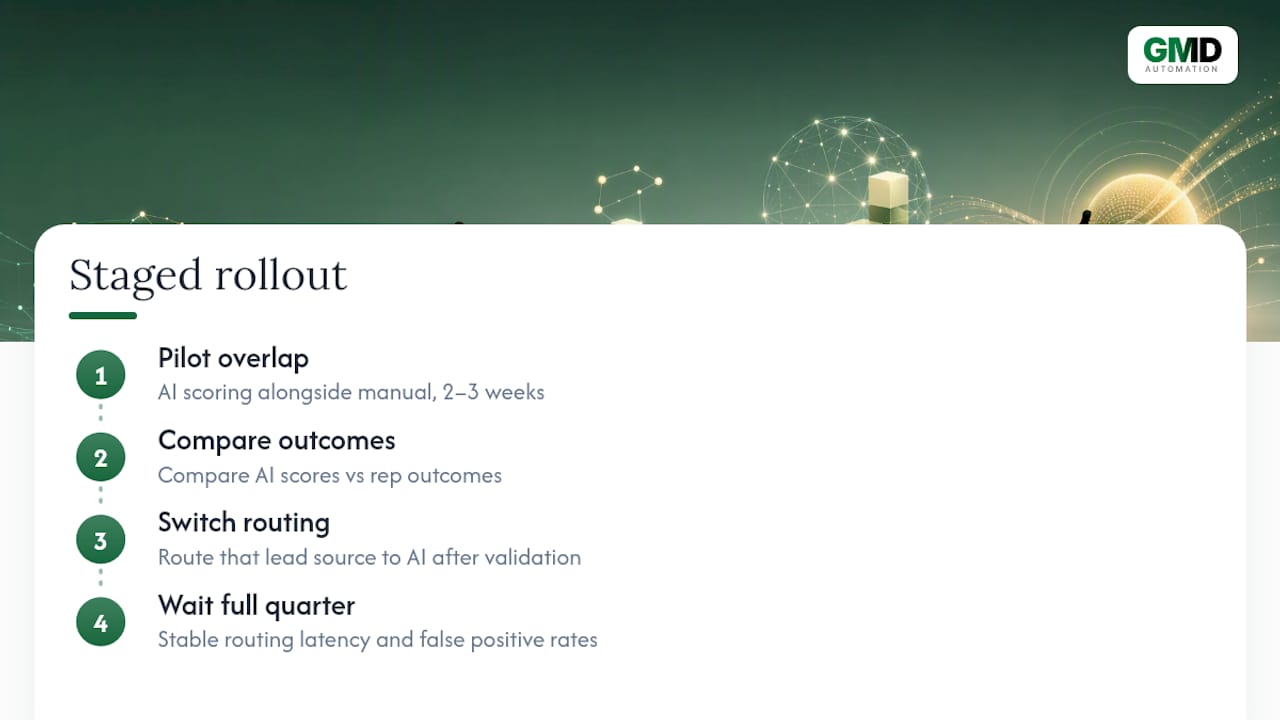
Once the pilot shows the AI scores track reasonably close to actual conversion outcomes, routing switches over for that one lead source first. Only after routing latency and false positive rates hold steady for a full quarter does the team expand to a second lead source, then a third. Teams that skip this staged approach and roll AI qualification out across every channel simultaneously tend to hit the biggest early problems, because a scoring error in one channel gets buried by good performance in another.
The teams reporting the strongest results treat the pilot as a data-gathering exercise first and a productivity win second. Seamless shows AI is proving most effective for prospecting, enrichment, and prioritisation specifically, which lines up with where the staged rollouts above tend to start: narrow, measurable, and closest to existing rep workflows.
What challenges come up during deployment, and how do you fix them?
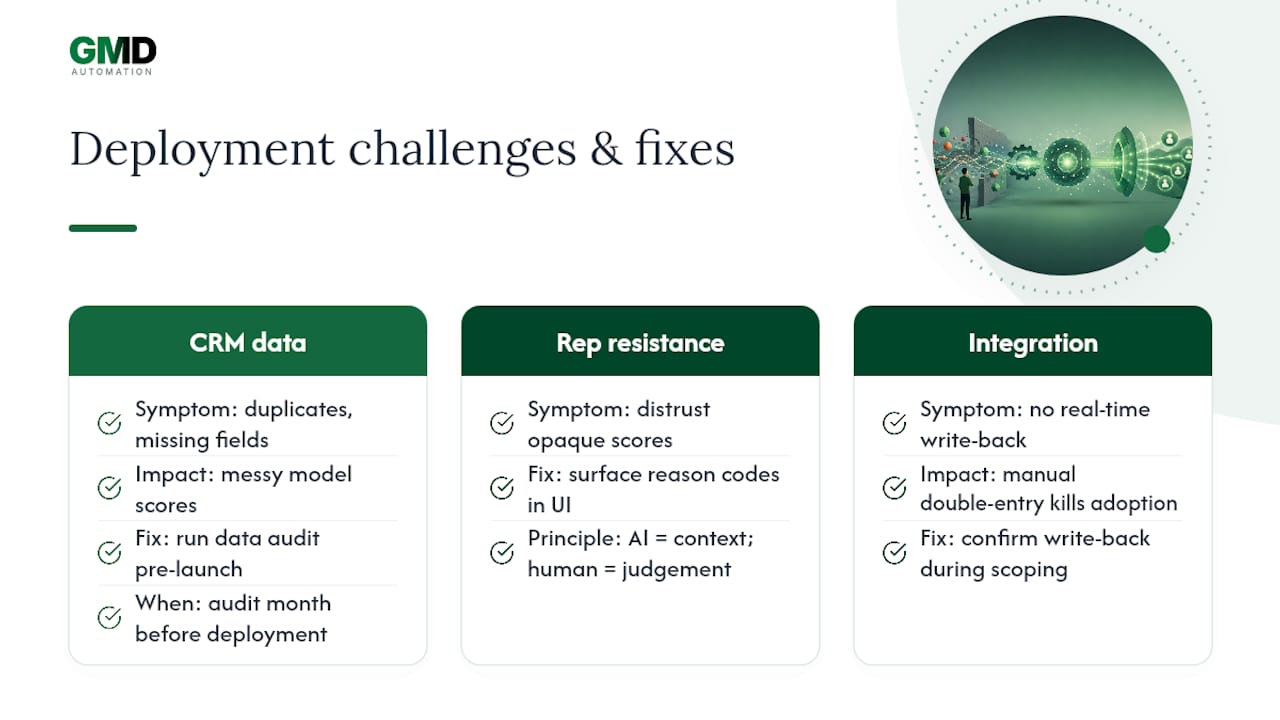
The most common deployment problem isn't the model itself. It's the CRM. Teams underestimate how much of their lead data lives in inconsistent fields, duplicate records, and half-filled forms until an AI system tries to score against it and produces obviously wrong results.
Fix data quality before scoring goes live, not after. Run a data audit on your CRM's lead fields for the month before deployment, checking for duplicate records, missing firmographic fields, and inconsistent naming conventions across sources. A model scoring against messy data will produce messy scores, no matter how well it was trained.
Rep resistance is the second major obstacle. Reps who have qualified leads by instinct for years often distrust a score they can't see the logic behind. Reason codes solve most of this, but only if reps actually see them in the interface they already use, not buried in a separate reporting tool nobody checks. Salesforce's guidance on AI and human roles in sales makes the point directly: AI should supply context, humans supply the relationship judgement, and reps need to see that division clearly to trust the system.
Integration gaps cause the third common failure. A scoring engine that can't write back to the CRM in real time forces reps into manual double-entry, which kills adoption within weeks regardless of how accurate the scores are. Confirm write-back access during the technical scoping phase, not after the system is already built.
Expect a slower-than-hoped ramp in the first month. Scoring accuracy typically improves as the model sees more of your actual outcomes, so treat the first few weeks as calibration, not failure.
How do you align sales and marketing around an AI qualification system?
AI lead qualification changes what counts as a qualified lead, and that single shift can quietly break the relationship between sales and marketing if nobody addresses it upfront. Marketing has spent years hitting an MQL volume target; sales now receives a smaller, more accurate list of leads scored by a model neither team fully controls.
Get both teams agreeing on scoring criteria before the system launches, not after reps start complaining about lead quality. Run a joint session where marketing and sales define what a genuinely qualified lead looks like, using real historical examples of leads that converted and leads that wasted a rep's time. That shared definition becomes the training foundation for the model.
Set expectations that MQL volume will likely drop even as quality rises. Marketing teams measured purely on lead volume will resist a system that produces fewer, better leads unless leadership resets the metric to something like MQL-to-SQL conversion rate, a figure that rewards the shift rather than punishing it.
Give both teams visibility into the same scoring dashboard. When marketing can see why a lead scored low, they can adjust campaigns and targeting accordingly instead of treating the AI system as a mysterious sales-side tool that arbitrarily rejects their work. Reason codes serve this dual purpose: they build rep trust and give marketing a diagnostic tool at the same time.
Run a short weekly review during the first two months where both teams look at a sample of scored leads together. It surfaces disagreements early, while they're still cheap to fix.
How do you measure AI qualification accuracy and ROI?
Four numbers tell you whether an AI lead qualification system is earning its keep, and none of them is the model's own confidence score. Track them from the day the pilot launches.
MQL-to-SQL conversion rate shows whether the leads the AI marks as qualified actually survive a real sales conversation. If this number doesn't improve within the first full quarter compared with the pre-AI baseline, the scoring criteria need revisiting before you expand to more lead sources.
Routing latency measures how long it takes from lead capture to a lead landing on the right rep's desk. This should drop from hours, in a manual process, to minutes or seconds once automated routing is live. A latency figure that isn't improving points to an integration problem, not a scoring problem.
Lead-to-meeting time captures the real commercial impact: how much faster leads convert into a booked conversation. This is the number that best demonstrates ROI to leadership, because it ties directly to pipeline velocity rather than an abstract accuracy percentage.
False positive rate tracks how often a lead scored as hot turns out to be a poor fit once a rep actually works it. Rising false positives are the clearest early warning sign of model drift, and the trigger for scheduling an off-cycle recalibration rather than waiting for the next quarterly review.
Calculate ROI by comparing the fully loaded cost of the AI system, including any managed service subscription, against the value of the additional meetings and closed deals the faster, more accurate qualification produces. Most teams find the clearest ROI signal isn't cost savings on headcount. It's the extra pipeline that faster qualification and routing surfaces before a competitor gets there first.
Practitioner perspective: what actually goes wrong
The deployments that struggle almost always skipped the centralised data bridge and tried to bolt AI onto three disconnected tools instead. Start with a minimal pilot, one lead source, clear KPIs, a four-week window, before touching anything else. Everything past that is refinement.
— Ravi
Get a working pilot without the build burden
Every checklist in this article, the CRM write-back, the centralised data bridge, the recalibration schedule, is exactly what most sales teams don't have spare engineering time to build. AI lead qualification can be deployed as a fully managed system, with zero upfront cost and a monthly subscription covering implementation, monitoring, and ongoing model recalibration, so RevOps gets the operational readiness this article covers without hiring for it.
The system integrates directly with your existing CRM for real-time scoring and write-back, handles the enrichment sources that keep data fresh, and reports against the same KPIs covered above: routing latency, MQL-to-SQL conversion, and lead-to-meeting time. It sits alongside Gmdautomation's outbound calling AI capability for teams that want qualification to extend into voice conversations, not just inbound forms. If you're weighing a build-in-house approach against a managed one, book a demo with Gmdautomation and see the scoring and routing logic running against a live pilot before committing either way.
Sources
- The future of B2B sales: how growth champions rewire their playbooks with AI — McKinsey
- Sales AI — Gartner
- 2026 State of AI in Sales Report - AI Sales Trends | Seamless
- Automated lead scoring: build an MQL system that works — ClickToClose
FAQ
How do you use AI for lead qualification?
Connect your lead sources (forms, chat, calls) to an enrichment and scoring engine, set score thresholds for routing, and integrate write-back to your CRM so reps see scores and reason codes directly in their existing workflow.
How much do qualified leads cost?
Cost varies widely by industry and lead source, but AI qualification typically reduces the per-lead cost of manual research and triage rather than the cost of acquiring the lead itself, since it compresses 15 to 30 minutes of manual work into seconds.
Is lead generation a good career?
Lead generation remains a viable career path, and AI is reshaping it toward strategy, campaign design, and scoring oversight rather than manual list-building, since survey data shows AI now handles much of the repetitive prospecting work.
What does lead qualification mean?
Lead qualification is the process of determining whether a prospect matches your ideal customer profile and shows genuine buying intent, traditionally done manually against frameworks like BANT and now increasingly automated with AI scoring.
How long does an AI lead qualification pilot take to set up?
A working pilot with tiered scoring and CRM routing typically takes two to three weeks to configure and integrate, based on standard implementation timelines for automated scoring systems.