

A fully managed, subscription-based AI workflow automation service is the practical answer for most businesses that want SAP-adjacent processes automated without a large upfront investment. Production-ready systems, deployed and maintained by a specialist provider, let operations teams start automating calls, credit control and customer workflows within weeks rather than months. Managed providers build these systems around a monthly subscription, so implementation, maintenance and optimisation are included from day one.
TL;DR:
- Most deployments should last 4 to 8 weeks for pilot testing and 3 to 6 months for full organizational scaling, depending on complexity.
- Providers should demonstrate secure hosting, clear data-handling policies, and human oversight controls before any contract is signed.
- Costs are predictable and based on the number of workflows, integration complexity, and compliance requirements, with typical pilots costing from £250 to £300 per month.
- Proper scope definition, KPIs, and a phased rollout with stakeholder ownership are critical for success and minimizing scope creep.
- Signing a managed service requires thorough review of SLAs, support levels, data portability, and compliance practices, not just price.
Table of Contents
- What a fully managed AI workflow automation service actually does
- Security, compliance and governance you should demand from a provider
- How to evaluate and procure a managed subscription provider
- Deployment shape, subscription pricing and realistic timelines
- Lessons from the ground on what makes deployments succeed
- Getting started with GMD Automation's managed subscription
- Sources
- FAQ
What a fully managed AI workflow automation service actually does
In this context, managed AI workflow automation means a subscription service that handles the repetitive, rules-plus-judgement tasks sitting inside enterprise operations: call handling, credit control, invoice processing and customer triage. It is not about SAP platform internals or ABAP-level integration work. It is about a provider taking full ownership of a working system that plugs into how a business already operates.
The use cases with the clearest returns tend to be the ones with high volume and predictable structure:
- AI call handling that answers, qualifies and books appointments without a human picking up the phone.
- Credit-control workflows that chase overdue payments and flag exceptions for a human to review.
- Social media management, including content creation, scheduling and reply handling.
- Claims triage and invoice processing that sort incoming documents by urgency and type.
- Customer service triage that routes enquiries to the right team or resolves simple ones outright.
Value is measured in concrete terms: hours of manual work removed, the number of tasks handled without a person touching them, faster turnaround on invoices or claims, and improved conversion or payment-recovery rates. Organisations that redesign the workflow itself, rather than bolting AI onto an unchanged process, tend to see the largest gains, and McKinsey's research links workflow redesign directly to stronger EBIT impact from generative AI. Adoption itself is accelerating too, with ONS business surveys showing a rising share of businesses now using or planning to use AI tools.
Security, compliance and governance you should demand from a provider
Handing workflow automation to a third party does not remove your responsibility for how it behaves. The NCSC's guidance on AI and cyber security sets out a secure-by-design approach that spans the whole AI lifecycle: design, development, deployment, operation and ongoing maintenance. It also states plainly that senior leaders, not just technical teams, are expected to own AI security outcomes.
Before signing anything, buyers should confirm:
- Where models and data are hosted, and which third-party APIs are involved in processing customer information.
- How data minimisation, consent and portability are handled if you switch providers later.
- Whether a human reviews or can override customer-facing agent decisions.
- Who owns incident response, and how quickly issues get escalated and fixed.
Human oversight is not optional. UK government guidance on AI agents and consumer law makes clear that businesses remain responsible for what their AI agents do, and are expected to train, monitor and quickly refine those agents to stay compliant. That responsibility does not transfer to the supplier just because the system is managed.
Deloitte's State of Generative AI survey finds that regulatory and governance concerns remain a top barrier to deploying generative AI, even as interest in agentic systems grows. That gap between ambition and governance readiness is exactly where a poorly vetted supplier can leave you exposed.
Pro Tip: Ask any prospective supplier to show you their secure-by-design documentation and incident response process before you discuss pricing, not after. For more on setting these foundations, see this guide to AI governance.
How to evaluate and procure a managed subscription provider
Procurement for a managed AI service looks more like vetting an outsourced operations partner than buying software. A structured process protects you from vague promises and hidden costs later.
- Shortlist providers and request evidence of secure-by-design practices and compliance frameworks.
- Ask for sample SLAs covering support hours, escalation paths and response times.
- Review exit and data-portability clauses before you commit to anything longer than a rolling contract.
- Confirm audit rights: can you or a third party review logs, model provenance and decision records on request.
- Agree a pilot scope with clear KPIs before any wider rollout begins.
On the technical side, check encryption at rest and in transit, how logs are retained, what third-party APIs the system depends on, and whether the provider offers sandbox testing before anything touches live customer data. A security architecture guide is a useful reference for the specific questions to ask.
Operationally, you want clarity on:
- Onboarding timeline and who trains your staff to work alongside the system.
- What human oversight looks like day to day, not just on paper.
- Defined success criteria for the pilot and for scaling beyond it.
- What the monthly subscription actually includes, so there are no surprise add-ons.
A sensible rollout runs a short pilot with two or three KPIs, reviews the results against agreed success gates, then expands scope only once those gates are met. This vendor procurement checklist covers the specific questions worth putting to any shortlisted supplier.
Deployment shape, subscription pricing and realistic timelines

The appeal of a managed subscription is that implementation, hosting, maintenance, optimisation and support all sit under one monthly fee, which removes the guesswork that comes with itemised project quotes. Transparent pricing also makes it far easier to compare providers on equal terms.
What moves the price up or down is fairly predictable:
- The number of workflows being automated at once.
- How complex the integration is with existing systems and data sources.
- How much data preparation and cleanup the workflows need before launch.
- Compliance and SLA requirements specific to your sector.
As an illustrative guide rather than a promise, a pilot typically runs 4 to 8 weeks, a production pilot with real customer interactions runs 8 to 12 weeks, and scaling across an organisation takes roughly 3 to 6 months. A useful pipeline examples resource shows what these stages look like in practice. To track return on investment, monitor hours saved, tasks completed without manual intervention, and any change in conversion or payment-recovery rates against your pre-automation baseline.
Lessons from the ground on what makes deployments succeed

The deployments that struggle are almost always the ones that try to automate too much at once, skip proper governance, or remove human oversight before the system has earned that trust. Scope creep kills more pilots than technical failure does.
What tends to work is the opposite: a narrowly scoped use case, a named executive sponsor who owns the outcome, KPIs agreed before launch rather than invented afterwards, and a supplier who responds quickly when something needs adjusting. One well-documented external example, a content workflow automation case study, shows how a tightly scoped automation project delivers a measurable time saving without overreaching into unrelated processes.
— Ravi
Getting started with GMD Automation's managed subscription
One provider delivers exactly this model: enterprise-grade AI workflow automation as a fully managed, production-ready service, with no large upfront cost. Everything runs under a single, predictable monthly subscription.
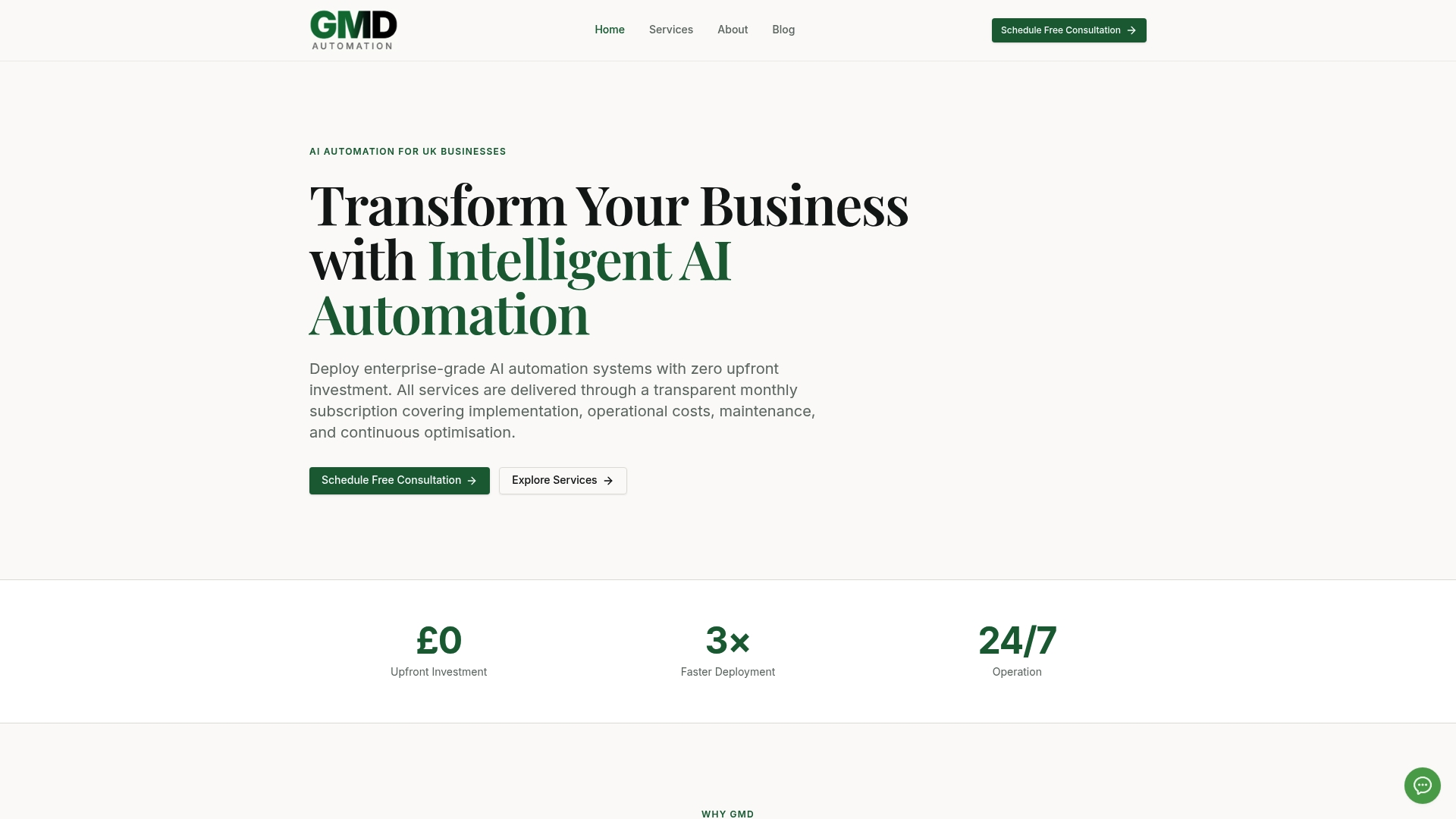
The subscription typically includes:
- Implementation and integration with existing operational tools.
- Maintenance, hosting and performance monitoring.
- Optimisation as workflows and volumes change.
- Rolling contracts with flexible scaling and an exit path.
Two services fit directly into the use cases covered above: Your AI answers, qualifies and books, from £300 per month, and Your AI credit controller for lettings, from £250 per month. Whichever provider you choose, verify the contract, SLA and data-handling terms in writing before signing. To see how either service would fit your operation, get in touch through the services page to arrange a demo.
Sources
- AI and cyber security: what you need to know (NCSC)
- Complying with consumer law when using AI agents (UK government)
- The state of AI: how organizations are rewiring to capture value (McKinsey)
FAQ
What does "managed AI workflow automation" mean in practice?
It means a provider builds, hosts and maintains the AI system for you, under one monthly subscription, rather than you buying software and running it in-house. This typically covers implementation, ongoing maintenance and optimisation without a large upfront cost.
How long does it take to deploy a managed AI workflow system?
Timelines vary by scope, but a common pattern is a pilot lasting several weeks, followed by a production pilot, then a phased scale-up over a few months. Treat any timeline as illustrative rather than fixed, since integration complexity and data readiness both affect the pace.
Who is responsible if an AI agent makes a mistake with a customer?
Under UK consumer law guidance on AI agents, the business using the agent remains responsible for its conduct, not just the technology supplier. That means ongoing training, monitoring and rapid refinement are expected of you as the buyer, even in a fully managed arrangement.
What should I check before signing a contract with a provider?
Confirm SLAs, escalation and support hours, data-portability and exit terms, and evidence of secure-by-design practices in line with NCSC guidance. Providers such as GMD Automation offer rolling contracts with flexible scaling, which is worth comparing against any fixed-term alternative.
How much does a managed AI workflow subscription typically cost?
Pricing depends on the provider and the scope of workflows involved. GMD Automation's services start from £300 per month for AI call handling and booking, and from £250 per month for AI credit control, both under a single all-inclusive subscription.