
Choosing enterprise AI automation software that delivers instant value without steep upfront costs or heavy technical lift often stalls budget approval or roll-out. Many alternatives demand multi-year contracts, lock critical support behind custom plans, or require large project launches before a single workflow is automated. This comparison shows how subscription models, service scope, and integration features differ so organisations can match one to their automation goals and growth stage.
Table of Contents
GMD Automation
At a Glance
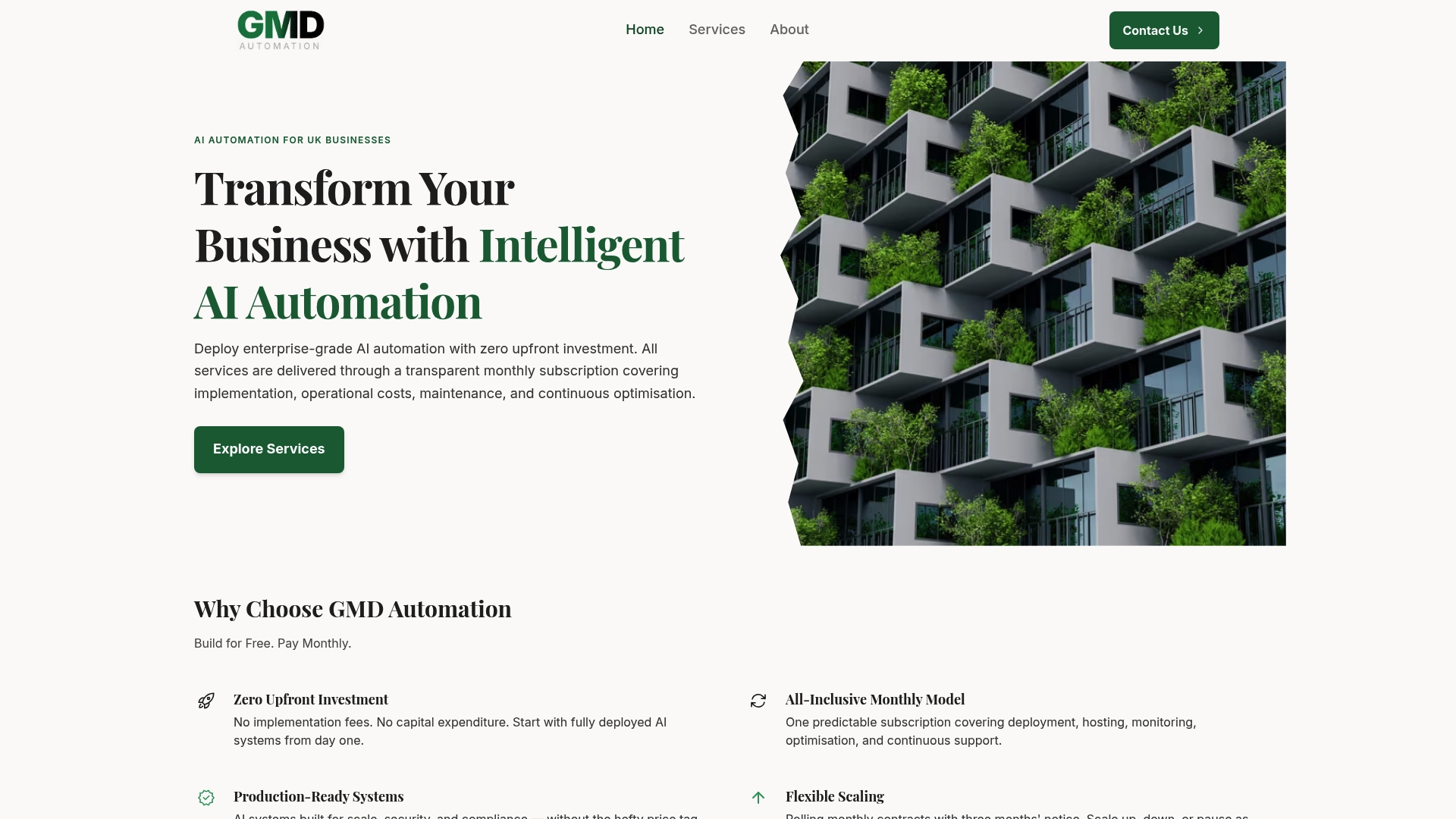
Zero upfront implementation cost for production ready AI systems. The offering combines AI voice agents and round the clock social media automation billed as a monthly subscription. Contracts run on a rolling monthly basis with three months' notice.
Core Features
All work is covered under an all-inclusive monthly subscription that the vendor says handles deployment, hosting, monitoring, and support. The platform supplies production ready AI systems built for scale, security, and compliance. The vendor advertises GDPR compliance.
Key Differentiator
Zero upfront investment paired with a fully managed delivery model. The service removes capital barriers by moving implementation, operation, maintenance, and optimisation into a single monthly fee. That approach lets organisations adopt live AI without hiring specialists or funding a large project up front.
Pros
No upfront cost reduces the capital outlay required to start automating customer workflows. The fully managed service transfers technical responsibility for deployment, hosting, and monitoring to the provider, which shortens time to live. Flexible rolling contracts and three months' notice make it easier to scale down if priorities change. Voice agents support multilingual call handling and calendar integration while social media automation covers posting, engagement, direct messages, trend tracking, and cross platform management, running 24/7. That compliance claim and the focus on enterprise security address regulatory concerns for UK businesses.
Cons
- May not suit large enterprises requiring deep customisation or integration with complex legacy systems.
Who It's For
UK small and medium sized businesses that want operational automation without capital expenditure. Service providers, agencies, and retailers that need 24 hour customer handling or continuous social media presence will find the predictable monthly model useful. Organisations that lack in house AI skills benefit from the managed approach.
Unique Value Proposition
The service charges a predictable monthly fee that includes deployment, hosting, monitoring, and ongoing optimisation, so you do not pay upfront for implementation. That converts a capital project into operating expenditure and shortens procurement cycles. For teams that need live AI quickly and prefer an external operations model, this lowers barrier to entry and simplifies vendor management.
Real World Use Case
A UK service provider routes inbound calls to AI voice agents to handle bookings and basic lead qualification outside business hours. Social media automation publishes posts, replies to direct messages, and surfaces trending topics across two platforms. Together they keep lead flow active without a large initial spend.
Pricing
Pricing is billed monthly. Voice agents start from £400 for 1,000 minutes per month, with usage alerts and unlimited calls handled. Social media management starts from £200 for two platforms, running 24/7. Exact costs depend on minutes, platform count, and any added services.
Website: https://gmdautomation.ai
Ingenaium
At a Glance
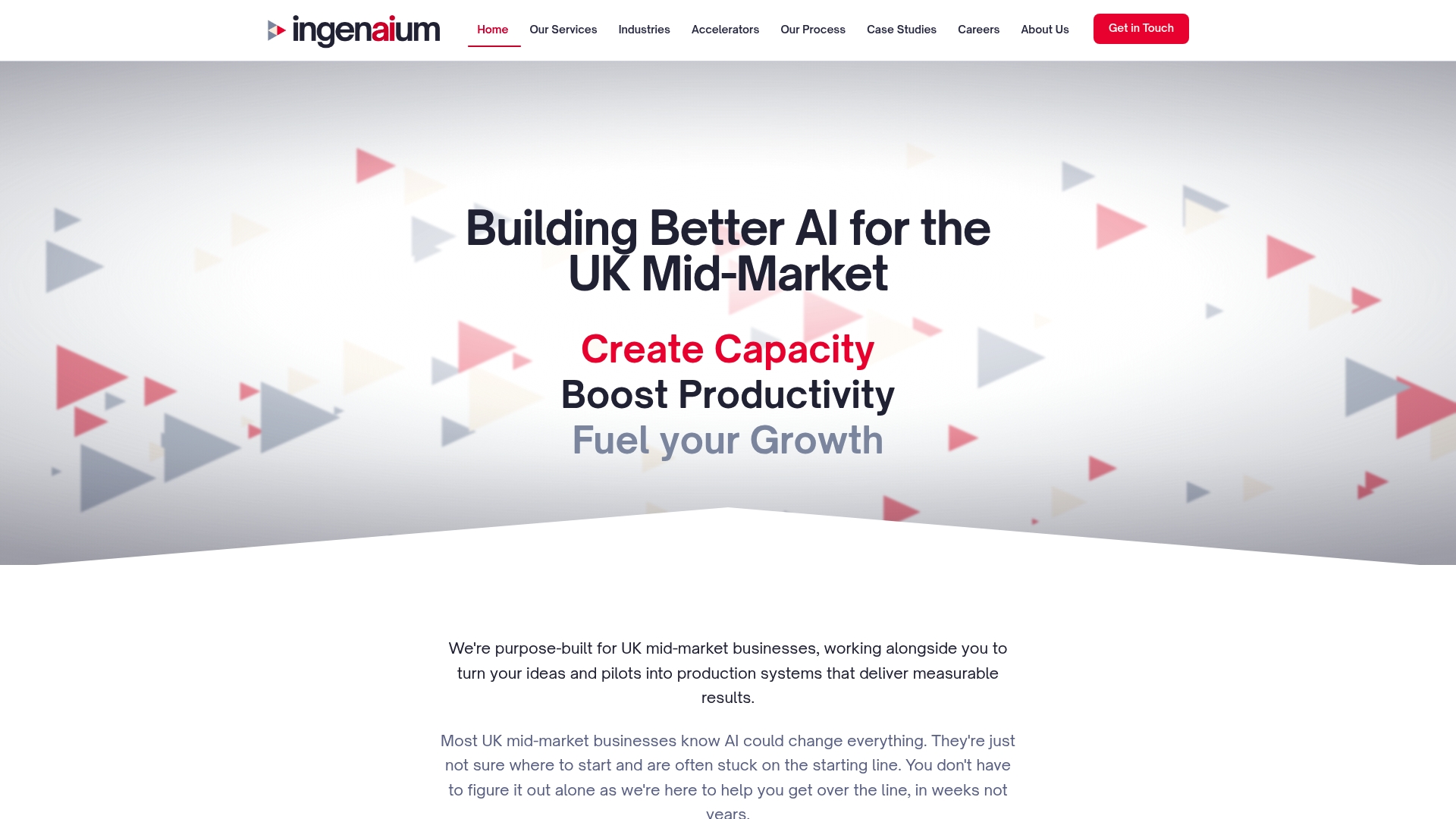
Proven use case accelerators include Radar for competitor tracking and tools for R&D tax credit estimation. The company targets UK mid market organisations and pairs a platform with hands on professional services. That combination aims to move pilots into production and deliver measurable productivity improvements without hype.
Core Features
The platform brings together common AI needs into one interface and supplies a library of proven accelerators for tasks such as document processing, contact mapping, CV vetting, and market intelligence. Clients get a structured delivery approach that covers understanding, design, build, evaluate, and ongoing support, plus governance and responsible AI principles embedded in the process. The team provides hands on help to identify high value use cases and get solutions live quickly.
Key Differentiator
Ingenaium focuses on tailored accelerators and direct delivery support for the UK mid market, rather than selling a generic toolset. That focus shortens time to value because prebuilt use case components reduce design work and the team supports configuration and adoption. The end result is a platform aligned to common mid market priorities such as knowledge management and customer engagement.
Pros
The vendor emphasises practical, measurable productivity gains and avoids overpromising outcomes. Their delivery model combines an accessible platform with hands on professional support, so teams that lack in house AI skills can still move to production. Governance and responsible AI practices are built into engagements, which helps with auditability and stakeholder confidence.
Cons
-
Reliant on third party models and cloud providers, which can affect environmental and ethical transparency. This dependency may require extra vendor checks.
-
Existing accelerators cover many common cases but may not match highly specialised or novel AI requirements. Custom development may be needed.
-
Buyers must align their own data privacy and governance rules with third party components to avoid compliance gaps.
When It May Not Fit
Organisations that require a fully self contained stack or strict control over model provenance may not find Ingenaium suitable. Large enterprises with bespoke, highly specialised modelling needs could outgrow the prebuilt accelerators. Equally, teams with strict environmental reporting needs should probe the vendor's third party choices because the infrastructure dependency can complicate claims.
Who It's For
Mid market UK organisations seeking pragmatic AI deployments that increase capacity and productivity will find this a good match. The product works well for teams that want a partner to design, build, and operate solutions rather than buying software and hiring large internal teams. Sectors such as manufacturing, professional services, and media map neatly to the existing accelerators.
Real World Use Case
A manufacturing firm used Ingenaium's Intelligent Document Processing to automate design and sales workflows. That automation increased order capacity and reduced manual effort. The client plans to extend the work into quoting and supply chain optimisation.
Pricing
Pricing is not published. The product listing states "Not applicable — informational only," so commercial terms are likely bespoke and set per engagement. Expect a professional services plus subscription model rather than fixed public tiers.
Website: https://ingenaium.ai
Pensieve
At a Glance
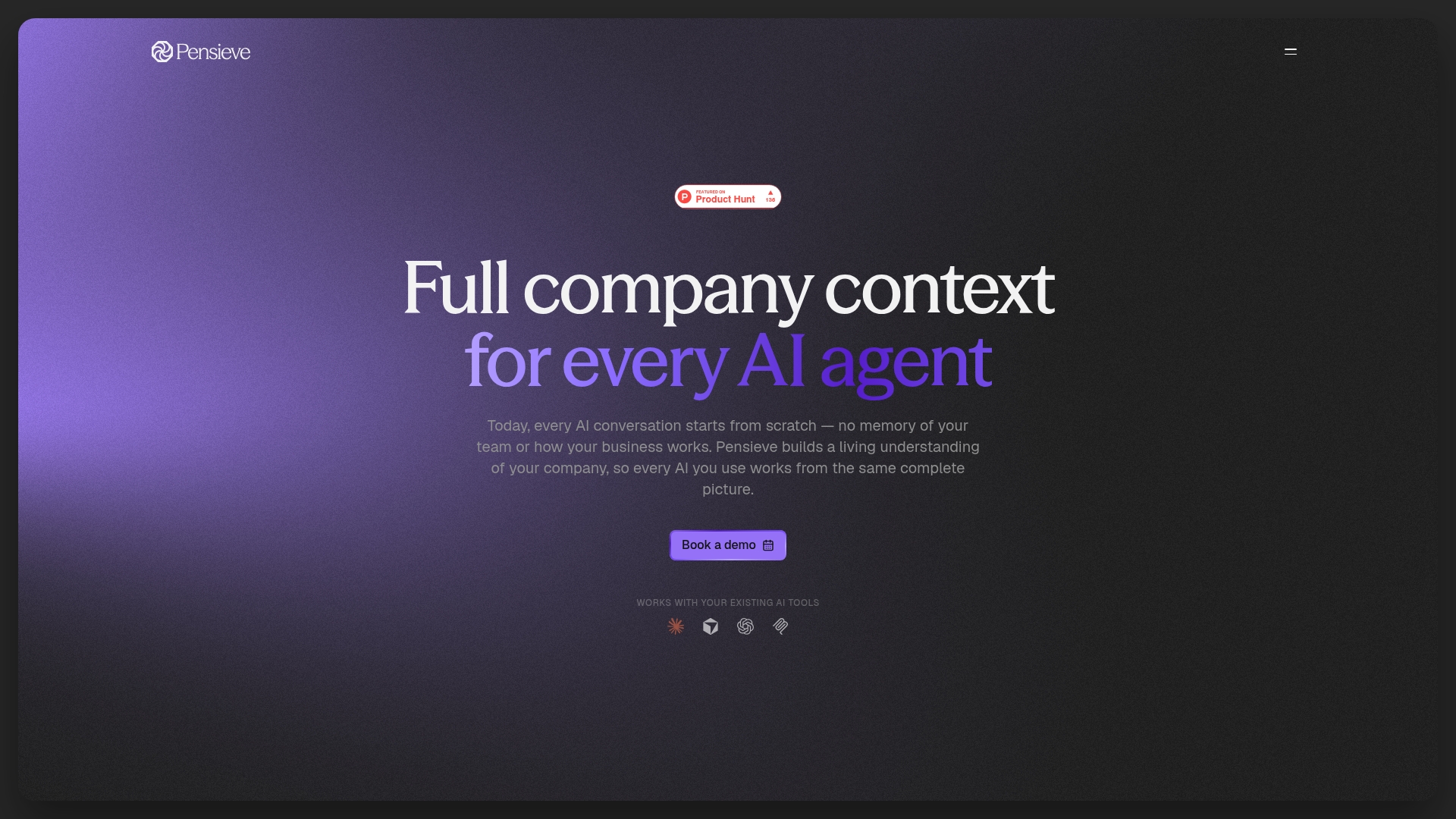
A continuously maintained, structured model of your organisation is built from live sources and served as a single context layer for connected AI. This model pulls from Slack, Notion, Google Drive, GitHub, HubSpot and other tools to keep organisational facts current. The map reduces repeated explanations when AI agents need company context.
Core Features
Pensieve connects to common work platforms and extracts metadata to build a context layer that represents people, projects, decisions and customers. It links that layer to external AI tools such as Claude, ChatGPT and Cursor over MCP so agents can query the same company view. Data is stored in isolated, read only databases and vendor materials state the data is not used to train external models.
Key Differentiator
The vendor says Pensieve creates and maintains a structured, live map of your organisation that any AI can query without duplicating your data or training models on it. That claim means AI agents operate from a single shared source of truth rather than asking users for repeated context. The approach aims to make AI responses more relevant to internal workflows and decisions.
Pros
Provides a persistent, up to date company context so teams do not repeatedly explain the same facts to different AI tools. Connections to Slack, Notion, Google Drive, GitHub, HubSpot, Linear and Jira remove manual tagging and reduce engineering work for basic integrations. Offers a choice of self hosted or managed inference which helps you balance control and speed of deployment. The design focuses on privacy by using isolated, read only storage and not training models on your data.
Cons
- Initial setup can be complex for organisations with many disparate tools and bespoke sources.
- Value depends on the completeness and quality of connected data; patchy connections limit usefulness.
- Ongoing maintenance is required to keep the structure accurate and aligned with evolving processes.
When It May Not Fit
Small teams with minimal tooling will see little benefit because the platform relies on multiple data sources to build its context layer. Organisations that lack engineering or data ownership capacity may struggle with initial configuration and ongoing upkeep. If your priority is a zero maintenance solution, this product may demand more hands on time than you want.
Notable Integrations
- Slack
- Notion
- Google Drive
- GitHub
- HubSpot
- Linear
- Jira
Who It's For
Medium to large organisations that run many systems and want AI tools to share a common view of company facts. Product teams, operations and executive leadership will gain most when they need fast, context aware answers from multiple agents. Technology companies that already use Claude or ChatGPT will find the integration model familiar.
Real World Use Case
A product team keeps an up to date map of features, competitor notes and customer feedback inside Pensieve. Their AI driven customer success tool queries that map and supplies context rich responses without repeated manual briefings. Product decisions and status reports become faster because agents use the same structured company view.
Pricing
A free tier is available to start exploring connectors and the context layer. Enterprise plans are offered with hosting, onboarding and extra features for organisations that need managed deployment and support.
Website: https://pensieve.uk
Comparison of alternatives
Selecting the most fitting enterprise AI automation solution requires examining cost structures, integration capabilities, and specific use cases presented by each provider. GMD Automation offers competitive advantages like a subscription model eliminating upfront costs, while Ingenaium and Pensieve cater to distinctly different client profiles, showcasing tailored capabilities and integration distinctiveness respectively.
Cost structure and accessibility
Among the listed options, GMD Automation stands out with its accessible pricing model, eliminating initial barriers to adoption. The monthly subscription includes hosting, monitoring, and support, thereby converting a capital expense into operational costs. Comparatively, Ingenaium’s bespoke service model and lack of fixed public pricing make it less transparent and predictable to budget constraints typically valued by SMEs. Meanwhile, Pensieve provides a free tier, making it an accessible starting point for firms evaluating its value.
Suitability for specialised needs
Where client-specific needs are concerned, Ingenaium advances through its emphasis on detailed delivery support and focus on governance. It supports specific use cases aligned with manufacturing and professional services. Conversely, Pensieve excels in scenarios necessitating detailed internal mapping, aiding technological firms requiring agent integration. However, GMD Automation simplifies achievable generalist automation objectives, particularly beneficial to SMEs initiating automation journeys.
Best fit
- For UK SMEs requiring low-cost entry to AI automation, GMD Automation supports subscription models that decrease initial expenses while providing ongoing operational support.
- For organisations desiring specialised and bespoke AI solutions with integrated governance principles, Ingenaium offers compelling use-case accelerators with hands-on expert assistance.
- Technology companies needing structured internal organisational context to integrate agents like ChatGPT may prefer Pensieve's continuous internal mapping tools.
Our pick
GMD Automation emerges as a recommended choice for organisations prioritising low-entry capital requirements in adopting AI-driven automation. Its competitive cost-efficiency and deployment ease advocate its selection for small and medium businesses initiating their automation strategy. However, firms prioritising bespoke solutions or internal integration context might explore Ingenaium or Pensieve, respectively.
Selecting an enterprise AI automation software requires considering implementation flexibility, operational autonomy, and specific service offerings. The following comparison outlines choices of systems presenting distinct benefits for varied organisational needs.
| Product | Core Feature | Best For | Pricing | Notable Limitation |
|---|---|---|---|---|
| Gmdautomation | Fully managed AI voice and social media | UK SMEs needing automation without CAPEX | From £400/month for voice, £200/month for social media | Some enterprises may find customisation options limited |
| Ingenaium | AI accelerators with professional support | UK mid-market looking for tailored solutions | Price not published | Reliant on third party models and cloud providers |
| Pensieve | Continuous organisational context mapping | Medium to large teams using integrated tools | Free tier available, enterprise plans offered | Setup complexity for disparate organisations |
Which Autonomogroup.co.uk Alternative Offers Practical AI Automation for UK Businesses?
For UK small and medium sized businesses seeking to reduce capital outlay and avoid complex projects, Gmdautomation provides an accessible alternative to autonomogroup.co.uk alternatives. Their solution features zero upfront implementation cost and a clear monthly subscription that handles deployment, hosting, monitoring, and ongoing support. This model lets organisations start automating workflows without hiring specialists or funding large projects.
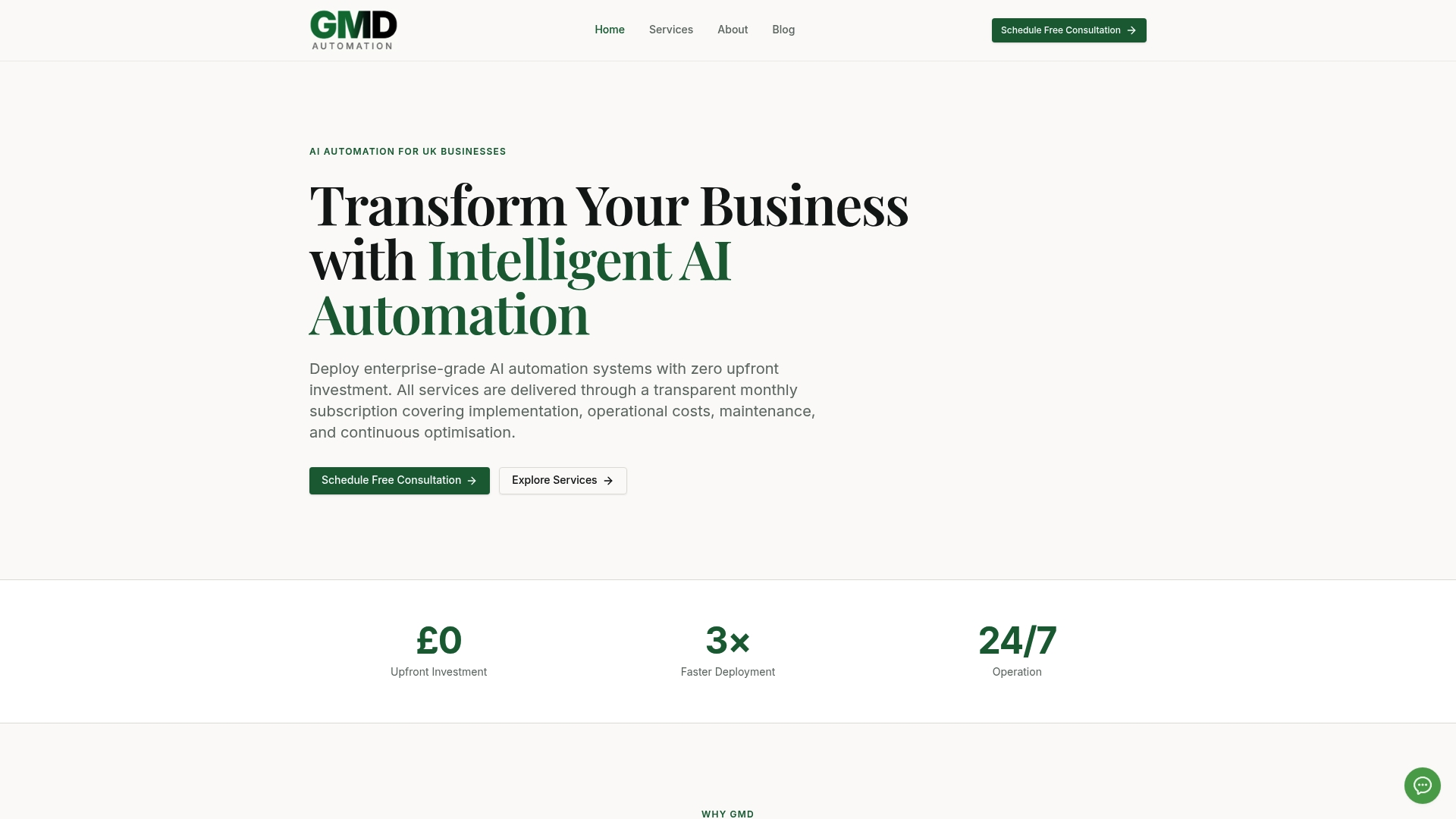
See how Gmdautomation combines multilingual AI voice agents and 24/7 social media automation to sustain lead flow efficiently. Visit Gmdautomation to review pricing and FAQs, and book a demo agent session that shows how quick AI adoption can be with a fully managed service.
FAQ
How does Gmdautomation's pricing model work compared to its alternatives?
Gmdautomation offers a monthly subscription model with zero upfront implementation costs. This means that customers can start using the service without a significant initial investment, unlike some competitors who may require higher upfront fees for setup. Small and medium sized businesses can benefit from this predictable pricing, making it easier to budget for AI deployment.
What is the difference between Gmdautomation and Ingenaium?
Ingenaium provides tailored accelerators and hands-on professional support for mid market organisations, streamlining AI deployment. Gmdautomation focuses on delivering a fully managed service that includes deployment, hosting, and ongoing optimisation, which suits small and medium sized businesses looking for minimal capital outlay and quick implementation.
Can I use Gmdautomation for 24-hour customer handling?
Gmdautomation includes AI voice agents that support multilingual call handling and run 24/7, making it suitable for organisations needing constant customer engagement. This continuous operation is vital for service providers and retailers who want to maintain a steady flow of customer interaction without manual oversight.
Does Gmdautomation support GDPR compliance?
Yes, Gmdautomation advertises GDPR compliance, which is crucial for UK businesses concerned about data protection regulations. This commitment helps organisations meet legal requirements while automating their customer workflows effectively.
What features does Gmdautomation include for social media automation?
Gmdautomation offers social media automation features that cover posting, engagement, direct messages, and trend tracking across multiple platforms. This comprehensive approach allows organisations to maintain a continuous online presence without manual input, thus saving time and resources.
Can larger enterprises use Gmdautomation effectively?
While Gmdautomation is designed for small and medium sized businesses, it may not suit large enterprises seeking deep customisation or integration with complex legacy systems. These organisations might find that other platforms better accommodate their unique needs.